Things I Love about… Avenue Q

WARNING: NOT SAFE FOR WORK. I have posted links to songs throughout this blog post, and some of the lyrics are raunchy.

I’ll come right out and say it: being happy these days is no easy feat. In my lifetime, I’ve never found the news more depressing, more indicative of a dearth of the values I was taught to hold dear — courage, knowledge, reason, and kindness. It’s enough to make me wish I could hide out with my loved ones in a bomb shelter. Come get us when it’s over. But that, of course, would be a failure of courage.

Isn’t it nice to reflect, in times like these, that everything in life is only for now?

Avenue Q 4

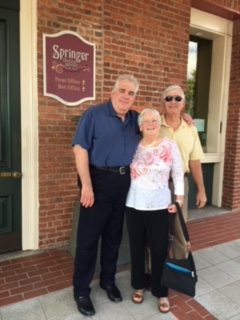
Avenue Q, winner of the Tony Award for Best Musical in 2004, has been popping up in various community theaters around the country, including the historic Springer Opera House in Columbus, GA, my husband’s home town. This Mother’s Day weekend, we went with his parents to see the production, and a delightful time full of much cathartic laughter was had by all. What with my already documented love for Jim Henson and Sesame Street, I could hardly be surprised that this “Sesame Street for adults,” featuring a group of young people making the best of their lives in a depressed New York neighborhood, should charm me.
Avenue Q 1

The Sesame Street fan will recognize many of these characters and appreciate the little tweaks the show gives them. Bert, our straight-laced pigeon-loving paper clip collector, becomes Rod, investment banker who irons his underwear and closely guards the secret of his homosexuality, while the fun-loving Ernie becomes the fun-loving Nicky, who assures his buddy in song that their friendship would still be strong if he were gay. We recognize Cookie Monster in the deep, growling voice and quirky grammatical cadences of Trekkie Monster, a recluse who has his own ideas about the purpose of the Internet (and it isn’t to debate “Star Trek,” either). Helpful humans Luis and Maria become considerably less helpful humans Brian and Christmas Eve, he an out-of-work aspiring comedian, she a therapist who loses clients thanks to her habit of being just a little too truthful. Christmas Eve may give some viewers pause, since she’s saddled with a thick stereotypical Asian accent, yet with her temper and her toughness she subverts the image of the submissive and empathetic “little woman.”

Along with these sort-of-familiar faces we meet a pair of new puppet characters who become the core of the show, Princeton, a recent college graduate who isn’t sure what to do with his B.A. in English (and as the holder of a PhD in English, I indulge in an understanding chuckle), and Kate Monster, idealistic, ambitious, with a plan to open a school exclusively for monster children and a hope that she can find true love along the way. Then there’s Gary Coleman, the former Diff’rent Strokes star who has fallen on hard times but still keeps his spirits up while working as the Superintendent of the apartment house on Avenue Q (despite the real Gary Coleman having passed away in 2010). That rounds out our ensemble of good guys, and an endearing lot they are, as they sing cheerfully about how much their lives suck.

Once they’ve all been introduced, the musical now has the job of making its audience care about these crazy kids. For that, it needs to strike a hard-to-find balance between satire and sweetness, and it manages beautifully. We may roll our eyes when Princeton contemplates the different paths he might take to find his purpose, or when Kate shouts in frustration that the Internet has many uses rather than just one, or when Rod sings in desperation about his girlfriend, who lives in Canada. But the story and the songs still put us on their side. We root for them, and when we laugh it’s far more often with them than at them. Kate is perhaps the most sympathetic of them, with her yearning for love and her earnest desire to make the world better for “people of fur.” She’s my favorite, even if she is a little bit racist.

Of course, a musical is nothing without great songs, and much of the credit for that satire-sweetness balance should go to the songs. Many of them are such spot-on echoes of Sesame Street tunes that songsmiths Jeff Moss (“Rubber Duckie”) and Joe Raposo (“C is for Cookie”) might have written them — particularly the “lesson” songs “Everyone’s a Little Bit Racist” and “Schadenfreude,” and “If You Were Gay,” close cousin to Ernie’s “That’s What Friends are For.” But we also have quieter songs like “There’s a Fine, Fine Line,” Kate’s heartbroken-but-coming-out-swinging ballad, and “I Wish I Could Go Back to College,” a lament for missed opportunity that almost anyone might identify with. (Who doesn’t wish they had taken more pictures?) When I bought the Original Broadway Cast CD back in 2004, I couldn’t stop listening to it for months, relishing the natural shifts in tone.

I had thought, at one time, that Avenue Q would resonate more strongly with Generation X-ers and others who grew up singing “I Love Trash” and “Bein’ Green” than with older audiences. But I’m happy to report that my in-laws enjoyed the Springer production every bit as much as my husband and I did. Indeed, that theater was full of people of all ages, and an electric current of enjoyment ran from seat to seat. When curtain call time came, we all sprang to our feet.

Good songs and a funny story can unite us.  Even if our lives suck.
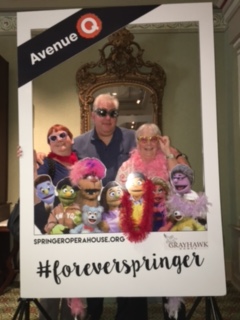
Avenue Q 2

From left to right: myself, my husband Matt, and my mother-in-law, Nicole Ceccato.
SFF’s Good Women, Classified

From time to time I’ve had friends question me about my relative lack of enthusiasm for female villains, specifically when no “good” female characters are around to challenge them. It’s an awkward time not to love female villains, as they seem to be all the rage on the Big Screen these days. Guardians of the Galaxy, Vol. 2 has one, plus several henchwomen. The Mummy of the title is a very ancient and very evil queen. Kingsman: The Golden Circle features a female Big Bad, while Thor: Ragnarok, if the trailer is all we have to go on, puts two bad-news femmes in key roles. If I cared about female villains and didn’t mind the paucity or ineffectuality of women on the good side, I’d have a lot to look forward to.

But no. Women on the good side interest me far more, because while female villains have been destructive forces to be reckoned with for as long as literature has existed, heroines and female heroes have only recently, over the last several decades, started to show up in large numbers. Not that we didn’t see them at all in centuries past — Antigone, Shahrazad, and many of the female leads in Shakespeare’s comedies serve as early examples — but their recent increase marks a sign of change for the better, as more writers and creators, men and women alike, show their faith in such characters.

As I’ve absorbed stories, both on page and on screen, and observed the female characters positioned in the stories as “good,” I’ve noted three broad categories into which they fall, based on how active a role they play in crucial events: the damsel, the heroine, and the female hero. Of the three, the damsel is easiest to identify. She’s the woman who finds herself overpowered by villains and needs to be rescued. That’s her function — to be rescued. She may have no useful skills at all, or she may have a few abilities that look impressive at first but prove to be no more than window dressing when crunch time comes.

A well-known example of the former is Buttercup from the film (not the book) The Princess Bride, whose idea of saving herself from being forced into a loveless marriage is to threaten suicide when her he-man hero doesn’t show up to save her as she expects. Of the latter type, we have Scarlet Benoit from Marissa Meyer’s Scarlet, who totes a gun but never manages to use it successfully, and Folly from Jim Butcher’s The Aeronaut’s Windlass, who has some magical skill but has the bad luck to fall into the clutches of a villainess so powerful that her own magic does her no good at all. A heroine or a female hero in Folly’s situation would find a way to turn her relative weakness, and the villainess’s underestimation of her, into an advantage and escape. But Folly, for all the quirks and speech patterns that make her an interesting presence, never manages this, and proves a damsel. The Folly/Scarlet types may be the most frustrating damsels of all, since we’re led to expect more from them than we actually get.

Once, women characters in the SFF genre were overwhelmingly divided between damsels and villainesses. Now, thankfully, heroines and female heroes have started to outnumber them, in print fiction at least.

The line between the damsel and the other categories is clear, but between the heroine and the female hero, things get blurry. Heroines are active, courageous, resourceful, and useful. They don’t wait around to be rescued; they rescue themselves and often rescue others. They bring their skills to the table to help ensure the triumph of good. But the operative word is help. A heroine may offer invaluable assistance to the main (usually male) hero, or she may be part of a team that defeats evil with combined powers. But she does not save the day on her own.

In current SFF, heroines may be the most crowded of the three classes. Hermione Granger in the Harry Potter series is the most famous and best-loved example. Hermione is a splendid character, a girl with brains, courage, and integrity who never backs down when she knows she’s right, even when her friends tell her she’s crazy. (She persists in her commitment to house-elf liberation, despite ridicule from nearly every one of her peers.) Without her, the titular hero would have been killed several times over. But even though Harry has far less personality and fewer observable skills than Hermione, he is still the story’s Chosen One. Hermione may help him and even save him, but only he can save the world.

A few more notable heroines include Starhawk from Barbara Hambly’s The Ladies of Mandrigyn; Sarene from Brandon Sanderson’s Elantris; Amara, Isana, and Kitai from Jim Butcher’s Codex Alera series; Inej and Nina from Leigh Barduro’s Six of Crows/ Crooked Kingdom; Suri and Arion from Michael J. Sullivan’s Age of Myth; Steris, Marasi, and MeLaan from Sanderson’s Second Mistborn Trilogy; and Iselle from Lois McMaster Bujold’s The Curse of Chalion. I love them all, and would recommend the books in which they appear; each gets her moments of awesome throughout the stories. But none of them get to strike the climactic blow against evil by themselves. That doesn’t make them bad or weak characters. It just makes them different from those in the final category, the female hero.

The female hero confronts evil on her own, and wins. She may have help along the way, but in the end she proves the key difference-maker. One of my favorite signs of progress is the growing number of female characters who fit this description, among them the ladies I praised in my previous post, Doreen “Squirrel Girl” Green and Matilda Wormwood. I can’t say too much, lest I stray too far into Spoiler territory, but here are a few more from my recent reading:

Shara Komayd, from Robert Jackson Bennett’s City of Stairs; Granny Weatherwax and Tiffany Aching, from Terry Pratchett’s Discworld; Vin, from Sanderson’s Mistborn: the Final Empire; Li-Lin, from M. H. Boroson’s The Girl With Ghost Eyes; Maia, from Todd Lockwood’s The Summer Dragon; Winter, from Django Wexler’s Shadow Campaigns series; Samarkar, from Elizabeth Bear’s Eternal Sky Trilogy (especially in the second book, Shattered Pillars); Kirit, from Fran Wilde’s Updraft; Paama, from Karen Lord’s Redemption in Indigo; Anyanwu, from Octavia Butler’s Wild Seed; Onyesonwu, from Nnedi Okorafor’s Who Fears Death; and Senneth, from Sharon Shinn’s Mystic and Rider.

Damsels I can do without, although I acknowledge they may at times be a necessary irritant. Heroines I always welcome. But what I love best are female heroes. Who are some of your favorite female heroes, from page and from screen?


Hoping for a Doreen-Matilda Effect

If I could consign one single idea from and about pop culture to the ash heap of history, never to rise to show its face again, it would be the prevailing notion that stories about girls are just for girls, while stories about boys are for everyone. We may see more girls and women playing important roles in fiction than ever before, but this one idea, I believe, is the root of the problems that stubbornly persist.

It’s why, despite strong (and well-performing) exceptions like last year’s Zootopia and Moana, the vast majority of “family” films continue to focus on male protagonists, with female characters usually stuck in the stock roles of sidekick, foil, or villain, if they’re there at all. It’s why animated movies like Mr. Peabody and Sherman and Mars Needs Moms don’t even bother to conceal their sexism — little boys and their parents won’t care about that, or so it’s thought. It’s why, when a family film does feature a female lead, trailers and ads mostly highlight the male characters to the point where potential viewers could be forgiven for thinking Moana actually played a supporting role in the movie that bears her name; we should not forget that the weak box-office performance of The Princess and the Frog (a fine movie that deserved better) was blamed on the use of the word “princess” in the title, and why the title Rapunzel was changed to Tangled to keep the movie from sounding too “girly” (the movie, for example, was called Rapunzel in Germany). And it’s why, in 2017, only two American animated films feature female leads, one a story about a ballerina, Leap, and the other a My Little Pony: Friendship is Magic movie.

It’s why, even though print fiction is many miles ahead of American cinema in terms of female representation, and even more in terms of female writers and creators, male leads dominate (albeit to a lesser degree) in children’s and middle-grade fiction. It’s why many writers of animal fantasy continue to make the majority of their characters male even though their maleness has no apparent bearing on the plot. It’s why, when award-winning author Shannon Hale visits a school to give a reading, boys are excluded from the assembly because the reading is “for girls.”

What’s the result of all this? Young men and women, the potential writers and creators, of pop culture future, grow up with “male as default gender” hardwired into their brains. They grow up thinking that stories about girls and women are by their very nature narrower in scope and therefore less interesting than stories about boys and men. If they’re aware of what they’re swallowing, their own writing may be a welcome reaction against this way of thinking. If they’re not, they will likely produce the same kinds of limiting stories, and the problem will go merrily on. One of the comments responding to The Mary Sue’s article examining the Twitter thread #ThingsOnlyWomenWritersHear is sadly telling: “I’d say that because of the overwhelmingly male perspective in lit and society can often mean WOMEN can’t write women,” citing J.K. Rowling (open for debate) and Anne Rice (no debate necessary) as examples.

In considering how we might slow down this vicious circle until it finally stops, we have to realize we’re playing a long game. I’m not the most patient of people, but we can’t put an end in mere years, or even mere decades, to ideas about characterization and gender that have centuries of reiteration behind them. We need to think carefully and consider all the facets of the problems we want to solve. Just why do boys’ stories presumably have more universal appeal, and why do so many authors, both men and women, prefer to write about male protagonists? No doubt a big part of it might be put down to plain old-fashioned sexism, but what else might be going on?

From an unconscious standpoint, the white male lead, the “default,” can seem wonderfully freeing. Because he is the default, the norm, the conflicts that he might face are without limit. Almost any story might be told about him — hence, the supposed wider appeal, and the presumption that his stories are for everyone. But if the protagonist diverges from this norm, say, in gender, many writers (again unconsciously) decide the story must revolve around said divergence — hence, the huge number of stories about “being a woman in a man’s world” in SFF, a genre that comes with the option of designing a world that’s at least a bit less of a man’s world. These stories foreground gender in ways the white male protagonist’s stories don’t have to do. This can limit their appeal, even for female readers who feel, like me, the endless repetition of gender-based conflicts is getting very boring.

The first step toward improvement is for us to get conscious, to train ourselves to think of the female protagonist as we think of the male protagonist, as someone who can carry any kind of story. If we writers can feel the same freedom writing about women and girls as we do writing about men and boys, it’s bound to result in female characters who are a lot more fun for all readers.

In the recent controversy about whether “diversity” is responsible for the drop in sales for Marvel Comics, one name kept coming up: Squirrel Girl. Nobody wants to lose Squirrel Girl. Male and female readers love her, and with good reason — because Squirrel Girl, a.k.a. Doreen Green, dashes into danger completely unhampered by all the self-doubts and second-guessing that slow down far too many female protagonists. She’s a combination of fearlessness and humor that wins readers over. Tor.com recently published a post about her appeal, and in the Comments section (which is actually worth reading most of the time on Tor.com) one person suggested the comic was obviously aimed at preteens, being too silly for anyone else. Two older fans, both men, wrote in at once to shut that nonsense down and make it clear that all ages of readers enjoy the character and her adventures.  I only need look at Matt, who laughs uproariously when he reads Squirrel Girl comics and shoves them into my hands when he is done.

More recently, we (Matt and I) took in the Tony-nominated musical Matilda at the Fox Theatre in Atlanta. I already loved Matilda. I’d read her story as Roald Dahl originally wrote it, and I’d seen her underrated movie. It hardly took a nudge for me to fall in love with her again, particularly as she sings that we shouldn’t just shrug off life’s unfairness because if we do, “you might as well be saying you think that it’s okay, and that’s not right.” Matilda has a brilliant and unbridled mind. She soaks up information whenever and wherever possible, reading every book she can get her hands on despite the obstacles her family throws in her path. She has a keen sense of justice and stands up not only for herself but for others who are mistreated. She fights the power, and she wins. When she overthrows her bullying schoolmistress, “the Trunchbull,” all the audience cheers — not just girls. I loved seeing so many little boys in the audience. If they weren’t supposed to admire or identify with Matilda because she’s a girl, they and their parents didn’t get the memo.

We love Doreen and Matilda because they display the qualities we want to see in our heroes, whether those heroes are male or female. Courage, determination, capability, and confidence are strong traits that needn’t be linked to gender. Doreen and Matilda are the very last people who would ever let insecurity and gender-related angst stand in the way of getting a job done. They are role models for everyone.

I would dearly love to see more heroines like this, heroines whose very existence flies in the teeth of the notion that the appeal of female-led stories is confined to girls. They are drops of rain, and in time, enough steady rain can wear away the hardest stones.

And remember: Squirrel Girl has the powers of both squirrel and girl. Eat nuts and kick butts!

The Center for Puppetry Arts: The Henson Exhibit

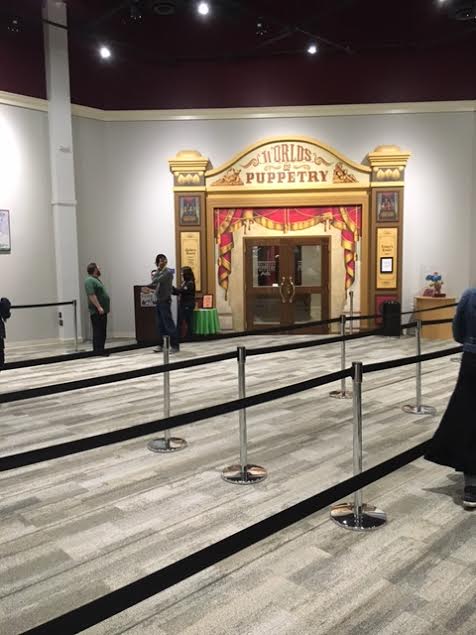
Living an hour and a half’s drive from Atlanta, GA gives my husband and me easy access to a number of geeky things we love. One of these is the Center for Puppetry Arts, with its special and extensive exhibit of the work of Jim Henson, complete with videos and original Muppets on display.

Center for Puppetry Entranceway

The first room of the Henson Exhibit is devoted to his earliest work, not only his local-channel hit Sam and Friends and appearances of Rowlf the Dog on The Jimmy Dean Show, but a score of darkly amusing commercials for such products as Wilkins Coffee and La Choy Chow Mein. Visitors can stop in front of a TV airing the commercials and watch for as long as they like. Imagine: commercials worth watching.

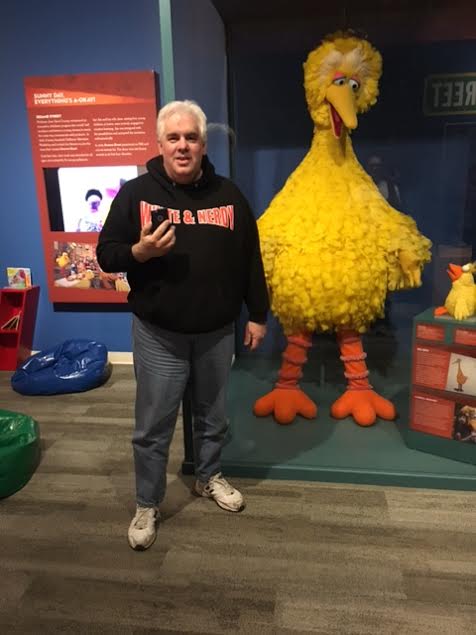
It’s in the second room, the Sesame Street room, that video watching truly becomes addictive, since visitors can sit in super-comfortable beanbags and re-live childhood joys. Here we find on display such luminaries as iconic buddy pair Bert and Ernie, and Big Bird, the good-hearted youngster who thinks the alphabet is the most remarkable word he’s ever seen. My husband stands at Big Bird’s side.

Center for Puppetry Bert and Ernie

Center for Puppetry Matt and Big Bird

I mentioned in my previous post that my favorite record growing up was the Muppet Frog Prince. When I saw the villainous witch Taminella (brilliantly performed by Frank Oz) on display, I couldn’t resist having my picture taken with her.

Center for Puppetry Taminella

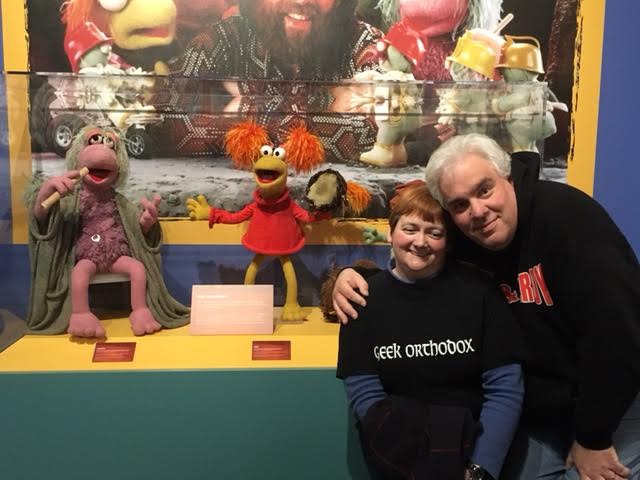
There are plenty of good reasons to watch Fraggle Rock, but I watch it for Red and Mokey, one of my favorite female buddy pairs to this day. Mokey is a dreamy artist and poet with a hippie streak, Red is a hyper-energetic and hyper-competitive athlete, and the two stick together through thick and thin and share many an adventure. Three years ago we had the privilege of seeing their performers, Kathryn Mullen and Karen Prell, when they visited DragonCon. At first they answered audience questions as themselves, but halfway through the panel they brought out their Muppets, and the two characters came to life before our eyes. We were no longer looking at Mullen and Prell. We were looking at, and talking to, Mokey and Red.

Center for Puppetry Red and Mokey

Of course I had to purchase my own Red puppet from the souvenir shop. I adore her pigtails. Don’t judge me.

Center for Puppetry Red Puppet

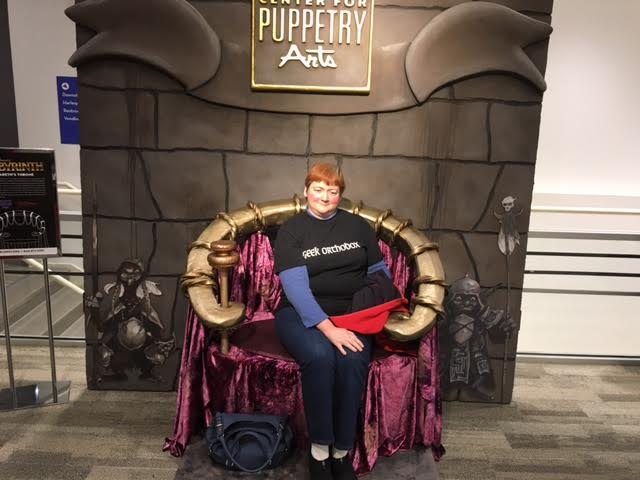
In honor of the Center’s screening of Henson’s 1986 coming-of-age film Labyrinth, visitors got a chance to sit in the Goblin King’s throne. Here I take my turn.

Center for Puppetry Jareth Throne

If your travels take you near Atlanta, be sure not to miss the Center for Puppetry Arts. Even if you’re not a Jim Henson fan when you go into the special exhibit, the chances are good you will be one when you come out.


Remembering Jim Henson, Part 1

When Jim Henson passed away from pneumonia in 1990 at the age of fifty-three, it was the first time a celebrity death came as a hard blow. Henson was relatively young, was nowhere near retiring, and had potentially years ahead of him to produce the kind of delightful work that had made me a fan. Since his passing, many have tried to capture his unique creative sensibility — an exact blend of whimsy and bite, warmth and incisiveness, the sublime and the ridiculous — but though some might have come close, none has quite managed it. What made the loss worst of all was that Henson and his work had been a part of my life since… well, since I was born. Sesame Street and I entered the world the very same year: 1969.

I remember being entranced by Sesame Street. I remember being just a little less scared of the monsters that might be living under my bed because one of them could have been Grover, my first introduction to the notion that monsters could be superheroes. I remember admiring Kermit the Frog, laughing with Ernie, and imitating Cookie Monster. I remember singing “Rubber Duckie” and counting to ten in Spanish. I remember that the first Christmas my parents, sister, and I spent in the house where I did most of my growing up, and getting a thrill at unwrapping packages that contained Sesame Street books, Sesame Street blocks, and Sesame Street puzzles. If it had anything to do with Sesame Street, I loved it.

I remember my favorite record when I was a young child: the Muppet version of The Frog Prince. I remember getting “They Call Me Sir Robin the Brave” stuck in my head for hours on end, talking in Spoonerisms like the cursed Princess Melora, cackling like the evil witch Taminella (performed with spicy relish by Frank Oz), and pretending to fall asleep like Sweetums the Ogre (“Nitey-nite!”). Years later, my parents showed my then four-year-old nephew this special on television, and I got to see him imitate Sweetums’ unique way of falling asleep. I confess his mimicry was better than mine.

I remember being a little bit flabbergasted by The Muppet Show when it first came on the air. Some sequences creeped me out, like the Muppet News Flash that reported furniture transforming into monsters. (Today that’s one of my favorite bits.) All the same, I remember smiling till my mouth hurt at such segments as a group of penguins aboard the Mayflower singing and dancing to “Alabammy Bound” and Viking pigs belting out their inimitable cover of the Village People’s “In the Navy.” I remember mimicking the announcer’s opening cry of “Piigs iin spaaaaace!” I remember laughing till I couldn’t breathe at all the Great Gonzo’s impossible stunts, especially the bit where he tries to jump his motorcycle so it will land “safely between those two elderly gentlemen” in the theater box, Statler and Waldorf. Later in my life, when I first started dating Matt, I learned we could laugh together over classic Muppet Show episodes. It was an early indication that I’d found The One. (I could never have fallen in love with anyone who didn’t love the Muppets.  In fact, when he helped me move into what is now our home, the first thing we watched together after he set up my DVD player was the Paul Simon episode of The Muppet Show!)

I remember seeing The Muppet Movie in the theater, and then watching it again every time it later aired on HBO. Instead of “Sir Robin the Brave,” it was “Movin’ Right Along,” Kermit and Fozzie Bear’s joyous road trip anthem, that I couldn’t get out of my head. These days, my husband and I watch it together and sing along as loudly as we please.

(If you were watching the reboot of Mystery Science Theater 3000 on Netflix, keep your ears open for a reference to this song in the first episode!)

I remember watching Fraggle Rock when it first appeared on HBO in the early 1980s, and liking it a lot but being hesitant to say so because I was entering adolescence and thought myself too old to embrace it. But when TNT re-aired it about ten years later, I watched the whole series in my dorm room in college. We have the whole five-season set on DVD. (Remind me to tell you the story about meeting Karen Prell and Kathryn Mullen, the Muppeteers behind Red and Mokey Fraggle, at Dragon Con 2013 one of these days…)

My reaction to Fraggle Rock turned out to be typical of my responses to Henson’s work in the 1980s. It bounced off me when I was a teen, as I was too proud for it, too pseudo-sophisticated. But later on I found it and took it to my heart — The Dark Crystal, Labyrinth, The Storyteller, and even The Muppets Take Manhattan.

Last year, my husband and I attended a screening of Labyrinth at the Center for Puppetry Arts in Atlanta, shortly after we learned of David Bowie’s passing. It was the most bittersweet time we had all year, not to mention the hottest ticket in Atlanta.  The CPA had to add several more screenings due to the demand!

Generation X-ers, those like me who were young when Sesame Street was young, will probably find it easiest to understand my strong sentimental connection with Henson and his work. But for those of you who need convincing, have a look at the clips included here.

Coming next: A Visit to the Center for Puppetry Arts.

No, Thank You: Books I Don’t Plan to Read (and Why)

I spent many years in college studying literature, working my way through courses and Comprehensive Exams lists for my graduate degrees. I learned a great deal and loved much of what I read; many of the works I studied have become firm favorites, such as Austen’s Pride and Prejudice, Hurston’s Their Eyes Were Watching God, Hansberry’s A Raisin in the Sun, and the poetry of John Keats and the short fiction of Edgar Allan Poe and Eudora Welty. Yet for all I value my long days of learning, I came away from them with a fixed desire not to read any new book I didn’t choose for myself. I will take friends’ recommendations under strong advisement, but at the end of the day I will read what I like.

I like stories set in a time and place apart from the here and now, so most fiction set in the realistic present goes unread by me, however highly critics and fans may praise it. I gravitate toward historical fiction, science fiction, and, of course, fantasy. Yet even after I’ve narrowed my options down to my favorite genres, I research prospective reads with certain questions in mind. Will I have an intriguing, if not always purely entertaining, time in the story’s world? Is the prose well-crafted and absorbing? Will the story and the characters engage my mind and heart? Will they ignite my own creative spark and inspire me to write? Will I like, or at least appreciate, at least one of the women in the story?

As I search for answers about books I might want to read, I learn a good bit about books I do not want to read. Nobody can read everything, and websites like Goodreads, Library Thing, Reddit Fantasy, TV Tropes, and Fantasy Faction can raise some very helpful warning flags. Those flags don’t necessarily say that certain books are bad — only that they are not likely to appeal to my own personal taste. Even when a book or series is, by all accounts, good, it may not be for me. So here is an initial short list of books I don’t plan to read, two of which are highly regarded in the fantasy community, and two of which at least have massive fanbases.

Robert Jordan, The Wheel of Time series.

This well-beloved series turns up on every “Best of Fantasy” list and may be the most widely praised fantasy series after Tolkien’s The Lord of the Rings. Some might even assert that you can’t call yourself a real fantasy fan unless you’ve read it. But since I don’t think there’s any one series, even LOTR, that a person who wants to call herself a fantasy fan has to read, I’m opting out, because I know that no matter how many other virtues these books might have, I would never be able to overlook the almost uniformly unsympathetic portrayal of women. The word most frequently used to describe Jordan’s female characters, all of them, both villains and non-villains, is “bitchy.” Even the series’ fans would accept this description is fair (one of them even noting he found himself developing a “homicidal hatred of the fair sex” due to its influence), but they argue that the women’s horribleness is a symptom of the world Jordan has built, in which women hold most of the power. They behave just the way men do in a patriarchy, defenders say.

I’ve read my share of stories set in patriarchal fantasy worlds — most fantasy worlds tend to be patriarchal — and in very few of them is every single male character an unpleasant, unreasonable narcissist totally lacking in wisdom and honor. If I read a story in which all men are unsympathetic, and their lack of positive traits is written as a function of their gender, I regard that as a flaw, and it puts me off the book. Whichever gender is in charge, men and women will still be individuals who vary in temperament, skills, and intellect, and I like to see them written as such. If I wouldn’t enjoy a novel in which every male character has the same repellent personality type, why would I welcome one that paints all its female characters this way? And so, while I acknowledge it may have many excellent qualities that have earned it a spot on all those “Best Of” lists, I say a polite “No, thank you” to The Wheel of Time.

Patrick Rothfuss, The Kingkiller Chronicles (The Name of the Wind and The Wise Man’s Fear).

Here’s another series that almost everyone adores, including quite a few of my friends; it appears on almost as many “Best Of” lists as The Wheel of Time. It tells the story of Kvothe, the first-person narrator who lets the reader know on the first page of the first book how no-holds-barred awesome he is. He parades across the pages radiating awesomeness. In the first book he sees himself as awkward with girls, but by the second book he’s grown so amazing that every woman, from an evil sex fairy to multiple members of a matriarchal warrior tribe, either beds him or wants to bed him, except of course the one woman he respects and cares about, a female character despised by 99.9% of the series’ fans. He manages to neutralize the evil sex fairy with his own unbridled sexual prowess. That’s how awesome he is.

Kvothe’s story, I have on authority, is told in very rich and vivid prose, but there’s one problem, at least from my perspective. He soaks up so much awesomeness that he leaves none for anybody else. The other characters in his orbit have no chance to shine. Those characters only matter as they reflect his own glory in some way. I can’t imagine not losing patience with that, however gorgeous the prose. And these are huge books. Since I tend to prefer stories in which the wealth of awesomeness is shared, at least a little bit, I once again say a polite “No, thank you.”

Stephenie Meyer, Twilight.

This isn’t found on many “Best Of” lists, but legions of fans really, really love it. There’s so much wrong with this series I can’t go into it all, so I’ll focus on what is, for me, the deal-breaking flaw: the female lead, Bella Swan, is deliberately written as an empty vessel devoid of any recognizable concrete personality traits, so that any girl reader can step into Bella’s place and get the vicarious thrill of being adored by not one, but two powerful supernatural hunks, without having to make the imaginative effort to relate to any characteristics she might not share, like black hair or an interest in science.

I don’t like reading about empty vessels, especially female ones. I want characters to have actual features, however different they might be from my own. I like knowing that Shallan from The Stormlight Archive has red hair and loves to draw. I like knowing that Steris in The Second Mistborn Series has a fetish for list-making and planning ahead. I like knowing that Isabeau in The Witches of Eileanan feels ill at the thought of eating meat. I like knowing that Starhawk in The Ladies of Mandrigyn is tall and raw-boned and a seasoned, skilled fighter. It doesn’t matter at all that I can neither draw nor fight, or that I love to eat meat, or that while I may be a bit of an obsessive planner I’m nowhere near Steris’ level. I love these characteristics I don’t share because they make the characters distinct and memorable individuals, and that’s whom I enjoy reading about. So no thank you, Twilight.

E.L. James, Fifty Shades of Grey.

I really need say no more than that this pulpy bestseller started life as Twilight fan-fiction, and as a result we find another featureless female lead, a supposed career woman who has no observable skills or ambitions. In Bella Swan this might be forgiven in a pinch, since she’s only a teenager, and many high schoolers aren’t quite sure what to do with themselves. But in an ostensibly grown woman, it’s faintly nauseating. It’s the empty vacuousness of Ana Steele, not the detailed sexual situations, that moves me to say “no, thank you” to this series.

If you want to read a story with elements of BDSM in which the heroine has agency and an actual personality, let me suggest Jacqueline Carey’s Kushiel’s Dart instead. I admit that when I read it I found some of those BDSM elements disconcerting, since the courtesan Phedre does experience pain as pleasure. Yet she’s also an intelligent, observant woman who plays a key role in protecting her country from its enemies. When Carey tells us, “That which yields is not always weak,” she offers evidence to back it up. This series I’ll read more of, though I don’t share the heroine’s lifestyle. Once again, heroines don’t have to be like me to be worth reading about.

What’s Making Me Happy: March 2017

Yummy Epic Fantasy Goodness!

I read many good books every year, and my favorites are always the ones that make me sigh with a smile, “Now this is why I love to read epic fantasy.” Brandon Sanderson’s Stormlight Archive and Django Wexler’s Shadow Campaigns series have hit this button for me, along with Michelle West’s Sun Sword series, Elizabeth Bear’s Eternal Sky Trilogy, and most books by Kate Forsyth and Juliet Marillier. This month I’ve lucked into two books I can add to the growing list: Kate Elliott’s Black Wolves and Michael J. Sullivan’s Age of Myth, both reportedly the first volumes in new series I’m already eager to follow to their ends. They have just about everything I look for when I pick up an epic fantasy novel, and even a little more.

The first, of course, is the quality of the writing itself. It’s hard to explain the appeal of prose style in a blog review without stuffing the review full of quotes, which I’m not of a mind to do.  I’ll say only that the prose I like best is that which puts me in the story’s world from the very first chapter. It makes me curious to explore that world further, curious to get to know the characters who inhabit it and see how they will cope with the challenges it throws at them. With these books, both Sullivan and Elliott succeed. Sullivan’s prose is breezy and energetic, a welcome antidote to the prevailing gray winds of grimdark. Elliott’s prose is a bit more challenging, more intricate, as befits the less traditional fantasy landscape she’s laying out. But both are involving, and they make an agreeable contrast.

Then there’s the world-building and the situations it sets up — the stakes, the complexities. I always appreciate the best fantasy writers’ capacity to create interesting value systems and throw them into conflict. In Age of Myth, Sullivan presents readers with a culture clash between a race of elves called Fhrey and humans, whom the Fhrey call “Rhunes” (ostensibly an insult). The humans worship these elves as gods, while the elves see humans as animals. Over the course of the novel, both these suppositions are challenged, thanks partly to a clever wrinkle: the Fhrey cannot kill each other, but humans can kill them, as we learn in the opening chapter when Raithe, the male lead, earns the sobriquet “God-Killer.” The Fhrey are intriguing creations, neither pure good like Tolkien’s elves nor pure evil like Terry Pratchett’s; some are villains, while others, though initially misguided, emerge as heroic. The female Fhrey, Arion, is a favorite of mine, as she’s injured and must depend on the Rhunes’ care.

In Black Wolves, nonhumans (demons) have a part to play, but the major conflicts revolve around religions competing for power in a multicultural society called the Hundred (a world with which readers of Elliott’s earlier Crossroads Trilogy will be already familiar). In many multicultural fantasy worlds, one subculture will seek to take over and create a homogenized society in which people follow their strict precepts and all dissent is crushed. In Elliott’s novel, this upstart subculture is the worship of Beltak, a faith that demands almost total segregation of the genders and the elimination of women from all say and activity in public life. Beltak worship is a growing danger, thanks to the foothold it has gained in the ruling family, and causing problems for female reeves (a force of peacekeeping riders of giant eagles) like Marshal Dannarah, a female lead in her late sixties. What I find interesting is that the culture of Beltak worship is not presented as wholly evil; some women actually thrive in their cloistered environment and appreciate their separation from men. The evil springs from the religion’s adherents’ insistence that their way should be the only way, their readiness to impose their will on others. Those on the side of good must find ways to protect and defend freedom in the Hundred.

But all the intricacies of world-building and conflict don’t matter much if I can’t latch onto the characters. When I read Spirit Gate, the first book in the Crossroads Trilogy, I struggled with it because I found myself hating every male point-of-view character in the story, since they all shared the same flaw — a crushing lack of respect for women. Thankfully Black Wolves doesn’t have this problem, as its central male figure, Kellas, retired commander of the titular Black Wolves, is a man of honor in the style of Stormlight‘s Dalinar Kholin. In Age of Myth we get to know Raithe the God-Killer, his wisecracking companion Malcolm (a former slave of the Fhrey), and Nyphron, the leader of a band of rebellious Fhrey. In short, both novels offer stalwart heroes, and if their ideas about gender may be a little backward at first, we get the impression they can learn better.

But for me an epic fantasy is only as good as its female characters, and any such fantasy that follows the Smurfette Principle (one lone woman among scores of men) will have to work very hard to win me over. Neither of these novels comes anywhere near that Smurfette mistake. Both offer not one admirable and honorable woman but many, and with a very pleasing diversity of age, appearance, and personality. Both place a mature woman at the center of the action: in Age of Myth, the widowed late-thirtysomething Persephone, and in Black Wolves, the aforementioned Marshal Dannarah. They’re presented as strong and sensible authority figures, with Persephone filling the role of chieftain for her community in the aftermath of her husband’s death, and Dannarah maintaining her command despite the encroachment of hostile forces and taking a leading role in protecting the kingdom. Considering how commonly the fantasy genre portrays female authority as evil, or at least untrustworthy and unnatural, it’s delightful to see women in charge depicted in a sympathetic light. These are women of vision, even if Dannarah’s concern for the kingdom’s well-being may very occasionally lead her to questionable decisions.

These aren’t the only women whose point of view we get. In Age of Myth we see through the eyes of Suri, a teenage mystic who can communicate with trees and who travels with a wolf, and Arion,, the powerful Fhrey who learns (thanks largely to Suri) that everything she thinks she knows about Rhunes is wrong. In Black Wolves we spend time in the shoes of the young reeve Lifka, desperate to protect her family from the Beltak priests and a prince’s petty vendetta, and Sarai, a disgraced woman seeking a place for herself through an arranged marriage (yes, in the book that makes sense). In addition we get a multitude of female secondary characters, also pleasingly diverse. These women aren’t just there for the male characters to fall in love with. In fact, in both books, romance is a comparatively minor concern (though granted, I’m still only halfway through Black Wolves).

Thanks to books like these, and other new releases in the offing (including Age of Swords, the follow-up to Age of Myth), I don’t have to worry overmuch about the state of epic fantasy. And that makes me very, very happy.

It’s Always Women’s History Month

When I want to engage with an inventive mix of realities and possibilities, what we are touched with what we might have been or what we might become, I look to fantasy and science fiction. But when I want to engage with the realities of where we are now through the lens of where we have been, I look to historical fiction and, very occasionally, nonfiction. Women’s place in history has always fascinated me — how they impacted it, how they coped with and/or defied restrictions placed on them. Women have always been complex individuals with lives worth exploring, even if their times and places haven’t been willing to recognize them as such. As another March draws to a close, I’d like to share some recommendations to help readers who share my interests keep the spirit of Women’s History Month alive in their minds and hearts.

Caleb’s Crossing (Geraldine Brooks)

Set in mid-17th century Martha’s Vineyard, this novel tells the story of the observant and insatiably curious Bethia, whose hungry mind keeps trying to escape the bonds set by the well-intentioned men whom her world grants authority over her. The “Caleb” of the title is a young Native American man with whom Bethia forges a friendship, who chooses to “cross” the racial/ethnic divide and embrace the Anglo-European culture he realizes will prevail in his land. Brooks’s quiet and well-crafted narrative shows how Bethia and Caleb sacrifice vital parts of themselves in order to survive in the world in which their “places” are rigidly defined. The prose gracefully evokes both the confining strictures and pastoral beauty of its setting.

Bitter Greens and The Wild Girl (Kate Forsyth)

These excellent novels mark Forsyth’s move away from the traditional fantasy style of The Witches of Eileanan and Rhiannon’s Ride series and toward an examination of the fairy tales that provide much of the genre’s foundation — how the stories were preserved and set down, and how they exert an ongoing influence. Bitter Greens is a blend of fantasy and historical fiction, a retelling of “Rapunzel” set in Renaissance Italy and the story of Charlotte-Rose de la Force, the delightfully unorthodox 17th century French aristocrat who composed her own retelling of the tale. The Wild Girl is straight up historical fiction, the story of Dortchen Wild, who contributed stories to the Brothers Grimm’s Nursery and Household Tales and later married Wilhelm Grimm. Both depict the value and the vitality of stories, and offer portraits of vibrant, creative women who played a crucial role in preserving those stories for posterity.

Hild (Nicola Griffith)

Some books contain prose so beautiful you almost ache when you read it. One such book is this portrait of a young woman in early medieval England both blessed and cursed by the Sight, valued as a well-born daughter who might make an advantageous “peace-bonding” match and suspected as a woman who knows more than she should and never quite manages to fit in. We see through the eyes of the brilliant, introspective, and often confused Hild as she confronts the responsibilities her visions give her and her own burgeoning sexuality. Because of the Sight, this book skirts the line between fantasy and historical fiction, but since less emphasis is placed on the supernatural elements than on the very detailed evocation of time and place, I would class it as the latter.

The Golem and the Jinni (Helene Wecker)

Even though the heroine and hero are a golem and a jinni, bookstores never shelve this beautiful novel in the fantasy section. The fantasy elements are a bit stronger here than in Hild, but the historical fiction fan will find much to enjoy in the vivid picture of two neighborhoods in turn-of-the-twentieth-century New York: the Jewish corner where the golem makes her home and the “Little Syria” the jinni inhabits. Along with our supernatural stars we get to know a dying rabbi and his social activist son, a socialite with dreams too big for the fate in store for her, an ice-cream seller who once glimpsed something forbidden and has suffered for it ever since, and a host of others. Though Chava the golem is a fascinating figure, for my money the novel’s real heroine is Wecker herself, whose prose will take a reader’s breath away. Well worth the time, in both print and audiobook.

Founding Mothers: The Women Who Shaped Our Nation (Cokie Roberts)

This engrossing nonfiction work offers a look at the lives of a number of prominent women of Colonial and Revolutionary America. Roberts gets things rolling with a description of the life of Eliza Pinckney of South Carolina, that shows us how far from passive and uninvolved her life was and how vitally women like her contributed to the life and culture of their country. In the course of the book we spend time with a number of remarkable women, among them Abigail Adams (a personal heroine of mine, an advocate for an education that would have allowed girls like Bethia to develop their intellect to its full potential), Mercy Otis Warren, Martha Washington, Deborah Franklin, Sally Knox, and Catharine “Kitty” Greene, each of whom proves a capable and courageous woman in exciting and challenging times.

Clever Maids: The Secret History of the Grimm Fairy Tales (Valerie Paradiz)

I read this piece of nonfiction before The Wild Girl came into my hands, and I was delighted to see Kate Forsyth cite Paradiz’s work as a source of inspiration as well as detail for her novel. Not only did Dortchen Wild tell stories for the famous brothers to set down in writing; all her sisters did as well, along with many other women from different social strata in early nineteenth-century Germany. Here again we see women whom the “bigger” history books ignore leaving an indelible mark on the culture not only of their own time but of countless generations that have followed.

Lastly, take a look at Kameron Hurley’s essay “We Have Always Fought: Challenging the ‘Women, Cattle, and Slaves’ Narrative,” which shows in compelling, persuasive detail that women’s roles in history are far more varied and complicated than some might prefer to think. It’s a well-known essay. You may have read it before. It’s worth a re-read.

Happy Women’s History Month.


Supplemental: Potentially Helpful Lists

If the “Best Of” recommendations lists don’t always (or even often) offer help to readers looking for good fantasy with a female lead that isn’t YA, urban fantasy, or paranormal romance, sometimes we have to look a little harder. Goodreads can be a useful resource, since its lists are often more specifically directed than the generalized “Best Ofs.” Here are a few:

https://www.goodreads.com/list/show/77337.High_Fantasy_Books_with_a_Strong_Female_Lead

https://www.goodreads.com/list/show/21792.Strong_Female_Characters_in_Epic_Fantasy

https://www.goodreads.com/list/show/86591.Adult_targeted_second_world_fantasy_with_noteworthy_heroines_or_female_protagonists_

Here’s the thing about Goodreads lists, however: since anyone can cast a vote, sometimes works may make an appearance even though they don’t fit what the list is asking for. Readers will be well-advised to explore the reviews posted for the titles that intrigue them.

Here’s another interesting list, from another website:

http://bestfantasybooks.com/top25-fantasy-books-for-women.html

Some of these titles I can highly recommend, but the comments are telling. Many commenters take the list-makers to task for their assumption that any fantasy novel with a female lead must be “for women,” as if 1) men would never want to read such things, and 2) works “for women” need a special list, as if they couldn’t compete on equal terms with the male-led titles.

(Note: The Death of the Necromancer and the rest of the Ile-Rien series are written by Martha Wells, not Mary Gentle. Wells has also written the Books of the Raksura, a series beginning with The Cloud Roads. I heartily recommend these books.)

Yes, We Do Part 2: More Trouble with Lists

In my post last week I focused on the issue of visibility for female writers and female-driven stories outside the urban, paranormal-romance, and YA subgenres. Women are writing high-quality epic and historical fantasy, and female leads are featured in it, yet despite obvious evidence (check out the long list of names of female epic-fantasy writers in last week’s post), many remain unaware of it. One culprit is easy to spot — fantasy stories by and/or about women remain a rarity on “Best Of” lists. Such lists can leave an unaware consumer with the impression that male-led stories by male authors are somehow inherently more worth reading.

One such list came to my attention a few days ago, in my Facebook feed: Paste Magazine’s 30 Best Fantasy Book Series of All Time. With thirty possible titles to choose from, the selection is heavily slanted in favor of stories about men — male heroes/saviors, male anti-heroes, male villain protagonists. And the funny-but-sad thing is that many people looking at the list might not think twice about this slant because hey, Brandon Sanderson’s Mistborn is on it.

Let me break it down.

Stories focusing on male heroes, saviors, or Chosen Ones: The Chronicles of Narnia (C.S. Lewis), The Chronicles of Prydain (Lloyd Alexander), The Chronicles of Thomas Covenant (Stephen R. Donaldson), The Dark Elf Trilogy (R. A. Salvatore), The Dark Tower (Stephen King), The Dresden Files (Jim Butcher), Harry Potter (J.K. Rowling), The Kingkiller Chronicles (Patrick Rothfuss), The Lord of the Rings (J.R.R. Tolkien), The Pendragon Cycle (Stephen R. Lawhead), Shannara (Terry Brooks), The Sword of Truth (Terry Goodkind), Temeraire (Naomi Novik), The Wheel of Time (Robert Jordan). That’s not to say that female characters have no roles to play. Sometimes they’re around to help the male hero, and they may even be awesome in that role (e.g. Hermione Granger from Harry Potter, Karrin Murphy from The Dresden Files); other times they exist to put the male hero or heroes through varying levels of hell (e.g. The Wheel of Time). But whatever the case, however impressive the girls or women might occasionally be, the boys and men are the ones with the day-saving Destiny. Total number of titles: fourteen.

Series that focus on male protagonists who aren’t quite so heroic: The Black Company (Glen Cook), The Broken Empire Trilogy (Mark Lawrence), The First Law Trilogy (Joe Abercrombie), The Gentleman Bastards Sequence (Scott Lynch),The Magicians Trilogy (Lev Grossman), The Night Angel Trilogy (Brent Weeks). Number of titles: six — which brings the total of male-centric “Best” series up to twenty.

Then we have the series in which protagonist duty is divided between male and female characters. Some are ensemble pieces, such as Steven Erickson’s Malazan Book of the Fallen, George R.R. Martin’s A Song of Ice and Fire, and Brandon Sanderson’s The Stormlight Archive. Others focus on male leads in some of the novels and female leads in others: Discworld (Terry Pratchett), The Earthsea Cycle (Ursula K. LeGuin), Redwall (Brian Jacques), Dragonriders of Pern (Anne McCaffrey), and The Realm of the Underlings (Robin Hobb). Sanderson’s Mistborn belongs in this category as well, even though plenty would recognize it as a female-led title; the first three books do focus on a female savior, but the more recent books feature a man in the savior role, the most powerful person of the cast (though three female characters I like a great deal are strong supporting forces).

The only title on the list in which the focus is on a female lead throughout: Philip Pullman’s His Dark Materials. And guess what — it’s YA.

No Kate Elliott. No Barbara Hambly. No Juliet Marillier. No Sharon Shinn, whose Twelve Houses series was one of my happiest discoveries a few years back. No mention of Django Wexler’s The Shadow Campaigns or Max Gladstone’s Craft Sequence, works every bit as powerfully written and thought-provoking as A Song of Ice and Fire, though not as nihilistic. These authors and their works get abundant praise from readers and critics who are actually familiar with them. Yet lists like this routinely leave them off, and meanwhile the same titles are predictably included. Of course The Chronicles of Narnia and The Lord of the Rings are going to be there, as they should; they’re a big part of the modern fantasy genre’s foundation. But must every list name The Kingkiller Chronicles, The Broken Empire, and The Gentleman Bastards? As good as these books might be, couldn’t at least one list-maker gravitate toward Elizabeth Bear’s sumptuous Eternal Sky Trilogy?

Readers like what they like, and Best Of lists can only be criticized so far. But when fantasy fans looking for a new read see the same titles recommended again and again, of course that’s what they pick up, and then recommend to others, and so well-written stories centering on female leads will continue to be ignored, even though they’re out there in abundance. Worse, prospective writers may absorb the notion that a female character’s sphere of action must be limited while a male character’s possibilities are boundless, thus affecting the kinds of fantasy fiction we see in the future.

Women have always had a presence in epic fantasy. It’s high time we stopped ignoring them.