This Again: Elements That Keep Turning Up In My Fiction

Some while ago I listened to a podcast episode devoted to world-building, on which the guests were Helen Lowe, Courtney Schafer, and Kate Elliott. Elliott, whose Spiritwalker Trilogy is one of my favorite reads of the past ten years, noted that a friend of hers called her attention to the recurring appearance of a certain type of character in her work, the intensely “pretty” male lead. The comment gave her some pause, as she hadn’t quite realized she’d been writing this type again and again. Yet after some thought, she decided it wasn’t really a problem and she should “go with it.”

The podcast confirmed what I’ve often thought: that writers have certain character types and/or themes to which we keep returning. These types and themes don’t exactly define us, but they certainly delight us, and rather than abandoning them, we can focus on finding inventive ways to employ them. Now that I have two novels, four short stories, and an abundance of Atlanta Radio Theatre Company scripts to my credit, I think it worth my while to take stock and pinpoint the features that keep insinuating themselves into my work.

The Heroine as Introvert

When I notice something missing from the stories I’ve been given for much of my life, it’s quite natural that my imagination should seek to fill the gap. One type I never saw represented enough in the movies or TV shows I watched as a teen was the female introvert. Boys could be loners, but girls always had to be super-social, concerned with popularity and dating above all else. Books may have offered better, but with the exception of Anne of Green Gables, I didn’t read books about teens when I was a teen. (I’m not sure what this might say, but I’ve read far more books about teens, specifically teens in fantasy settings, since I became an adult.) The message I kept getting from other media was that while boys might have or find something of their own, some interest or ambition that might carry them forward into the future, girls were supposed to live for and through others, be they love interests or peer groups. But this wasn’t how I saw myself, or even how I wanted to see myself. Is it any wonder that more introverted female characters began to take shape in my fancy, to convince me they could indeed exist?

Introverted does not have to mean anti-social. An introvert may have a variety of traits and interests. All that really binds introverts together is a keen understanding of the value of solitude. I’ve never really been drawn to the introversion that expresses itself in bitter black-clad alienation (which some people mistakenly believe defines the introvert) or in passive navel-gazing. The introverts that draw me, in others’ fiction as well as my own, are those for whom solitude offers food for creativity and innovation — which brings me to my next frequently recurring element:

The Heroine as Artist

One of the first bardic (creative) characters I loved as a child was Hans Christian Andersen, not the historical figure but the singing storyteller played by Danny Kaye in the 1952 film. As I got a little older I noticed his flaws — his hunger for recognition, his insensitivity — yet oddly enough, those made me like him more. The trouble was I didn’t want to marry him. I wanted to be him, and it didn’t take me long to notice there weren’t any female singing storytellers around. Not until much later did I learn that women storytellers played vital roles in a number of cultures and that Jacob and Wilhelm Grimm actually got most of the tales in their famous Nursery and Household Tales from women.

Yet when I was in middle school, I had my first meeting with a heroine who convinced me that girls, too, might spin wonders through the power of imagination — Jo March, of Alcott’s Little Women. Here was a wild, temperamental mess of a girl who loved stories and story-making as much as Hans Christian Andersen did, and as much as I was beginning to. I wanted, and still want, more Jo Marches, more Anne Shirleys, more Francie Nolans, and still later, more Menollys of Harper Hall. I have yet to discover any reason why I shouldn’t create them myself.

Of all the creative skills I do not possess, playing a musical instrument is the one I most covet, but if I can’t be a female instrumentalist, I can certainly write about them. Hope in The House Across the Way, Nelly in Candle Magic, the heroine of Sarabande for a Condemned Man (whom I can’t name, being mindful of Spoilers), Nichtel in Atterwald, and Meliroc in Nightmare Lullaby all understand that a song, like a story or poem, can capture and interpret feeling. They are all in the business of drawing a glorious something from a dark well of nothing. While musician heroines have dominated my work thus far, I’m just getting started, and as I look ahead to my own creative future I can see the forms of heroines who are painters, poets, sculptors, potters, embroiderers, glass-shapers and glass-blowers, actors and playwrights and set designers… the list goes on. Any art that can be made, I will find a heroine to make it.

These elements are wide enough to give me room to keep employing them in new ways in different works. Yet what have I not yet done, that might be worth doing or present me with a rewarding challenge? Next up — Not This Again: Elements I’d Like to Try.


My Favorite Tall Heroines

True confession: I’m 5’3. By any standard that’s on the short side of average. Yet in recent years I’ve found myself particularly keen on stories that feature statuesque heroines — bonus points if they’re as tall as, if not taller than, their love interests (also oddly divergent from my own experience, since my husband is over six feet tall). Just where does this inclination come from? Why wouldn’t I be more interested in reading about heroines who look more like me?

I can date it from the time I started working on Nightmare Lullaby and found my imagination seized by my giantess heroine, Meliroc. As her story unfolded in my mind, I started to notice the ways tall women were, or weren’t, presented in fiction — often they’re cast as villains (something I’ve noted in an earlier post), sometimes they’re drawn as shallow supermodels, and almost always they’re presented as somehow unnatural. Taller-than-average women, I’ve realized, are underdogs in their own way, and the evidence is all around us, from criticisms of tennis superstar Serena Williams’ “mannish” physique to Geena Davis’ confiding to Jesse Thorn on NPR’s Bullseye podcast that as an unusually tall adolescent she often found herself wishing she could “take up less space in the world.”

So even though her struggle may not be my struggle, I take special satisfaction in seeing a tall heroine triumph over adversity. Here are some of my favorites:

Lady Sybil Ramkin Vimes, from Guards! Guards! etc. (Terry Pratchett). I’ve sung her praises in previous posts, but I can’t forbear to include her here. From her first appearance I knew I’d grow to love her: “Vimes knew that the barbarian hublander folk had legends about great chain-mailed, armour-bra’d, carthorse-riding maidens who swooped down on battlefields and carried off dead warriors on their cropper to a glorious roistering afterlife, while singing in a pleasant mezzo-soprano. Lady Ramkin could have been one of them. She could have led them. She could have carried off a battalion” (123).

Princess Bronwyn, from Bronwyn’s Bane (Elizabeth Ann Scarborough). Bronwyn has frost giant blood, so at twelve years old she already tops six feet, and she’s determined to be the fiercest sword-wielding warrior her country has ever seen. She has also been cursed never to tell the truth, so she has to think cleverly and quickly in order to get her thoughts across. (At one point she lets the boy she’s befriended know she wants to accompany him into danger by telling him, “My sword thirsts to assist you” — when of course her sword, being an inanimate object, has no feelings on the subject.) Despite her high rank, Bronwyn gets little respect from those she meets, but she lets nothing get her down for long, and on her journey she wins a best friend, a sweetheart, and a stronger sense of self.

Thianna, from Frostborn (Lou Anders). Her human mother is dead, so Thianna has been raised by her frost giant father — which makes her practically a midget in that community. Thianna fights with brash determination for her right to be considered a giantess, and when she finds herself among humans, nothing thrills her more than to hear people remark on her comparative hugeness. Thianna may be “the brawn” in comparison with her co-adventurer, the brainy human boy Karn, but as they face danger together she discovers she can be smart and cunning as well as strong and brave.

Norah Blackstone, from Bride of the Rat God (Barbara Hambly). A number of Hambly’s heroines are described as tall, including Starhawk and Sheera in The Ladies of Mandrigyn and Kyra in Stranger at the Wedding, but Norah, of all of them, is the most creative and introspective, a contrast to her petite, flamboyant sister-in-law Christine, a star of silent cinema. At first, Norah feels completely out of her depth in the glittering world into which she’s thrown, but over time she carves a niche for herself, discovering a knack for scenario writing and making a love connection with a cameraman who’s a few inches shorter than she is.

Princess Sarene, from Elantris (Brandon Sanderson). A political bride in a nation not her own, forced to consider herself “married” to a husband presumed dead, Sarene towers over everyone around her and is cursed with a painful sense of not-belonging. But even as she wonders if she’ll ever find a way to fit in, we see her kicking all manner of butt — defending her adopted country against both religious and military invasion, teaching the court ladies how to fence, and initiating a sea change in an oppressive economic system. In time she too comes to realize her worth. She also finds love, which here is a definite plus (though with her, as with Norah Blackstone, the romance is a vital part, but not the whole, of her story).

Things I Would Like to See Fewer of in Fantasy Fiction, Part 2

“Not like other girls” heroines.

In my Unfavorite Tropes series last year, I singled out the Smurfette Principle — the inclusion of a single “token female” on a team of heroes, and sometimes even among a male cast of hundreds — as one I most despise, a habit to which even writers brilliant enough to know better may succumb. But since then I’ve come to question which is worse: including one woman in an otherwise all-male cast, or including multiple women but depicting all but one of them as some shade of worthless (selfish, shallow, stupid, helpless, catty, etc.). The more I think about it, the more I realize it’s the latter. While it’s often responsible for poor characterizations, the Smurfette Principle trope may not be inherently sexist. The “Not Like Other Girls” trope is, though we may not realize it because it’s often, though not always, employed by female authors.

It came strongly to my attention not long ago when, lured by the promise of a dragon shifter heroine (something for which I have an admitted weakness), I decided to give Shana Abe’s YA fantasy romance The Sweetest Dark a try. While I found Abe’s writing style artfully lyrical and the first-person voice employed with skill, I should have taken the almost immediate emergence of that current YA-fantasy-novels-with-female-protagonists cliche, the Love Triangle, as a warning. When two hunky guys fight for the attention of a seemingly “ordinary” girl who is shocked that they would find her worth the bother, said girl isn’t likely to find time for any meaningful friendship with another female character. Still, this would have been tolerable if other girls simply stayed in the background, incidental to the heroine’s story. They don’t.

Bit by bit, the story introduces female characters who are not the heroine, and every one of them, without exception, proves to be despicable. Since the heroine, Lora, is a scholarship student at an exclusive private school for girls, all her fellow students despise and persecute her, the one “exception” being nice to her in fits and starts only because it will annoy her even more shrewish stepsister. Female servants are equally loathsome, sneering at our heroine as a governess-in-training. Female teachers, even the one who seems kind at first glance, are narrow-minded hypocrites. No other halfway positive female figure, not one potential friend or mentor, emerges in these pages. And their depressingly unsympathetic contrast to the heroine we’re meant to adore is too central to ignore. Abe, a talented writer, ought to be able to see how sexist this is, since the implications in this and other “Not Like Other Girls” stories are clear:

No two girls or women can ever trust each other.  Since all girls and women but the heroine are sly, cowardly, or both, the heroine cannot hope to forge any friendships with them. A reader may catch herself thinking that with two X chromosomes comes a moral taint from which the heroine has somehow miraculously escaped.

Since girls are inherently petty and deceitful, the exceptional heroine can hope for love and friendship only from boys/men. Because boys are better than girls — more honest, more open-minded, more courageous, smarter, kinder.

Interests and activities coded as “feminine” are worthless wastes of time. Are you a girl who likes to cook? Who likes pretty clothes? Who likes to discuss the social circle and the maneuvering therein? Who daydreams about getting married? Then you’re an airhead. You’re shallow and frivolous. The idea that a girl might care about both fashion and books, or that she might notice social maneuvering but also be compassionate and kind, rarely if ever occurs to authors who employ this trope. The heroine’s lack of interest in any of this “girly stuff” is presented as a sign of her moral and intellectual superiority. Shouldn’t we be wary of any and all suggestions that there is only one “right way” to be a woman?

My impatience with the “Not Like Other Girls” trope is such that I seek out books that subvert it, that show girls and women as true and loyal friends, whenever I can. Since the noxious trope seems to be particularly prevalent in YA, I present some of my favorite counter-examples from that genre:

Cinder. The titular heroine may not be much like her stepsisters, but she genuinely cares about the younger one. She has a firm bond with an A.I. who identifies as female. She even lends a helping hand to the lead of the series’ second novel, Scarlet.

Mechanica, the steampunk Cinderella. Two girls love the same man, but they don’t let that get in the way of their friendship.

Anne of Green Gables. Sometimes the old ones are the best ones, and the unorthodox Anne’s solid friendship with the more “ordinary” Diana is definitely one for the ages.

Spindle’s End. Robin McKinley’s take on “Sleeping Beauty” is worth reading for quite a few reasons, not the least of which is the friendship that forms, despite initial dislike, between tomboy Rosie and girly Peony.

Things I Would Like to See Fewer Of in Fantasy Fiction, Part 1

“Sexism-made-me-evil” villainesses.

The female character who rebels against the restrictions her society places on women is a stock (and in my opinion, regrettably overused) figure in fantasy fiction. Most of the time, the rebellious girl or woman is a heroine whose struggle we are meant to support. Even though I find myself weary of the genre’s perpetual reiteration of this same conflict, it can still be rewarding to read about if the writing and characterization are strong. In Zen Cho’s charming Sorcerer to the Crown, for example, half-caste heroine Prunella Gentleman fights with wit and cunning for a measure of independence in an alternate-Regency England that holds women lack the physical and mental fortitude to practice magic. (So you see, women are kept from practicing magic “for their own good.”) Prunella, a unique and unpredictable creation, makes the book. In the end she emerges victorious in a battle different from the one she set out to fight, and despite other characters’ description of her as “unscrupulous,” we root for her all the way.

But what if the rebel against oppressive patriarchy isn’t a heroine at all? In that case, where are our sympathies meant to lie — with the girl or woman willing to overthrow male privilege at any cost including her very soul, or with the patriarchy under attack?

A couple of months ago, I listened to the audiobook of Mercedes Lackey’s The Wizard of London, which I’d liked very much when I read it in print. I still like it. It has much to recommend it. Lackey employs a solidly readable style for a retelling of Andersen’s “The Snow Queen,” centering on a misanthropic leader of an all-male Elemental Masters’ (magicians’) Circle, his old flame now happily married to another, and two little girls with psychic abilities. I appreciate the central place given to the girls’ staunch friendship, as well as the fact that the adult heroine is mature and already married, so that the story is heavy on magical adventure and light on romance — a rare and welcome thing when female characters are central.

Yet I’d forgotten the depths of evil in the story’s villainess. A very powerful Master (and in this novel, the only female Master), she rages at the limits her gender places on the authority to which she might aspire, and in order to breach those barriers, she’s willing to sink to any depravity. Most notably, she is a serial killer of children, trapping and enslaving their ghosts — the ultimate perversion of the maternal, nurturing Feminine Ideal. This monster has to fall, and we’re relieved when she does. Yet when she falls, the challenge to gender roles and male power falls with her. The heroine offers no similar challenge, being quite content and successful in the traditional female roles of schoolmistress and child-minder. Gender restrictions are left comfortably in place, and we’re meant to think, “Whew!” This is the typical conclusion to stories that feature the “sexism-made-me-evil” villainess, which is why I can’t find any satisfying feminist message in such stories. Drawing a clear line between feminism and toxic misandry does real feminists no favors whatsoever.

Showtime’s Penny Dreadful is a favorite series of mine, thanks to its complex and well-developed collection of characters, most of them culled from two centuries of famous horror stories. One original figure is the female lead, Vanessa, a tormented but surprisingly kind soul whose struggle with the dark forces seeking to possess her forms the heart of the show. Penny Dreadful has just returned for a third season, and I’m happy to have it back (especially since I’m worried about Supergirl and miffed about Agent Carter).

But my delight is mixed, as the trailers for the new season make it clear that the depravity of a “sexism-made-me-evil” villainess is on the menu. We see the petite blonde “bride of Frankenstein” gathering a circle of abused women around her and whipping them into a homicidal frenzy against their male oppressors with no regard for consequences or collateral damage. We know the threat she represents will have to be neutralized, but who will do it? If she’s taken down by men, the challenge she presents to male power will amount to nothing. I can think of only one possible satisfying conclusion to this plotline: one of her female recruits realizes she’s being led down a path of no return and rises up against her, having come to understand that there are better and more constructive ways to battle sexism. I wish I could have some faith that’s what will happen. I’ll just have to buckle in and find out.

Fellow writers: when you create a villainess who turns to murder and mayhem to avenge herself on the patriarchy, you may think you’re making some sort of feminist point. But are you really, especially if a righteous male hero must topple her and restore order? Wouldn’t such a character serve to confirm patriarchal assumptions (particularly the assumption that feminism is rooted in misandry) rather than subvert them, and render the threatened patriarchy stronger than ever at the end? Think about that. I’m looking at you, Steven Moffatt.


Answering Some Tough Questions

I frequently browse Reddit Fantasy in search of exchanges of ideas on topics that interest me, but I have yet to join the group myself. I’m content to lurk, because I fear that if I start posting I may find it difficult to stop.

Occasionally, I’ll encounter a discussion thread that makes my fingers itch to participate, and I have to fight with all my will the temptation to sign up so my voice can be heard. One such thread turned up a couple of weeks ago: Some Tough Questions For Female Fantasy Fans/Authors/Critics/etc. Since I’m a female fantasy fan, and author, and critic in a minor way at least, and tough questions don’t scare me, I’m fairly sure my opinions would be relevant. I doubt, however, that much of what I have to say would mean anything to the original poster, since if one follows the link it isn’t hard to see he’s coming from an angry place. (He even admits as much, later in the discussion.) I know from my own experience how anger impedes our ability to listen. When our blood is up, any disagreement is going to come across as the unintelligible squawking of an adult in a Peanuts cartoon.

All the same, being ready to face tough questions, I offer my views in this forum.

Do the majority of women really have issues with chain mail bikinis/battle panties?

I make no claim to speak for the majority (though I do recall a podcast on which one female author, whose name I’ve alas forgotten, declared that she loves chain mail bikinis). I can only explain why I have an issue with it: if you’re going into battle, it makes practical sense to keep as much flesh covered as possible. The more skin exposed, the more vulnerable the warrior is to injury. If a woman goes into battle barely dressed — unless she comes from a culture in which warriors of both genders wear very little — I’m not only less inclined to take her seriously; I’m less inclined to take the battle seriously, which, in action-adventure fantasy, is never a good thing. I find the chain mail bikini impractical, not offensive.

Why is there always uproar and controversy when female characters suffer, but rarely if ever uproar for male characters suffering the same way?

Two possibilities: 1) Readers may be growing impatient with seeing female characters suffer the same injuries in story after story, with that particular brand of suffering being linked tightly to their gender (why does it always have to be rape?); male characters, by contrast, tend to be put through a much wider variety of suffering. 2) When male characters suffer, they tend to be given the chance to avenge themselves, whereas female characters are more frequently avenged by others, usually men. (A famous example is Alan Moore’s highly regarded Batman graphic novel The Killing Joke, soon to be released as an animated feature on DVD. Barbara Gordon suffers and suffers, but this isn’t her story. The focus is on her avengers, Batman and Commissioner Gordon. I freely admit I avoid stories like this.)

Why do female fans always criticize male characters for doing “misogynistic” things but female characters are never called out for their misandry?

I find myself highly suspicious of absolute words like “always” and “never,” and can only speak for myself. I personally find gender-hate an intensely off-putting character trait in both male and female characters. When gender-hate is hauled out as a central motivation for either a despicable villain or a tortured hero(ine), I zone out. Stories that revolve around the “battle of the sexes” interest me very little (if the prose is good) or not at all. I’ve always found that a “battle of the sexes” has no real winners. When men and women see each other as an incomprehensible and untrustworthy Other, both sides lose.

Is the portrayal of a female character in a fantasy novel ever “good enough” for you?

Oh, good Lord, yes. A substantial number of my blog posts center on portrayals of female characters I love. I try to focus, whenever I can, on what I feel certain authors are doing right. Here’s a list of books I’ve read in the past year in which the female characters have been plenty “good enough” for me:

Sorcerer to the Crown. The Girl With All the Gifts. Bride of the Rat God. The Pool of Two Moons. Tower of Thorns. The Price of Valor. Sunbolt. Cold Iron. Mistress in the Art of Death. Treason Keep. The Red Knight. First Rider’s Call. And All the Stars. Mechanica. The Shadow Throne. The Witches of Eileanan. Lady of the Helm. Wild Seed. God’s War. The Price of the Stars. Fool’s War. The City Stained Red. Uprooted. Kindred. The Thousand Names. The Palace Job. Good Omens. Shadow Scale. The Summer Queen. The Bards of Bone Plain.  Okay, that should do for now.

One point with which I must take some issue, however, is the poster’s assertion that as an “aspiring writer and a dude,” he’s tempted to leave female characters out of his stories altogether in order to avoid controversy. I have to admit I can understand where he’s coming from — not the proposed omission of female characters, but the author’s fear of rejection from readers who may not find those characters “good enough.” As a writer I have to swallow the bitter pill that not everyone is going to love my stories. Some readers may write bad reviews. Some may simply decline to read my work at all. We writers may know in our heads that we can never please everyone, but our hearts still feel the sting.

Another Reddit discussion thread, for example, asked what characteristic will make readers put a book down. The original poster started things off with his own pet peeve: first-person narration. He offered no explanation other than he just doesn’t like it, which of course is his prerogative. My first thought: well, then, he won’t have much use for my Nightmare Lullaby, in which a good number of the chapters are told from a first-person point of view. I know quite well I was right to tell those portions of the story in first person, and I would never change the narrative to placate one Reddit poster. Still, I felt a little twinge. We’re never comfortable knowing that some readers out there just flat out don’t want to buy what we’re selling.

What more can any writer do than tell the story he/she believes in? That’s what I would say to this aspiring writer. Dive head-first into the story that is in your heart. Write it the way you know it should be told, as only you can tell it. If female characters belong in the story, you’ll know it, because they will demand to be included. But maybe they don’t belong there. Maybe only male characters demand entrance. That’s okay, too. I may not read your book in that case, but plenty of others will. You may not be able to please everyone, but if you don’t please yourself first, you won’t please anyone.

What’s Making Me Happy: April 2016

Audiobooks.

“Read me a story.” Short-sighted people believe this is a pleasure we outgrow by the age of ten, but of course those people aren’t paying attention to the popularity of audiobooks. The more I listen, the more I feel that audiobooks are a marvelously comforting and stimulating hearkening-back to the oral tradition, to a time when one absorbed a tale through the ear rather than the eye, and listening, remembering, and repeating were essential skills. The oral tradition draws in young and old alike.

I’ve been enjoying two very different novels-on-CD this month: Brandon Sanderson’s Elantris and Helene Wecker’s The Golem and the Jinni. At first I found the narrator of the former, Jack Garrett, sounded rather like the “Honest Trailers” guy, and I found the resemblance a distraction. But the more the story drew me in, the more I liked his voice. Now I’m learning how all those made-up words and names (e.g. Kiin, Ahan, Telrii) should be pronounced. (Apparently “J” is always “Y” in Sanderson’s worlds.) The latter’s narrator, George Guidall, is a mature man whose gentle Semitic accent perfectly suits Wecker’s novel, set in an ethnically diverse turn-of-the-twentieth-century New York. I enjoyed both these works when I read them in print, and it’s a joy to revisit them in a new form and remember why, and how much.

The Fell Sword.

Sometimes my heart yearns for a good old-fashioned fantasy epic with a sprawling cast, action sequences full of heroic (and not so heroic) derring-do, monsters, dastardly villains, and magic as a neatly integrated part of the furniture. Miles Cameron’s Traitor’s Son Cycle is such a series, and The Fell Sword is its second volume. It’s been compared to George R. R. Martin’s A Song of Ice and Fire, and I expect a good many fans of Martin’s work would find much to like here, including violence, political machinations, and a dash of moral ambiguity in the “good” guys. But this saga, I find, has a lighter, more frequently humorous tone, and while traditional gender roles do come into play, this world isn’t quite as brutally misogynistic as Martin’s Westeros; rape is an occasional rather than an omnipresent threat. And I like Cameron’s women — the female knight Ser Alison (who, unlike Martin’s Brienne of Tarth, has the respect of most of her colleagues), the wise-woman seamstress Mag, and the magically gifted nun Amicia, a devout woman depicted sympathetically — better than most of Martin’s.

Blindspot.

I started watching this freshman mystery series, about a tattooed amnesiac woman who becomes the linchpin for a series of cases worked by a team of dedicated but flawed FBI agents, because I relished seeing Jaimie Alexander, whom I’ve loved as Lady Sif in the Thor films (darn it, why does Thor keep looking at other women when Sif is right there?), as the center of her own show. As I expected, she’s awesome. But I’ve come to enjoy the entire diverse cast, which offers a satisfying punch in the eye to the Smurfette Principle. Many shows would have expected us to be content with Alexander alone, but this one also gives us a tough Latina agent battling her own demons, a gay black woman (the superb Marianne Jean-Baptiste) as the team’s director, and a blonde computer specialist and puzzle expert who, in her spare time — insert squeal of delight here — plays Dungeons & Dragons! Yes, girls and women play D&D too, and it’s wonderful to have a TV show acknowledge this at last, even if it is only in a throwaway moment in an episode that focuses on something else entirely. The mysteries are tight and involving, both the stand-alone cases and the ongoing arcs, but for me, the people make it worth watching.

Anatomy of a Front Cover

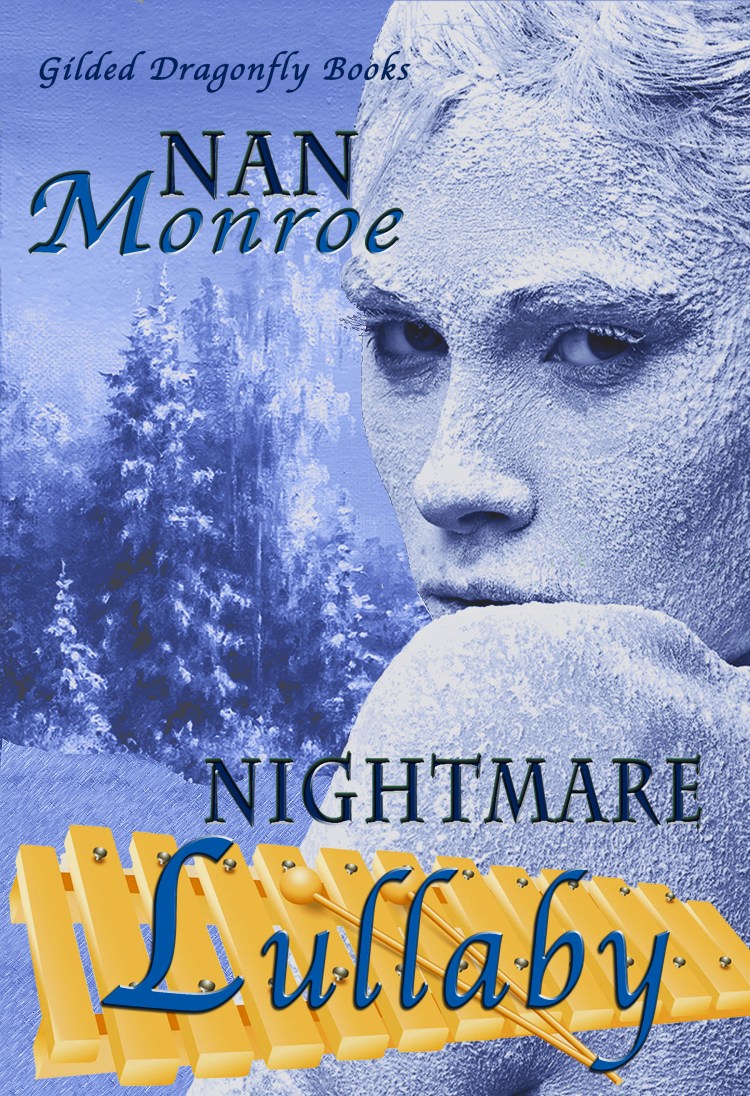
My second novel, Nightmare Lullaby, is very nearly ready to make its debut before the world — I’m reading the “home stretch” of the proof even now — and it has a front cover, courtesy of Gilded Dragonfly Books‘ artist Gina Dyer.

One of the things I love about working with GDB is their approach to covers. I’ve heard many writers complain about complete lack of input when it comes to the images meant to sell their books to the public. GDB, however, does nothing without checking with me first. The images you see on this cover are an integration of pictures I found on depositphotos.com, so in a sense I collaborated with Gina on this cover.

The vision of a white-skinned woman dominates, the closest I could find to a representation of Meliroc, my lead character. She lacks the blazing, angry green eyes I describe in the novel, but hey, when you choose to make your lead an eight-foot-tall albino, finding even a “close-but-no-cigar” image can be a challenge. The pictured woman does have Meliroc’s otherworldly beauty, and even better, her skittish mistrust, as she’s looking over her shoulder to confront whatever threat may approach from behind. In the distance to the left, we see a winter-scape. I started working on this book during a cold January and decided a wintry setting suited the tale.

The blazon “Lullaby” covers a background image of a xylophone, which represents the instrument that masked musician Feuval bestows on Meliroc. The music she makes with it proves to be her lifeline but also her greatest danger.

Nightmare Cover.jpg

Toward a More Female-Friendly Fantasy Canon

Part 3: Worthy Additions

To frame my suggestions for inclusion in a female-friendly fantasy canon, I’ve considered some of the characteristics for which books often included on “Best Of” lists tend to be praised. Strong and vivid prose is, of course, one aspect they have in common, though their styles may differ.

If you seek detailed world-building, complex politics, and a dash of moral ambiguity, you may enjoy–

  1. Michelle West’s multi-volume epic series The Sun Sword. The first book, The Broken Crown, is as violent, dark, and troubling as A Song of Ice and Fire, George R. R. Martin’s much-loved series better known by its TV name Game of Thrones. Yet sadly and inexplicably, few fantasy fans seem to have heard of these books. They deserve far more recognition.
  2. Kate Elliott’s Crossroads series. The first volume, Spirit Gate, is almost too dark and violent for my tastes, but the intricacy of the detail is tremendous, and we do get to know some fascinating heroines. The Steampunk-inflected Spiritwalker Trilogy, starting with Cold Magic, is even better in my opinion.
  3. Django Wexler’s The Shadow Campaigns, a planned five-part historical fantasy that begins with The Thousand Names. It may be very new, but other brand-new series have made it onto “Best Of” lists, so why not this one? The action sequences are stirring, and the political wheeling and dealing is a blast. And there are women. Lots of them.

If you’re looking  for detailed world-building and a sense of awe and wonder, you may like–

  1. Kate Forsyth’s Eileanan series, beginning with The Witches of Eileanan, a.k.a. Dragonclaw. Magic in threat, faeries, monsters, shifters, stalwart heroines, scheming villains — they’re all here. The sequel series, Rhiannon’s Ride, which I accidentally read first (and liked far too much to put down and backtrack to the first series) is also well worth a read. It has a female pegasus! I’m practically sold right from that point.
  2. Elizabeth Bear’s The Eternal Sky, the trilogy beginning with Range of Ghosts. This book offers a treat for those weary of pseudo-Medieval Europe fantasy worlds. Djinns, afrits, magical horses, and mutant tigresses populate this Arabian Nights landscape, along with female wizards (two of them, both wonderful), a destined hero, and a queen who can command an army of monsters.
  3. Anything by Patricia McKillip. The words “awe and wonder” are all but synonymous with McKillip’s numinous, poetic writing style. Those I’ve read: Winter Rose, The Bards of Bone Plain, Alphabet of Thorn, Ombria in Shadow, The Sorceress and the Cygnet, and The Cygnet and the Firebird.
  4. The Sevenwaters Trilogy, beginning with Daughter of the Forest. Juliet Marillier’s series brings Celtic mythology vividly and lyrically to life, and it reminds us that a heroine does not always need to wield a sword in order to save the day, as Sarah Letourneau points out.

If you like rough-and-tumble action with heroes and heroines kicking butt side by side, you should appreciate–

  1. Barbara Hambly’s Sun Wolf and Starhawk trilogy, beginning with The Ladies of Mandrigyn. Hambly is one of the most solidly readable writers I’ve discovered in the last decade. (I’ve heard her Star Wars tie-in novels aren’t the best, but at this point I’d be tempted to read a shopping list if Hambly wrote it.) Her heroes are flawed but understandable, and boy, do they ever make the villains sorry they crossed them. A touch of moral ambiguity is on the menu here (there’s a distinct gritty toughness), but so are friendship, loyalty, and satisfying self-discovery.
  2. Violette Malan’s Dhulyn and Parno series, beginning with The Sleeping God. I admit I picked up that first book because the statuesque, muscular, poised-for-action image of heroine Dhulyn Wolfshead looked like someone I wanted to read about. Now, with only one more book to go in the series, I find it criminal that Malan’s work isn’t better known. There’s plenty of action here, for those who love action, and romance, for those who love romance.

If you enjoy alternate-history or historical fiction with fantasy elements, you should try–

  1. Kate Forsyth’s “fairy tale” series. Bitter Greens merges a retelling of Rapunzel with the story of one of the ancien regime fairy-tale authors who recorded it, Charlotte-Rose de la Force. The Wild Girl tells the story of Dortchen Wild, the girl who became the wife of Wilhelm Grimm and one of the storytellers whose tales he and his brother recorded. Both books are immensely powerful and cathartic, more of a challenge than the superbly dreamy Eileanan novels. To read both sequences is to witness the versatility of a gifted writer. The “fairy tales” series has a new entry, The Beast’s Garden, which I’ve yet to read but can’t wait to get my hands on.
  2. Anything by Guy Gavriel Kay, but especially A Song for Arbonne, alternate-history France in the age of the troubadours, and The Lions of Al-Rassan, a depiction of the conflict between Christian (Jaddite), Muslim (Asharite), and Jew (Kindath). Lions is my favorite due largely to its female lead, the Kindath physician Jehane, a beautifully realized rule-breaker.

If you like fantasy that intersects with the real world and presents complicated, often disturbing moral dilemmas, you will enjoy–

  1. Kindred and Wild Seed, both by the justly lauded Octavia Butler. In the first, a modern African-American woman is transported to the pre-Civil War South and saves the life of an adorable redheaded boy — only to return again and again and watch as he evolves into a vastly less adorable young man. In the second, a powerful shape-shifting force of creation is locked in a centuries-long dance of doom with her evil opposite number. Both books are strong meat, and would serve as a wake-up call for those who believe women only write “soft” fiction.
  2. Nnedi Okorafor’s Who Fears Death. The heroine who strides powerfully through the wastes of post-Apocalyptic Africa is part destroyer, part savior. Once again, very strong meat.

If you like urban fantasy in which the plot is NOT driven by the protagonist’s sex life, you should be pleased with–

  1. Emma Bull’s War for the Oaks, a foundation work in the subgenre. Musician Eddi McCandry may fall in love with a supernatural ally, but she doesn’t let romance distract her from fighting to save her city from Fair Folk with evil intent. This book has plenty of humor and verve, and I need to reread it soon.
  2. Daniel O’Malley’s The Rook. Good and evil mutants battle for the life and soul of contemporary London, and the female protagonist is an amnesiac, fearless, supernaturally gifted office drone. What’s not to love?
  3. The Girl With All the Gifts. I’m not sure if M.R. Carey’s novel of a zombie-plagued England and the mismatched misfits who try to navigate it really belongs in this category, but I have to put it somewhere. It’s just too good for me to leave out.

Whew! That’s quite a lot, and I’m sure I will need to add more as my reading life proceeds. For a finish, I offer a list of books that may do for young readers what Hambly’s Dragonsbane did for Brandon Sanderson:

  1. Peter S. Beagle, The Last Unicorn
  2. Terry Pratchett’s Tiffany Aching books, beginning with The Wee Free Men, and The Amazing Maurice and His Educated Rodents
  3. Robin McKinley, The Blue Sword, The Hero and the Crown, and Spindle’s End
  4. Anything by Tamora Pierce
  5. Anne McCaffrey, The Harper Hall of Pern, beginning with Dragonsong
  6. Patricia C. Wrede, The Enchanted Forest Chronicles, starting with Dealing With Dragons. (She has several good series, but this is my favorite.)

Toward a More Female-Friendly Fantasy Canon

Part 2: Choosing the “Best”

In my last blog post I wrote of my difficulties as a new fantasy fan trying to find something “like Tolkien, but with more women.” Because this was the late ’80s and early ’90s, I had no vast and wondrous Internet to guide me, no Goodreads or Library Thing or genre-specific websites like Reddit Fantasy, Fantasy Cafe, or SFFWorld. Resources like this might have proved a huge help to me when I was starting out, yet even with them I could have run into a difficulty, a thorn in the foot of readers in search of high-quality fantasy literature in which women play central or at least important roles: outdated notions about “target audience.”

Put simply, too many people cling to the idea that stories centering on female characters will only appeal to female readers, while stories with male protagonists have universal appeal. Women readers can be engaged with equal ease by men’s and women’s stories, but boys and men are only interested in reading about other boys and men. Evidence of this notion in action is painfully easy to find. Author Shannon Hale, whose The Goose Girl I’ve enjoyed, describes on her blog the notion’s roots and the way libraries, teachers, and especially parents unconsciously water this poisonous plant. Then we have the recent brouhaha over the teaser trailer for the upcoming film Star Wars: Rogue One. Evidently, to a noticeable number of male Twitter users, two Star Wars movies featuring female heroes are too many, and the highlighting of female characters leaves the poor male viewers out in the cold, with no one awesome to latch onto.

This in a toxic nutshell is holding us back, keeping the number of active, capable female protagonists comparatively small. Until we find a way to root it out and burn it, progress will be slow.

Recommendation lists abound, purporting to point newcomers to fantasy toward the best the genre has to offer. If you want to know just how amazing and thought-provoking fantasy fiction can be, the list-makers claim, these are the books you must read. Yet take a good look at such lists. On this one posted by “Cory Novah Fifi Stars,” female authors are conspicuous by their absence, and, a likely consequence, stories of men dominate — male Chosen One heroes, scruffy male anti-heroes, male villain-protagonists. The most female-positive series listed here is probably Brandon Sanderson’s The Stormlight Archive, which does place a woman in the central role in the second book and does not subject its female characters to threats of rape or other forms of degradation every five pages.

Here’s another “Best Of” list which is a bit wider-ranging. A few female authors do make the cut, but on a list of thirty they are substantially outnumbered by men, and female protagonists, while better represented here, remain a distinct minority. quartzen, a friend of mine on Twitter and Library Thing, puts it this way: “How to write a ’10 fantasy novels…’ list: 8 books by men with male protags, 1 by a man about female protag, 1 by a woman about male protag . . . (Note that you can swap out one or two series about sprawling ensemble casts heavily skewed towards male characters for any entry above).” (used with permission) When the number of choices increases from ten to thirty, the ratio remains much the same, if not worse. Yet sometimes, when somebody remembers that female readers enjoy fantasy, we get lists like this. The choices aren’t the problem; this list includes some very good ones indeed. The problem is that in the title of this list we see yet another repetition of the idea that fantasy novels with complex and intriguing female protagonists must be “for women.”

Such lists leave me wondering: are fantasy stories about men somehow better — more riveting, more challenging, more imaginatively constructed — than those about women? Do authors both male and female magically write better when they’re writing about men? If the answer is “yes,” that’s the most disheartening prospect I’ve come across in a long time — so disheartening that I refuse to accept it. Rather than questioning the worth of women’s stories and authors’ ability to write them well, I question the biases, conscious or unconscious, of those who make the lists and their judgments of which books deserve a place in the “fantasy canon.”

If we want to come up with a more woman-positive fantasy canon, the first thing we have to accept is that works don’t have to be cut out in order to make room for others. Do Robert E. Howard’s highly testosterone-driven “Conan” stories need to be erased in favor of C.L. Moore’s tales of the sword-wielding heroine Jirel of Joiry? Why not read both, for double the rollicking adventure? (Confession: I haven’t read either — yet.) I’m not here to suggest that the works of Gene Wolfe, Fritz Leiber, Mark Lawrence, and R. Scott Bakker don’t belong on anybody’s Best-Of lists, though it’s doubtful they would ever make mine. Rather, I want to see a little more acknowledgement of the quality of female-centric fantasy novels, a quality that should appeal to all readers, not just women. Recently Brandon Sanderson delighted me with an article in which he honored the middle school teacher who recommended the book that changed his life. That book? Barbara Hambly’s Dragonsbane, which tells of the adventures of witch Jenny Wayrest.

Coming Soon: Part 3 — Nominees for inclusion in the fantasy canon