Five Things I Love about… Trainwreck

When my husband first suggested we go to see Judd Apatow’s Trainwreck, I admit I was a little bit skeptical. Comedy with a contemporary setting isn’t a genre I usually feel moved to see in the theater; Netflix will do just fine. I’d never seen a Judd Apatow film. I’d heard of Amy Schumer, but I’d never seen her show. And frankly, not having seen a halfway decent romantic comedy since Disney’s Tangled, I’d become convinced that romantic comedies are a genre that Hollywood quite simply no longer knows how to make. But after I read Internet film critic James Berardinelli’s review, I decided I’d give it a shot. I enjoyed it far more than I’d imagined I would. In fact, if we could find the time, it might be fun to see again.

Five things I love about Trainwreck:

1. It’s a step in the recent march of progress for women in the comedy genre.

Had I been asked a few years ago, I would have proclaimed that comedy was the least woman-friendly of all movie genres, with a sharp divide between light-as-cotton-candy “romantic” comedies in which the viewer is hard pressed to care whether the couple end up together at all, and bromantic comedies like The Hangover, The Dilemma, and Hot Tub Time Machine, in which female characters are portrayed as either sex toys or killjoys, and emotional commitment to a woman is to be avoided at all costs. The latter type, of course, was far more likely to flourish at the box office and even to win critical seal of approval. Then along came a game-changer: Paul Feig’s Bridesmaids, the director’s effort to show that women can do the raunchy-comedy thing as well as men — a bit too crude for my tastes, but a box-office hit, Since then, women’s stock in big-screen comedy has been on the rise. This summer we’ve seen not only Trainwreck but Spy, the first of Paul Feig’s woman-centered comedies that I actually want to see. Both have proved successful with audiences and critics, and how can I not love that? Trainwreck also boasts a screenplay by Amy Schumer herself, so the movie constitutes a Win for a woman behind the camera as well as in front of it.

2. Amy Schumer’s character is complicated and messy, and seems like someone I could meet in real life.

There’s something so down-to-earth, so real, about Schumer that I couldn’t help loving her character in spite of her sometimes questionable behavior, or maybe even a little bit because of it. That she could veer so wildly from insensitive and arrogant to vulnerable and heartbroken (the funeral scene is genuinely moving) and still seem so authentically herself is a sign of the talent of both Schumer the actress and Schumer the writer. It’s why I could buy the movie’s traditionally happy ending, which some have seen as anti-feminist, and still cheer when, at her sister’s baby shower, “Amy” purposely shocks the “real housewives of Hell” with a story of one of her raunchier sexual exploits.

3. Bill Hader’s character is a nice guy, not a Nice Guy.

We’ve all heard of the “Nice Guy,” the guy who thinks he’s entitled to get the girl because he’s “not like those other jerks.” If a girl doesn’t return his love, it’s her fault, and she should be ashamed of herself for not appreciating his virtues. (The Nice Guy’s psychotic underside is Elliot Rodger, who went on a killing spree to avenge himself on the women who wouldn’t date him.) Hader’s character could easily have come across as this, but writer Schumer and actor Hader tread the fine line with care, so that the character emerges as the kind of person we should see more often in comedy: a good-hearted straight-arrow gentleman who genuinely cares about the people around him, and who richly deserves his happy ending. That sense of entitlement that makes the Nice Guy so toxic is missing from “Aaron.” He considers himself lucky to have found “Amy.”

4. LeBron James is a fan of “Downton Abbey!” Who knew?

My favorite scene has nothing to do with the romance. It’s the bit where LeBron James, playing (a version of) himself, tries to set up a time when he and sports doctor “Aaron” can watch the latest Downton Abbey episode, because if he doesn’t see it before the next practice, his teammates will Spoil it for him. And another stereotype goes down in flames.

5. Trainwreck is a romantic comedy men and women can both love.

Movies that end with a kiss or a wedding tend to be dismissed out of hand as “chick flicks,” as if an appeal to/for a female audience somehow made a movie less worthy of attention and respect. But here is a movie that knows how to mix raunchy, politically incorrect humor and sentiment without coming across as jarringly incongruous. Plenty of women love this movie, as they should. But men are enjoying it, too. My husband had as much fun as I did, and I’ve heard as much positive word of mouth from men as from women. Together, Schumer and Apatow have injected new life into the “date movie,” with an offering that both people on the date will want to see.

(“Five Things I Love about…” is a new blog series in which I will cover a variety of things that have made me happy, from books to movies to television to music.)

One more thing, courtesy my husband Matt: if you desire to see Trainwreck, please try to see at a theater that serves booze.  You do not need to consume any booze to enjoy the film, mind you.  But a boozy atmosphere with adults will make the experience one you’ll truly enjoy.
Interview with A.R. Cook

Today’s guest is A.R. Cook, author of the Scholar and the Sphinx series (The Scholar, the Sphinx, and the Shades of Nyx and The Scholar, the Sphinx, and the Fang of Fenrir). I’ve been holding off reading the second book until I can get my hands on the third, but the first book is an absolute delight. If you have a taste for YA historical fantasy with a spicy dash of diverse mythologies, this series is for you.

1.                  First, tell a little about yourself (brief bio).

I’m originally from Riverside, Illinois, although I’ve lived in Gainesville, Georgia for over 8 years now. At the University of Iowa, I studied English literature and theater arts with a focus on play writing, and had six short plays and one full-length children’s play produced there. Since moving to Georgia, I have authored the YA book series “The Scholar and the Sphinx” with Mithras Books, the YA imprint of Knox Robinson Publishing. Books 1 and 2 are currently available, and Book 3 will be out this Nov. 10. I also have short stories published in the anthology “The Kress Project” from the Georgia Museum of Art, and the fairy-tale collection “Willow Weep No More” from Tenebris Books (with another story to be published in the follow-up anthology, “Shadows of the Oak,” coming out this October). Additionally, I was the book review columnist for the Gainesville Times, one of the most widely distributed newspapers in northeastern Georgia from 2009-2013, but I still occasionally do reviews for Toasted Cheese Literary Journal.

  1. What inspired you to write the Scholar and the Sphinx series?

This is a story that has been a good 18-some years in the making. It was originally a short story I was writing in junior high school for a fantasy writing contest (nope, didn’t win) and it was extremely different – more mainstream fantasy than what it would eventually become. The story then remained dormant on a floppy disk (yes, a floppy!!) for years until one day I dug it up again, and remembered there were a lot of aspects about it I liked, but it definitely needed reworking and I wanted to expand on it. I had also become more interested in history, and found myself wanting to weave historical elements into the plot. Plus I replaced the main dragon character with a sphinx, and the blacksmith protagonist with a young scholar who was named David (for my husband) with the last name Dewitt, and he was British. Then, one day I was sitting in the dentist chair for a check-up, and suddenly I thought, “Spanish! David should be Spanish!” Following that thought, my mother-in-law’s last name is Sandoval, so I replaced Dewitt with that. From there, the character really became more like a 16-year-old incarnation of my David, and the rest just came together on its own.

  1. Who is your favorite character in the series, and why?

That’s kind of like asking me to pick my favorite child…I think each of my characters has their strengths to admire, and weaknesses to empathize with. I like Tanuki because he adds humor to the stories – he tends to be a lot of readers’ favorite character in the series. He’s that best friend we’ve all had: a bit of a clown but goodhearted, wisecracking but loveable. I also love Acacia; in many ways I wish I was more like her (I guess she channels that aspects of me I tend to reserve). And of course I’ll always love David, because I love the real-life inspiration for him, my husband (both are David Sandovals, but mine has the added “Cook” on the end).

  1. What’s the most important thing you hope readers will take away from the series?

I try to have a main theme to each of my books. The first book carried a message about “what makes us monsters, and what makes us human?” We are not defined by what we appear to be to the rest of the world. Book 2 was more about the relationship between generations; how youth and elderly need to respect one another and each can learn from the other. Book 3 reverts to a classic theme in fantasy, “destiny vs. choice,” but also how the threads of our own lives are all woven together with the threads of everyone and everything around us, and each has a place in the tapestry of the world.

  1. Who are some of your favorite fantasy authors, and why?

Neil Gaiman, no question. Much of what he’s written has influenced my own writing, plus he has explored every writing medium there is, from books, to movies, to comics, to TV shows, everything. That is something I aspire to do. I also remember one of the first fantasy books I read was “The Cat who Wished to be a Man” by Lloyd Alexander, so I’ll always appreciate how he got me interested in the fantasy genre. Also Anne McCaffrey, Margaret Weis, Tracy Hickman, Terry Brooks, and I’m finally getting more acquainted with Terry Pratchett’s work – what an imagination!

  1. What would you like to see more of, and less of, in YA fantasy?

The one thing I was getting tired of seeing in YA fiction in general – the dystopian future – is starting to wane, so I would like to see what the next “big theme” is for YA in general.  I believe we are also seeing more stories that have male and female protagonists who can work together on the same level, as opposed to the typical “one is the hero, the other is solely the love interest/foil that needs saving.” I would like to see more YA fantasy writers trying to create original worlds and creatures, rather than the usual “urban fantasy” or “medieval fantasy” that’s common with the genre. I mean, I adore those types of fantasy, but I’d love to see fresh, unusual landscapes, stretched to the limits of the imagination.

  1. What’s the most important thing that aspiring writers of YA fantasy need to know?

Stephen King said it best: “Amateur writers wait for inspiration; professionals just go to work.” You can’t be a writer unless you write! I know we tend to write our best work when we get that “divine spark” of an idea, but you’d be surprised what will come to you if you just sit down and start typing away, even if at first we don’t know what to type. Write about your day. Write about what scares you. Write about your favorite food in ridiculous detail. And if you really get stuck, pick up a book and read. Most of the writers I know are (or were) readers – we love stories, whether it’s being the audience or being the storyteller. Only by being both can you spin a story well.

Many thanks to Ms. Cook for her time and her insights!

Interview with Lauren Berkley

In this week’s blog, Lauren Berkley of Geeks are Sexy answers a few of my questions.

1. Tell us a little about yourself.

LB: I grew up an only child in suburban Atlanta and began writing at an early age. I have a degree in Telecommunications (Broadcasting) from Georgia State University, with minors in English and Film Studies. After graduation, I began working at The Weather Channel and after about 4 years, I got a job at CNN. I am obsessed with doggies, pop culture, TV/movies, and musical theater, both attending shows and performing in them. I’ve studied tap, ballet, and jazz, as well as vocal training. I currently live in Phoenix, AZ with my fiance Will and Mackenzie, our cattle dog mix. I work at iHeartMedia (formerly Clear Channel) as a news writer for a wire service.

2. How would you describe Geeks are Sexy? What are the coolest things this site has to offer?

LB: I would say that Geeks Are Sexy is an amalgam of anything even remotely geeky, at this point. It began as a tech-heavy, review-heavy site — and it still is that — but it’s grown into more than just computers and hardware. I think it had to, honestly, in order to compete with the smorgasbord of geek-related & “tech only” sites out there. You want cosplay ideas? We have that. You want funny online comics? We got that, too. Want the latest casting news? Movie trailers? Breaking news? The latest perspectives on women or female characters in pop culture? How about cats dressed as “Game of Thrones” characters? Geeks Are Sexy serves all your needs. Since I began writing for the site — oh gosh, three years ago now — I’ve made it a personal goal to conduct and include more interviews.

3. What inspires you to write your blog?

LB: I initially began writing for GAS as both a creative and personal outlet, as my job at the time was extremely unfulfilling, and I felt like I was losing my mind. When I first started, I would also write about anything and everything, in part, because I was desperate for an outlet and partly because GAS happens to be able to pay their writers per post. Now, though, I’m older — I’m planning a wedding, I finally have a very fulfilling, fun, and successful job, I’m acting again — so I write a lot less now, but when I do, it’s mostly over topics I actually care about, rather than anything and everything.

4. What would you say is the best thing about geek culture?

LB: There are so, so many things, obviously, but I’ve thought about this question a lot, actually, and I think I’ve narrowed it down to two things: One, overall, I’d say maybe even 99 or 99.9 percent of the time, the geek community are the kindest and most welcoming, most all-inclusive group of people you’ll ever meet. Yes, there are examples of “us” being not-so-great people, but I firmly believe those instances are anomalies. And ‘geek’ is such a broad term now. It doesn’t just refer to comics or Star Trek, which — and I realize this will sound hypocritical — is both good and bad, but mostly good, I think. Some ‘purists’ or whatever you want to call them might say, “Ugh! TWILIGHT doesn’t deserve to have a place at our con!” But you know what? Those Twilight fans should be able to gather together from all walks of life and share their glee in a place where they should feel safe. And better still, what if some — or even just one — of those fans learns about Anne Rice or Nosferatu or yes, even True Blood, and it expands their fandom and a whole new world of vampires or horror or whatever opens up to them? That’s what being a geek and fandom is supposed to be about.

The other thing I love about being a geek is seeing little kids taking after their geeky parents. I love going to cons and seeing 4-, 5-, 8-, 10-year-olds cosplaying as their favorite superhero or villain or princess and seeing the joy in their faces as they see Batman walk right by them or as they take a picture with Darth Vader or Princess Leia. Parents, you’re doing it right!

5. What would you say is the worst thing about geek culture?

LB: I think “Corporate America” is doing more harm than good, in the long run. Since shows like “The Big Bang Theory” and even “Bones” or “CSI” made being a geek ‘cool,’ geeks are the new, sought-after demographic. Companies, or most I’ll say, don’t care about us at all. We’re just dollar signs to them. And EVERYONE seems to be trying to get a piece of the geek pie, and personally, I think we’re hitting a saturation point, even in media. I realize this might finally be “our time” and many of us are seeing our beloved characters on screen for the first time, but how many of those movies and shows and such are actually GOOD? And how much can we consume at once? There are only so many hours in a day, esp. if you work 40 or more hours a week. We’re so desperate for the content and characters that speak to us, that we’ll accept nearly anything, even if it’s awful and we complain about it. We’ll still watch it. And part of that, honestly, lands on the fans. We should be demanding MORE and BETTER than what we’re given much of the time, but I understand the flip side, too: If enough geek shows don’t do well, then we’ll stop getting them, because, again, it all comes down to money and companies will think the ‘general public’ doesn’t want shows about zombies or superheroes or scientists or WOMEN, instead of realizing (or caring) that we DO want those things, we just want them to be done WELL. So it’s either consume what we’re given or boycott it, watch it get cancelled or discontinued, and run the risk of not seeing something like that again ever, or at least for years and years and years. I mean, I get it. I understand, I’m in the same boat, and it sucks. [laughs] And yes, I’m even talking about ‘geek’ companies here — DC, Marvel, et cetera…. It all comes down to money for them, too. I mean, listen, I haven’t seen it yet, but Ant-Man is currently at 76% on Rotten Tomatoes, for what that’s worth. But remember when Edgar Wright was attached? And remember when Joss Whedon said that he read what Wright wrote and what his vision was and basically said Wright’s Ant-Man would have been the most Marvel movie that ever Marvel-ed? Well, we’ll never get Edgar Wright’s Ant-Man now because of “creative differences.” We won’t get an Ava DuVernay-helmed Black Panther now because of “creative differences.” Patty Jenkins didn’t end up directing the “Thor” sequel because of “creative differences.” Marvel literally has a formula for their movies, and if you don’t fit that formula, you’re out, even if your vision would result in a 100% rating from every critic — and fan — everywhere. I majored in media. I’ve worked in media for nearly a decade. I realize media is made with the “average” person in mind, i.e., not hardcore fans, but there needs to be a line. Or at least, there should be. The mentality of “well the fans will go see it no matter what” needs to stop, and it starts with us.

6. What’s your favorite geeky book? Movie? TV show?

LB:

I’m gonna be honest: I barely read anymore. I used to be an avid reader, but after being ‘forced’ to read in college and then working jobs where I’m staring at a computer screen all day, writing my own words, reading others’ words…the LAST thing I want to do is come home and read more words. That being said, I go through phases where I’ll start reading again, and I’m actually reading two books at once right now: “Gun Machine” by Warren Ellis and “Going Clear” by Lawrence Wright. I’m flat-out fascinated by Scientology (and serial killers,l unrelated) and it’s the book the HBO documentary “Going Clear” is based on. And while I’ve been remiss in not reading “Transmetropolitan,” I absolutely love Ellis’ first novel, “Crooked Little Vein.” I also should probably finish “Ready Player One” and “The Strain” at some point. And “Altered Carbon.” And “Dune” (yeah, I know, I haven’t read it). THERE’S TOO MUCH! Which is also why I don’t read a lot — too overwhelming to catch up on stuff, both old and new.

As for movies, well…you’re going to be sorry you asked me that question! My favorite movie of all time is “Singin’ in the Rain,” followed by “Vanilla Sky.” I am a huge Mel Brooks fan — my dad showed me “Young Frankenstein” at an early age, but “Robin Hood: Men in Tights” is my favorite, followed by maybe “Spaceballs,” because I love “Star Wars.” I’m obsessed with “Dredd” and the new “Mad Max,” and “The Princess Bride,” of course, but I’ve also had a love of classic films since an early age — I even have a tattoo of Charlie Chaplin and I was named after Lauren Bacall. I love sci-fi and fantasy and comic book movies, but before I accepted and embraced my geekiness, my taste in movies has always been action — “Die Hard,” “Mission: Impossible” series, Nic Cage movies, Tarantino…virtually anything where stuff blows up and bullets and fists fly everywhere. In my late teens/early 20s, I also developed a love of horror movies, with the “Hellraiser” franchise being my favorite. I’ve seen every single one, no matter how awful.
I have less time for TV now than I’ve ever had before, which is unfortunate, I think, because TV is better than it’s ever been. My favorite TV show of all time is the reboot of “Battlestar Galactica”; I even have Starbuck’s tattoo on my shoulder blade. Honestly, though, my taste in TV is a lot less nerdy — I don’t watch too many of the comic book or fantasy shows that are out there, although “Daredevil” on Netflix is definitely the best one so far! I love “Castle” and “Law & Order: SVU,” and “The Blacklist,” but that’s mostly for James Spader. I watch “Agents of SHIELD,” but I don’t know why, and I never finished the first season of “Arrow,” although, I’m told it gets better. I watch “Game of Thrones,” of course, and “True Blood,” when it was on — definitely a guilty pleasure. Same with “Scandal” and “Grey’s Anatomy.” I enjoyed “Fringe”…until the final season. I really like “Doctor Who,” although I’m so behind it’s embarrassing, so that probably doesn’t count. “Orange is the New Black,” oh, and “House of Cards,” how could I forget! Honestly, if you look through my Hulu and Netflix accounts, you’ll see that my TV tastes tend to lean towards dramas or procedurals, rather than shows classified as ‘geeky.’
Many thanks to Lauren for her time and her insights!

Hollywood’s Girl Trouble

First, the good news: Pixar’s Inside Out is a mega-hit. Today’s conventional wisdom holds that movies that center around girls are risky ventures, but this movie is packing ’em in, even though at least half its major players are female and the conflict revolves around the emotional well-being of a pre-teen girl. Riley is one of the very few female protagonists of an American animated film who isn’t a princess of an age to fall in love and marry. But unlike Home and Monsters vs. Aliens, this movie is liked by critics as well as audiences. Parents of daughters, rejoice! Here at last is a good movie you can take your girls to, that won’t ask them to follow the adventures of a boy, man, or male toy/monster/insect/fish/car/etc.

Enjoy it while it lasts. I’ve been to see Inside Out twice in the theater, and here are the movies for which I saw trailers: Minions, The Good Dinosaur, Hotel Transylvania 2, The Peanuts Movie, Zootopia, Underdogs, and Pan (the only live-action trailer). A pretty diverse lot, perhaps, in terms of setting and tone. Yet they all have one thing in common: male protagonists. That’s right — we get seven movies with male heroes, but only one, albeit a very good one, in which a heroine holds center stage. We have quality but can’t seem to muster quantity, all thanks to Hollywood’s notion that girls will happily watch family movies centered on boys while boys will avoid girl-centric movies like some girl-cootie plague. For Hollywood executives, boy protagonists equal dollar signs.

Was it always like this? When, and why, did girls become box-office poison?

In the 1930s, the biggest child star, bar none, was Shirley Temple, the curly-haired moppet with a song in her heart. I saw my fair share of her movies when I was a small girl. Most of them are painfully dated. Now I think only 1935’s Wee Willie Winkie holds up well, thanks largely to John Ford’s direction and co-stars Victor McLaglen and C. Aubrey Smith. I’ve also read that kids in the ’30s really didn’t like Shirley, but were dragged to her films by parents who pointed to her as a model of adorable behavior. (Toni Morrison’s The Bluest Eye offers a rather grim deconstruction of Temple’s popularity.) Nonetheless, her movies made a ton of money, and 20th Century Fox cranked them out through the decade. Jane Withers was another girl star, albeit less precious than Shirley, and Judy Garland featured in her share of films prior to The Wizard of Oz. Their movies co-existed happily with boy-centered vehicles for Jackie Cooper, Freddie Bartholomew, and Mickey Rooney.

The 1940s also saw more balance between boy- and girl-starring movies than we see today. Filmgoers saw the advent of Roddy MacDowall and Dean Stockwell, but also Margaret O’Brien, Peggy Ann Garner, and young Elizabeth Taylor. In the 1950s, child stars in general seemed to fall out of favor, giving way to teenage stars (e.g. James Dean, Natalie Wood). Yet it’s worth noting that in 1951’s Angels in the Outfield, the baseball fan whose prayer summons the angels is a little girl. When the film was remade in the 1990s, the character was changed to a boy, reflective of the recent “girl-cooties” outlook.

The 1960s brought Hayley Mills, one of the few young girl stars to make a seamless transition from child to teenage roles. Pollyanna holds up beautifully, as do The Trouble With Angels and Whistle Down the Wind. The decade also saw two of the finest depictions of young girls’ coming of age ever put on film: To Kill a Mockingbird and The World of Henry Orient. In the 1970s, in addition to the gritty Taxi Driver, young Jodie Foster starred in good family films like Freaky Friday and Candleshoe, while Tatum O’Neal made Paper Moon and The Bad News Bears. Women may have gotten fewer good roles in 1970s films, despite the rise of feminism, but girls were still a presence, and could occupy the center of successful films.

Then came the 1980s.

Here we can see girls receding into the background. Almost all the decade’s well-known family films have boy heroes; if girls are “on the team,” they’re there mostly to scream. Girls only had relevance, apparently, once they became teenagers and could be played by Molly Ringwald or Ally Sheedy. Even as teens, girl characters concerned themselves primarily with popularity and finding boyfriends, while boy geniuses could hold the fate of the world in their hands in movies like War Games and The Philadelphia Experiment. Perhaps here we touch on the root of the problem, the idea that boys’ stories will appeal to boys and girls alike but girls’ stories will appeal to girls alone. If boy heroes get bigger battles to fight and wider spheres of action in which to move, is it any wonder that their stories speak to a greater range of audiences?

For all the flaws in Shirley Temple’s films, she could be an Everychild, though she was obviously a girl. She and O’Brien and Mills could confront problems boys and girls share: losing loved ones, learning values, and making sense of a confusing and often frightening adult world. Yet in more recent films we saw a more limited idea of the kinds of stories that could be told about girls. This narrowing found expression in a statement made by a TV executive in the late 1980s, printed in the TV Guide article “Does TV Shortchange Teenage Girls?” He explained the preference for boys’ stories by noting that while boy heroes deal with life’s major questions as they come of age, “only one thing happens when a girl grows up: she tries to be pretty so boys will like her.” (Had I not been a feminist before, reading this statement would have been enough to turn me into one.)

Spoken like a man who has no daughters, and certainly has never read Anne of Green Gables, A Tree Grows in Brooklyn, or A Wrinkle In Time. Yet this was one of the men in charge, and while television made significant strides in the years following the article, the Big Screen continues to reflect his mindset. A gem like Matilda, 1993’s The Secret Garden, or 1995’s A Little Princess may turn up on occasion, but when those movies fail at the box office, Hollywood executives shake their heads and blame it all on the presence of female protagonists, and continue to ignore girls’ stories. Some years we see one really good one. Other years, we see none at all.

This year, we’ve already seen Inside Out. Later this year, we’ll see Mockingjay Part 2, which will hopefully be better than its predecessor. But I still await the day when the release of a good movie with a young female protagonist doesn’t seem like such an unusual event.

Nan Monroe at LibertyCon 2015

LibertyCon is always one of my favorite weekends of the year. For one thing, it’s held in Chattanooga, TN, which is also home to the Hot Chocolatier and McKay’s Used Media Store, two of my favorite places in the universe. For another, it offers an opportunity to discuss the ins and outs of science fiction and fantasy with like-minded souls, without the often confusing sprawl of DragonCon (which I also love, I hasten to point out). Finally, the Atlanta Radio Theatre Company always finds an appreciative audience there. This year, on Saturday night, 6/27, we performed The Passion of Frankenstein, Thomas Fuller’s stirring adaptation of Mary Shelley’s classic novel. On Sunday morning, 6/28, we held a “table reading” which featured performances of H. Beam Piper’s “Crossroads of Destiny,” Isaac Asimov’s “Liar” (in which I had the privilege of playing Susan Calvin), and a chapter from The Nightmare Lullaby, a forthcoming novel by new author Nan Monroe — yours truly. My gratitude for this honor is boundless.

This adaptation of Chapter 11 is the first public introduction to a new story and to a protagonist, Meliroc, for whom I have special affection. I have always had a soft spot for “gentle giant” characters like Fezzik from The Princess Bride and Hagrid from the Harry Potter series. Yet they always seem to be male. The Literature link on TV Tropes’ page devoted to the Gentle Giant even points out the rarity of female examples. When I note such a gap, I try to consider how I might fill it, so I chose to write Meliroc as a formidable eight feet tall. She is not always gentle. She has a bitter streak, and pretty valid reasons for it. Yet her first act is to save a tiny man from freezing in a snow-drift, and her foremost ambition throughout most of the story is to find a series of songs that will release an undead wraith from the hold of his enchanted musical instrument. Because she sees herself, and imagines others see her, as a monster, she can feel compassion where most would feel dread, and is willing to put her emotional health at risk to discover the last song, as we learn in the table reading.

Here is the video, courtesy of my wonderful husband, Matt Ceccato. Alicia Cole performs Meliroc as narrator. Liz Schroeder performs her as the character living the events. Bob Brown performs Cedelair, the sorcerer Meliroc is geas-bound to serve. I give the introduction. Also present at the table is David Benedict, ARTC’s co-director, without whose tireless efforts ARTC could accomplish nothing.

Interview with Dave Schroeder

Today I offer something a little different: an interview with fellow author Dave Schroeder, one of the great friends I have found through the Atlanta Radio Theatre Company. Dave is the author of the science fiction novel Xenotech Rising.

Dave Schroeder, pronounced SHRAY-der, is a retired Chief Information Officer who has written and produced a musical off-off-Broadway in New York along with writing his first book. He lives in suburban Atlanta and enjoys performing with and writing for The Atlanta Radio Theatre Company and acting in community theatre productions. He has a wonderfully supportive wife and a daughter who’s just graduated from college. Dave is well into the second volume in the Xenotech Support series, which is due for release in 2016.

1.     What first sparked the idea for Xenotech Rising?
DS: The first scene, about the aliens asking Earth to join the Galactic Free Trade Association, just popped into my head one day and I wrote it down on a napkin to make sure I didn’t lose it. The need for someone to support all the galactic tech down the road naturally suggested itself based on all the years of experience I’ve had doing tech support for various forms of high tech.

2.      What aspects of the book are you proudest of?
DS: Finishing it, for one. It’s my first book. I’ve had lots of ideas over this years but this is the first one I got across the finish line. I’m also proud of the fact that readers seem to be really enjoying my characters.

3.     What do you think will draw readers to the book, and what do you hope they will take away from it?
DS: I think the action and the humor will draw readers to the book, but the characters and the love story will keep them wanting more. That’s a good thing, since I hope to make Xenotech Support an on-going series. I hope readers will take away lots of smiles and a laugh or three. The book is a romp, not “serious” literature—it’s designed to be fun, not a slog. I hope they’ll also take away their own thoughts about what might happen if we do join something like the Galactic Free Trade Association someday. Not every encounter with aliens has to result in humans being a key ingredient for a recipe. I hope my new series will offer a sense of optimism not often seen in a lot of modern science fiction.

4.      What would you say are the key characteristics of a good science fiction novel? (Give a couple or three examples.)
DS: I think good science fiction novels should stretch our minds and help readers think about things from new perspectives. The best SF novels take characters that feel “real” and put them in situations that would only be possible in the fictional universes authors create for us. Some authors paint miniatures, like Ursula K. Le Guin’s exploration of relationships on a world with fluid gender in The Left Hand of Darkness. Some paint on vast canvases, like David Weber’s epic space battles in his Honor Harrington series. But all good science fiction makes us think and feel in ways we couldn’t without the help of the special features of the author’s science fictional universe. Ernest Cline explores the power of friendship in a science fictional world where virtual reality has become so powerful that literally anything can happen in Ready Player One, A Novel. Cline blurs the line between science fiction and fantasy, but it’s not a hard line. I see science fiction and fantasy as Siamese twins, eternally bound, much the same but with slightly different “rules.”

6.      What would you like to see more of in science fiction? What would you like to see less of in the genre?
DS: I don’t have as much time as I’d like to read a lot of science fiction these days, so I tend to stick to favorite authors unless something, like Ready Player One, is recommended to me, so I’m not in a good position to talk about trends in the genre as a whole. My sense of things is that the field, despite, or maybe even because of the Sick Puppies controversy, seems to be quite healthy, with lots of authors turning out a broad range of high quality work. I think the self-publishing revolution is helping voices be heard that might have never gotten audiences in the past, though it’s also increased the amount of poorly written prose on the market. Reviews help sort the wheat from the chaff. I find the explosion in discussion about science fiction, thanks to social media, wonderful, by the way.

As to what I’d like to see less of in the genre, I’d say I’m not happy with the amount of derivative, “me, too” kinds of novels that jump on a trend and elaborate on it without adding anything truly new to their fictional universes. Some of the urban fantasy these days feels like the authors couldn’t figure out unique twists for their worlds. I’d also like to see less SF, particularly military SF, with cardboard characters. I’ve got a few characters like that in Xenotech Rising, but they know they’re cardboard and can wink at the reader about their status, which is part of the fun.

It’s been a great pleasure to share and reflect with your readers, Nan. Thanks so much for the opportunity.

If any of the folks reading your blog would like to get a copy of Xenotech Rising, they can find it on Amazon in Kindle or trade paperback format at the following link: http://www.amazon.com/Xenotech-Rising-Galactic-Association-Support/dp/0692447288. They’re also welcome to check out the Xenotech Support web site at http://www.xenotechsupport.com, where they can see pictures of some of the aliens described in the book and check out a preview of the cover of the next volume in the series, Xenotech: Queen’s Gambit.

“Atterwald”: Bringing Them Together

My previous excerpts from my novel Atterwald have introduced the three major point-of-view characters. Brendis the lovelorn mouse-man has transformed into Baltasar the sorcerer. Meinrad has seen visions beyond his sick-bed. The outcast rat-child who calls herself “the Dying One” has been adopted by respectable mouse-woman Ricarda and given a name, Nicht Naught Nothing, or “Nichtel.” In the following scene, the three come together for the first time.

Tall unshuttered windows lined the upstairs corridor Nichtel and Baltasar walked along. White-gold sunlight flooded the hallway, singing of the pleasures to be found outdoors. Restlessly she quickened her pace. She grinned at the fiddle-shaped bundle under her arm, anticipating the melodies she might find once she took her violin out into the garden. Intervals already filled her fancy.

But first she had to make someone’s acquaintance. She recited silently all the rules Ricarda had taught her about making a good impression.

“Here we are,” Baltasar half-sang  as he reached a door marked with gold-gilt letters, M-R. He turned the knob and stepped into shadow, beckoning for Nichtel to follow.

She could tell at once that light and fresh air were strangers to this room. As Baltasar pulled the door closed behind her the meager glow of his candle revealed faded green walls, an ebony writing-desk topped with books and a bottle of ink, dust-dappled green plush chairs, and a four-poster bed with sheer white drapery. A window hovered over the bed, its blinds drawn fast. Tiny fingers of light struggled through the swirling dust-mites to fall upon the bed’s occupant.

A man — or was he a boy? — lay propped on a mound of pillows, a thin hand dangling over the bedside. He lifted his eyelids to acknowledge the newcomers. His thin lips tightened, as if their intrusion displeased him.

“How are you feeling this happy hour, my boy?” Baltasar asked, his voice so gentle that Nichtel hiccoughed in surprise.

The boy drew his head up straight and said, “I feel as if a tree has fallen on my chest, my throat is raw and dry, my feet are swollen, my head longs to drop off my shoulders, and I haven’t slept in nearly two days. Will that do for a report?”

Baltasar’s lips crinkled. “Leoda said you were improving.”

“Leoda is an idiot.” The invalid straightened himself on the pillows as his half-closed eyes fell on NIchtel. “What is that supposed to be?”

“This is Nicht Naught Nothing, a medicine-maker from Wennhalt. I have brought her here to see if she can make you well. This is my son Meinrad, young rat. You will spend your afternoons caring for him.”

Nichtel curtseyed and greeted Baltasar’s son. Her gaze took him in and wondered. He was in every way the reverse of his father. Baltasar had no scent, yet Meinrad’s mouse-scent was distinct. Baltasar was small and round, yet Meinrad was lank, all angles and edges. The father’s face bore a healthy red tint, while the son’s sunken visage was deathly pale, crowned with a mop of frowsy light blond hair.

“Nicht — Naught — Nothing,” Meinrad echoed. “You have brought Nicht — Naught — Nothing to make me well. That is precisely what can make me well. Night — naught — nothing!”

His gray eyes opened wide as he spat her name, and she started at the venom that brightened them. When she pulled back, trembling, Baltasar took her arm and drew her forward. “You must excuse my son’s rough manners,” he said. “He isn’t accustomed to company.”

“Whose fault is that, I wonder,” Meinrad returned in a harsh whisper. “Perhaps the one who sealed us up in this fortress so that we never see or hear anything of the world outside it, except in books? The one who invites no visitors here, except crabbed old soothsayers and milk-faced rat-brats? Look at her, all swathed in black. Come for my funeral, have you, my lady vermin?”

“Were I you, my boy, I would not be so quick to dismiss ‘my lady vermin,'” Baltasar returned, still gently. “Her talents may surprise you. For one thing, she can hear the wind.”

“Everyone hears the wind — save those of us shut up in sick-rooms.”

“Not as she does.” Baltasar cast a side-long grin at Nichtel. “She hears its secrets, and they may lead her to your cure.”

“You mean she’s a magician? Splendid! Since one of that lot has pumped and prodded me with all manner of spells that have only made me worse, I’m quite eager to endure the ministrations of two.”

Baltasar forced a laugh as he turned to Nichtel. “My lad prizes magic and magicians very lightly, I fear — though were he well I suspect we’d soon see he has abilities of his own.”

“All-Guide, I hope not.” Meinrad sniffed. “I’d throw myself from a bridge. And as to this one having the power to cure me, you know that’s rot.”

“You have so little faith in me,” Baltasar murmured, reaching out to rest his hand on his son’s forehead.”

Bristling with rage, the boy drew back. “Why should I have faith in you?”

Baltasar drew an obliging step backward, his fingers trembling as if they’d been burned. “You see how it is, Nicht Naught Nothing. I would cut off my own hand for his sake, yet he hates me. Boys his age blame everything on their fathers.”

“Boys my age,” Meinrad echoed, his lips curling into a sour smile. “Come a little nearer, rat.” When Nichtel ventured a step closer to him he said, “Try to guess my age.”

She centered her gaze on his face — the angular chin, the hollow cheeks, the gray eyes with their curdled-milk expression. How could one pinpoint the age of such a face? She found it simpler to consider Baltasar’s age, and how old his son might be, and so settled on an estimation. “Seventeen.”

“Crows and vultures!” cried Meinrad. “She got it right! And here I thought my condition had aged me past recognition.” He relaxed on his prop of pillows. “I don’t talk in the manner of most lads of seventeen, do I? Of course I have only books to go by.”

“I wouldn’t know about that, sir,” she admitted. “I’m not much used to company either. One good lady and her children in one small cottage — that’s been my society.”

“Indeed?” A spark of curiosity flashed in the lad’s washed-out eyes. “How old are you, rat?”

“Sixteen, I believe.”

“You believe?”

“I’m not exactly sure when I was born.” She drew still nearer the bed. “I had my first birthday present when I was nine, and that was an actual birthday. Ricarda’s twins saw that while they always had cake and presents on their birthday, I never did. ‘Why doesn’t Nichtel — that’s me — have a birthday?’ asked they. Ricarda turned to me like a queen with a scepter and asked, ‘When would you like to be born? The autumn or the spring?'”

“The autumn,” Meinrad put in, reflexively.

“I’d suspected that of you. You’re an autumn sort of person, that’s clear in your eyes.”

“Why?” The lad’s voice sharpened once again. “Because I’m dying?”

She tensed, struggling to bridle her tongue, yet her next words slipped out carelessly, prodding the dangerous point. “No, sir. Because your eyes have an autumn melancholy. When I look at you I see a tree shedding its leaves.”

“There, you see? Dying,” he snapped, folding his arms.

“The tree doesn’t die,” she pointed out. “It merely waits. For my part, I love spring and autumn nearly equally, so it took me a minute to choose.”

“But you chose spring at the last,” Meinrad guessed. “You’re a spring sort of person. That’s clear in your eyes. How long will we have the pleasure of this rat’s society, father?”

“That depends, ” Baltasar replied. “So now that you’ve met my son, what’s your diagnosis, my medicine-maiden?”

Nichtel stared up and down the length of the bed, feeling her inadequacy as Ricarda’s apprentice like a stinging slap. She could only offer an obvious statement. “He should eat more, and he needs sleep.”

“Sleep!” Meinrad groaned. “Yes, I do believe that sleep indeed might do me more good than anything — and as much good as nothing,” He cast Nichtel a brief smile and nod. “But the pain won’t let me rest. Have you some trick up your sleeve for that?”

“Perhaps, my boy,” suggested Baltasar, “what you need is a lullaby…. Take up your fiddle, Nicht Naught Nothing, and see if you can play my son to sleep.”

Nichtel gnawed at her lip. She heard and felt no music in this stifling room. “I’ve never played indoors,” she told Baltasar.

“Then I suggest you try,” he returned.

With lead-heavy fingers she drew her violin and bow from their cloth cover. The fiddle did not quiver at her touch, as it always had before. Nonetheless, she tucked it under her chin and set the bow in place.

Closing her eyes, she cast the net of her memory around the happiest moment she had known so far — the morning when she’d found a cake and a birthday crown at her place at the breakfast table and afterward had rushed out into the spring and played her fiddle with such merry abandon that the sunlight itself had danced. Play that moment, she urged herself and set her bow and fingers in motion. Her heart raced, jubilant, as the jig-like strain rushed forth. She could make music indoors, as long as she remembered the wind’s whispers and touch. Her playing grew louder, stronger, until she imagined herself back in that first birthday, under the fahrian eln with Hulbert and Adelyte kneeling beside her. At any minute Ricarda would call them in to lunch. Her eyelids fluttered as the music slowed, then stopped.

The emaciated face stared up from its pillows. “Father,” Meinrad whispered, “where did you find this rat?”

“I told you before, at Wennhalt,” Baltasar replied. “A lovely strain, young fiddler, but hardly a lullaby. Play something calmer.”

She expected Meinrad to snap that as ill as he was, a change in the tempo could hardly matter. But he kept silent, his gaze expectant.

Once more she closed her eyes, calling other images to mind: soft moonlight falling through the curtain upon Ricarda and her youngsters as they slept, the curtains stirring in a faint breath of wind, the steady whirr of crickets, even a house’s tiny creaks when all is peaceful. From these threads she wove a nocturne.

A hand touched her back. She turned lazily, half-expecting to look into Ricarda’s careworn face. Instead she found Baltasar, beaming. “Behold,” he said, with a wave of his hand toward the bed where Meinrad lay, fast asleep. . .

“If you can heal my son, I swear to you all the treasures I possess save one are yours for the asking.”. . . Shadows loomed in his eyes, black as shrouds. “If you fail, you will wish you had not seen the light of day. For your own sake, Nicht Naught Nothing, make him well.”

A Taste of “Atterwald,” Part 3

Atterwald‘s third main point-of-view character, the central protagonist, is a hal’ryth’kei of the Rat Tribe, and has lived among the nomadic bandits thinking she has two choices: grow up to become like them, or die. She believes the latter might be a better option. Yet in this excerpt, she finds herself unexpectedly liberated from her lawless comrades.

A swish, and suddenly she felt light and free. Her tether had been cut.

You’ve been a captive, something whispered in her ear, no different from that poor mouse-man with the crooked chin. What do captives do when they have the chance?

Her lips formed the word. Escape. She raced toward the nearest tree to hide. She clutched her knees and let herself blubber, she ventured to hope, for the last time.

The wind wrapped around her like a cool, soft quilt. It merged with the shadow of the tree to shelter her, chanting in rhythmic whispered words she didn’t recognize: fahrian eln… fahrian eln…

Drawing in the bark’s damp scent, she understood suddenly that this lovely phrase was the tree’s secret name. She sensed as it swirled gently around her that the wind was befriending her, touching her and speaking to her as no other being ever had. She yearned to remain here where she would be safe, or at least slip out of life happily, at peace for the first time.

The wind-whispers wafted in circles about each other, forming patterns she envisioned as glowing spirals of color and light. She heard them leaping and racing, winding and diving. In this dance she sensed an invitation to discovery. She listened with every atom of her being.

Music.

She loved the word and at times thought she understood it. Though her elders’ raucous shouting offered her no example, she sensed it in the rustling leaves and whispering grass. Here, in the weavings of the wind, she caught it at last — music. She needed to hear it more closely.

Willing her transformation, she spun downward, like slipping down a waterfall stone. Her head pitched dreamily as her senses sharpened. The harmonies of the wind grew sweeter, moving through her fur and setting her tail a-tingle. She let out a long breath and closed her eyes as they sang her to a peaceful sleep.

She awoke to the touch of sun on her face. Yawning, she stretched herself into a human once more. She was bursting with some glorious thing she couldn’t quite name. The breath of wind played about her ears. Savoring it, she opened her eyes. White threads of sunlight streamed through a verdant curtain of leaf and limb above her. She stretched out her fingers to them, pondering. What might it be like to rise into the sky, absorbed in these lovely strings of light?

She peered around the tree at the little house and garden. Though the hut still stood, the garden looked as if a storm had torn through it. The flowers’ stems were crushed, their petals scattered. Of the vegetables, only a few scraggly carrots and bruised radishes remained. The bladed instrument that had cut her tether now lay half-buried in disheveled greenery…

The wind ruffled the leaves under the child’s hand. As she moved her fingers, they struck something odd. Soft, smooth, slippery. A cloth of some kind. The sketch of the dancing children flashed in her mind’s eye. Had she found one of those fat hair ribbons? Her fingertips tingled as if they’d brushed against ice.

Half turning, she glimpsed an object wrapped in a shiny white blanket, lying in a hollow at the tree’s roots. She reached in to draw it out. Her breath in her throat, she unfolded the blanket, uncovering a wooden rod and a thing she had never seen before.

The breeze strengthened. She heard it whispering something about this strange object. She strove to think of something, anything it resembled. A figure… like her own if she were attired as she wished to be — long neck, curved bosom, waist, and spreading skirt. She liked the feel of her fingertips along its edges.

A gust blowing across the strings made a heart-stirring sound. She heard the faint but distinct suggestion of music — those glorious harmonies the breezes had sung.

This thing could make sounds like that.

Yet how? She shuddered, breathless as she noticed the stick, too, had strings bound and drawn tight to it. String against string. Heart tight with anticipation, she scraped the stick’s strings across the strings of the larger object.

All this effort got her was a high-pitched shriek. She ground her teeth in annoyance, but her heart wound tighter still. The thing shivered under her fingers. It lived, somehow. If she moved the stick-strings and touched the thing-strings just so, she could unlock its soul. She tried again. Still it screamed at her.

“So they left one behind.”

Startled, the Dying One dropped the objects.

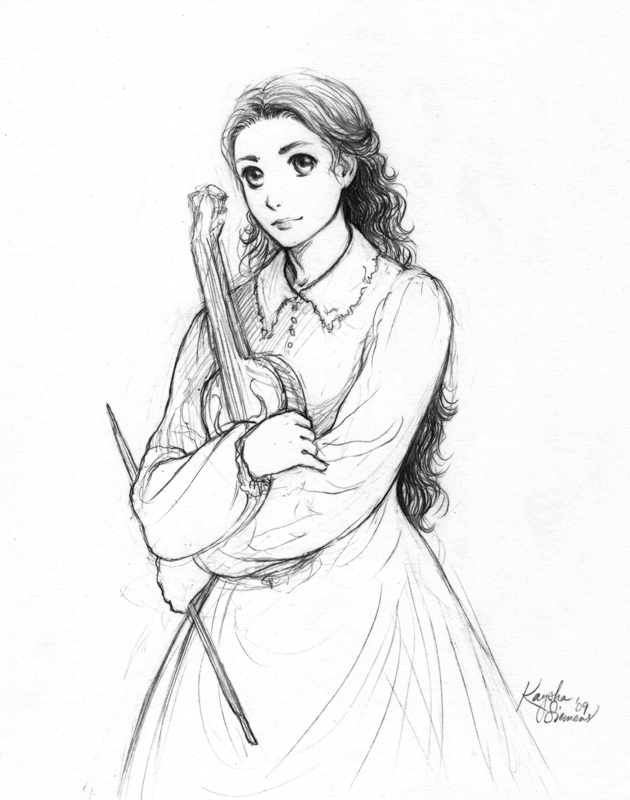
Nicthel for Kelley AWA 09_small “Nichtel,” by Kaysha Siemens

A Taste of “Atterwald,” Part 2

Here is another excerpt from Atterwald, introducing the story’s second major point-of-view character.

1843

Meinrad lay in bed, his coverlet drawn up to his chin. To ease his racking pain, he was trying to turn himself to stone after the fashion of Grave Limring in The Golden Prophecy.

He drew a deep breath up from his toes, then centered his mind on them, willing them to numbness. He felt them freeze and harden and he managed a tiny smile. He coaxed the stone upward into his soles, his heels, his ankles. Soon he could feel only heavy rocks where his feet had been. Pain had no power over rock.

Into his calves, up to his knees the brittle numbness spread. As well as the trick was working this morning, he might succeed, as Limring had done, in suspending his breath. When Leoda arrived with her wash-basin and her mirror, she might believe he’d died during the night. She would hold the mirror to his lips, but no fog would mar it. When she lifted the blanket to cover his face he would spring into motion. She would drop her basin and fly from the room, shrieking.

When the stone had gained his neck the door opened, and a portly figure appeared, wheeling a tray topped with a basin and a lit candle. “Good mo-o-orning, Master Meinra-a-ad!” the figure called in a chirpy sing-song. The stone in his limbs gave way to a tingle of longing to throw something breakable.

“Did you sleep well last night, Master Meinrad?” Leoda asked as she wheeled the cart to his bedside.

“I slept as I always do,” Meinrad grunted, forcing himself to look the housekeeper in the face. A wave of revulsion broke in his stomach at the broad smile, the sparkling dark eyes, the gray hair knotted and drawn back to fit under a white lace cap. She always beamed, as if her visits to his sick-chamber were the greatest pleasure life afforded her.

“Today is a big day for you, Master Meinrad,” she announced, lifting him by his shoulders and adjusting his pillows to prop him up. “You’re to have a visitor.”

“Lovely,” he mumbled while his heartbeat quickened.

She dipped a cloth in the wash-basin, then gently wiped his face. “Master Heinemach. You may have read about him. He’s quite famous.”

“Who is he?”

“Is that all?” he returned with a lazy yawn.

Leoda continued her work, turning him from his side to his stomach as she soaped him down. “He’s coming at your father’s request to have a look at you,” she said.

“So he can say how much longer I’ve got to live?”

“So he can say what might be done to make you well.”

“I would have thought that would be obvious by now,” he grumbled as the cold damp raised goose-flesh. “Nothing.”

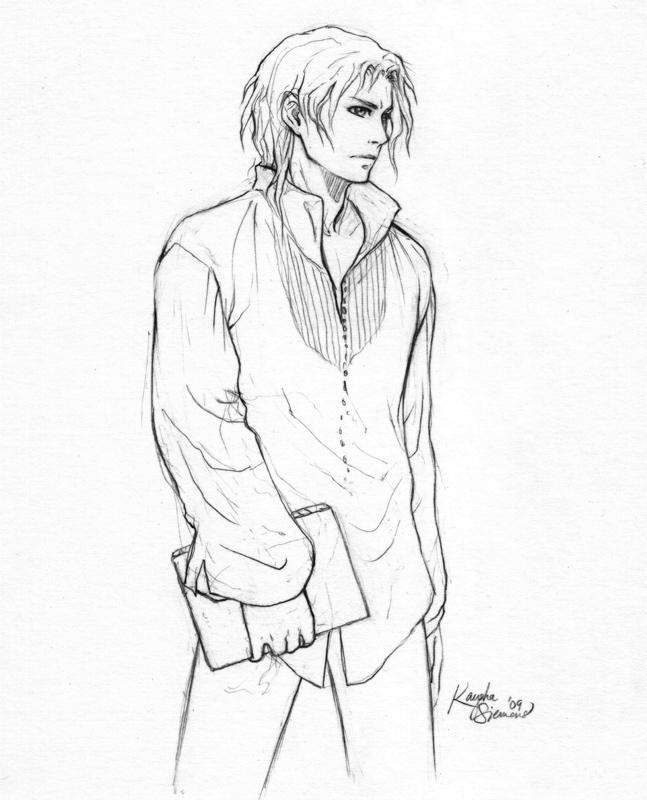
Meinrad for Kelley AWA 09_small“Meinrad,” by Kaysha Siemens.

A Taste of “Atterwald,” #1

This weekend is an exciting one for me: my first signing and public reading of Atterwald! I’ll be getting together with some of my fellow authors at Gilded Dragonfly Books, and in addition to my novel, we’ll also be selling and signing the anthology Finding Love’s Magic and C.C. Ansardi’s novel Shaman Woman. It all takes place at Cafe’ JAYA in Stone Mountain, GA, this Sunday, June 7, between 2:30 and 5:30 p.m.

What better time to share an excerpt from Atterwald, the first in a series. This one introduces Brendis, a young hal’ryth’kei (shape-shifter) in the throes of a first crush.

1824

Brendis had always loved to watch the owl-people parade into view at sunset, riding proud upon their deer. Lately, however, he had a special reason to stare. He laid his hoe down at his feet, licked his upper lip and frowned at the stinging salty taste of sweat. He looked up and out toward the rim of trees on the horizon. He held his breath at the clop of deer’s hooves….

The first owls emerged from the wood — silver-haired gentlemen in top hats and black, sharply tailored frock coats, nodding with regal condescension at the mouse-people at work in the field. Why they did that, Brendis could not say, for the mouse-folk paid no heed to the parade. Only he seemed to know the owls were even there.

More owl-folk appeared, all in neat frock-coats, all with slim, bolt-straight figures. A tiny part of him hated them and their beauty and aristocratic mien. He loathed finding himself transfixed by them.

His stomach spun as his special reason rode into view. Unlike the others, she wore a riding-suit of pale gray, with a white kerchief about her neck and a gauzy veil streaming down her back. But even without these odd color choices, she would have stood out from the rest. Some of them might wear their honey-gold hair in ringlets. Some of them might have skin like white rose-petals while others might boast soft oval faces with clear gray eyes, but all these beautiful features combined in her alone. Even they might have added up to nothing but for her smile, so wistful and pensive that he constantly wondered what she might be thinking.

Brendis had to think of the golden maiden by some name or other, so he invented one for her, Verina, the Glory of Her People. This satisfied him for now. To present himself to her and learn her true name would content him for good.

But his kind did not speak to hers. He remembered asking his mother just why this was. She had sniffed a non-answer. “Because it isn’t done. All we need to know about them is that they’re there.”

Brendis had vowed then and there never to ask his mother a serious question again. In the five years since, he’d kept that vow….

The leader of the parade, the tallest and proudest-looking of the silver-haired gentlemen mounted on a six-pointed stag, folded into himself. His shoulders shrank and his arms and limbs retracted, and suddenly, where a man had been a wide-winged gray owl hovered in mid-air.

On their leader’s signal the other owl-folk transformed. Brendis, his gaze locked on Verina, saw her melt into a ball of snowy bright feathers. She stretched her wings, and with the others she rose and soared over the jagged treetops.

Watching them disappear into the horizon, he heard his brother grumble, “Don’t see why you stare at the owls. They’re not doing anything remarkable, only changing shape.”

“It’s beautiful when they do it.”

“Why?”

“Because they take wing. Imagine what it’d be like to be bound to the ground one minute and then take to the sky the next.”

Arne responded with a grunt and a shake of his head.

Brendis turned his eyes from his brother to the deepening sunset sky. Where had she disappeared to? What might she be looking on right now? Sometimes, when he thought very hard about her, he could imagine himself flying with her, the wind under his toes. He could even catch the sharp green scent of the pines below.

Such fantasies were generally fleeting, but lately they’d been growing clearer, more intense, giving him hope of a time to come when he might linger long enough in the air to tell himself he wasn’t dreaming. In the sky with her was the place he most wished to be. Something strange growing inside him whispered he might find himself there yet.