Here’s the new book trailer for Atterwald, assembled and scored by my wonderful friends at Gilded Dragonfly Books!
My Cinderella Is Alive and Well
I come to my blog page today with happy news: a new short story publication! Gilded Dragonfly Books‘ anthology of romantic tales Finding Love’s Magic, set in the fictional small town of Cupid’s Bow, near Savannah, GA, is now available for purchase. Included is my story “Neighbor Haint,” which I adapted from my first ever play for the Atlanta Radio Theatre Company, “The House Across the Way.”
I mentioned in my earlier blog “Fairy Tales and Me” that “The House Across the Way” is my take on the Cinderella myth. You know the one — persecuted heroine breaks free of her abusive situation thanks to the appropriate application of magic and the love of a man a few rungs above her on the social ladder. Not long after I posted that blog, I got the commission to write a story for Finding Love’s Magic, and since “Nothing-at-All” and “Christmas Rose” had done well when adapted to prose, I set about transforming “The House Across the Way” into “Neighbor Haint.” In doing so, I revisited the Cinderella myth. There’s something about Cinderella that keeps us coming back, even if we suspect she may not be good for us.
We go back a long way, Cinderella and I. As a child I loved the 1950 Disney animated feature and the Rodgers and Hammerstein musical, and I even loved The Slipper and the Rose, the live-action musical with songs by the Sherman Brothers and with Richard Chamberlain (an early crush of mine) as the Prince. But it wasn’t until I was in graduate school at Auburn University and began to work on my dissertation that I really examined the story at close range. I chose to write about fairy-tale patterns in Victorian fiction, and my first chapter concerned three versions of the Cinderella story: Charles Perrault’s iconic “Cinderella” (Cendrillon), the Grimms’ “Aschenputtel,” and Charlotte Bronte’s Jane Eyre.
The Perrault story is the source for most film and stage adaptations, but I found that to my grown-up mind, it suffered by comparison with the Grimms’ version. Perrault’s story is all shiny slippers and beautiful gowns, while the Grimms go to dark places, with a heroine in mourning for her lost mother and two villainesses mutilating their feet to make them fit the golden shoe. But what struck me most was the difference in the heroine herself. In Perrault, that cute-as-a-button fairy godmother is the source of all the story’s magic, and she dresses Cinderella like a doll, with Cinderella herself contributing very little. Grimm’s Aschenputtel, however, engineers her own transformation from drudge to incognito princess, thanks to her spiritual connection with the spirit of her lost mother, embodied by the tree Aschenputtel planted on her grave. Perrault’s Cinderella has to leave the ball or risk being exposed as a commoner, while Grimm’s Aschenputtel chooses to leave. Aschenputtel is much more in control of her own fate. True, the ending is the same: rescue comes in the form of marriage to a prince. It’s tempting to judge the story harshly on these grounds alone, but to do so would be to forget that Aschenputtel is not a modern-day heroine with an abundance of choices open to her. She does her best with the options she has, and that may be why her story has such lasting appeal.
Most of today’s writers who take on the Cinderella myth like to play with it, to reshape it so that it falls more into line with contemporary ideas of what a heroine should be. This malleability is part of fairy tales’ staying power, and “sticking with the script” is not necessarily a virtue. The 2015 Kenneth Branagh film, though generally well reviewed, came in for some criticism because he chose to tell the story straight, in a faithful adaptation of the 1950 film, rather than looking for ways to tweak and twist. I have to admit I’m not in a rush to see the film, though I may catch it on Netflix. “Have courage and be kind,” the advice Cinderella receives from her dying mother (interestingly, this comes more from Grimm than from Perrault), is sound, but I wish some room could have been found for “Be clever.”
I may still value the fairy tale and even have a soft spot the classic Disney film (in which the heroine does have a personality, even a touch of humor), but the retellings I favor these days don’t play the story straight. I prefer the movie Ever After, in which the tough, bookish Cinderella rescues the Prince from a gang of thieves by hoisting him onto her shoulders; Marissa Meyer’s YA science fiction novel Cinder, in which Cinderella is a cyborg mechanic; and Gail Carson Levine’s Ella Enchanted, in which Ella’s inability to disobey her heartless family is the result of a stupid fairy’s “gift.” I’m also fond of the Native American version of Cinderella, in which truthfulness and insight, rather than beauty, lead to the heroine’s deliverance. In looking at our various Cinderellas, we should consider how and why they are rewarded. Need it be all about passive patience and gorgeous clothes?
“Neighbor Haint” is set in the mid-1800s. My Cinderella figure, Hope Caudle, is a smallpox survivor, but her vain mother, deeply ashamed of the girl’s scarred face, pretends before the community that Hope died of the disease. In true Cinderella fashion, Hope is used as a drudge by her mother and lazy sisters. She doesn’t try to escape, as she’s convinced her ravaged face will earn her the loathing of anyone she might meet in the outside world. But she manages to use two of her chores, cooking and quilting, as channels for self-expression. She keeps her imagination sharp as she seizes upon her few opportunities to read and watches, from her window, the house across the street (hence the title of the ARTC play). No magic comes to her aid. She doesn’t transform. Instead, her compassion for the son of the house, in the aftermath of his father’s death, may offer her the key to escape her prison.
I’m proud of my own contribution to Cinderella mythology, and I hope you will enjoy it.
From My Bookshelf: Musical Heroines
In my adolescence, I made two huge back-to-back mistakes. When I was twelve, I quit the piano, and when I was fifteen, I gave up the flute. At the time I could come up with ample reasons for both, but I will never fail to feel a pang of regret at what those decisions cost me. I can sing, and thus give voice to other people’s music. But when I gave up my instruments, I lost the means to find my own tunes.
That’s a big part of why I’m moved to write stories about heroines who are gifted musical instrumentalists. When I read the Russian folktale “The Tsaritsa Harpist,” I seized the chance to turn it into the ARTC play “Sarabande for a Condemned Man,” which I’m now in the admittedly slow process of turning into a novel. In Atterwald, Nichtel can weave magical visions through the music of her violin. In my prospective follow-up The Nightmare Lullaby, Meliroc discovers vital truths about the nature of life and love as she composes melodies on a xylophone-like graft from a magical carillon. Music and magic are strongly linked, as music taps into the listener’s soul in a way no other art form can quite manage.
I’m far from the only writer who has discovered this. I’m stepping in the large footprints of some very gifted story-smiths. Here are some of my favorite books which feature musical heroines:
1. Elizabeth Haydon, The Symphony of the Ages series: Rhapsody, Prophecy, Destiny
In a sequence from Prophecy, heroine Rhapsody seeks martial training from a warrior mentor, Oelendra. This mentor seizes Rhapsody’s lute and throws it on the fire, calling it a “distraction” from the vital work of learning swordplay. Neither exploding in rage nor letting her get away with it, Rhapsody explains in clear terms why music is essential to her being, her weapon of choice. For one of the few times in the fantasy genre, the master apologizes to her pupil. The series has its flaws, but this scene will always be special to me. (Fortunately the lute is not Rhapsody’s only instrument.)
2. Anne McCaffrey, The Harper Hall of Pern series: Dragonsong, Dragonsinger, Dragondrums
Intense, gifted, and regrettably unloved, young Menolly finds her only joy in music. After a time of struggle, her talent leads her to a new home where she can thrive and to a far better family than the one she was born into. Menolly is a gifted composer as well as instrumentalist, and McCaffrey provides us with plenty of examples of the lyrics she writes.
3. Allison Croggon, The Books of Pellinor series: The Naming, The Riddle, The Crow, The Singing
Young Maerad’s musical talent is merely the first sign of her immense power. Here, magical music is a means to heal the world, and despite obstacles the reader might think insurmountable, Maerad finds a way to make it.
4. Emma Bull, The War for the Oaks
This is one of the few works of contemporary fantasy that I actually enjoy, and for me its biggest selling point is its heroine, the unstoppable rock musician Eddi McCandry. Not a glitzy, overproduced puppet of image consultants, Eddi plays the guitar and composes her own songs. Her musical gifts prove crucial when she must take a stand against malevolent elves.
5. Rachel Hartman, Seraphina and Shadow Scale
A half-dragon caught in the middle as tensions between humans and shape-shifting dragons escalate in her home kingdom of Goredd, court musician Seraphina has her hands full. Yet even with the fate of two races riding on her shoulders, she still manages to find time to exercise her musical gifts. Like Menolly and Eddi, she is a composer, and in one beautiful sequence from Seraphina, she uses music to clear her vision and put her confused heart in order. (These two books may be the best pieces of YA fantasy fiction written this decade, for more reasons than this. Highly, highly recommended.)
6. Michelle West, The Broken Crown
This is only the first volume of The Sun Sword, a sprawling epic fantasy with a huge cast of characters, but in this one, the musical abilities of Diora, one of several heroines, are among the focus points. Diora lives in a country where women are denied any overt form of social or political power. Her magnificent voice and her skills as a harper are her only means of creative expression and self-assertion. Over the course of the novel, she slowly but surely comes to understand the power she can wield. I look forward to seeing where it takes her as the series goes on.
My Villainess Problem
D. B. Jackson’s acclaimed historical fantasy Thieftaker features a remarkable female character who challenges any and all notions of gender roles in the time and place in which she lives, 18th century Boston. She holds a position of authority. She’s good in a fight. She wears trousers. She owns her sexuality. She’s free from all romantic encumbrance. She’s the kind of woman I would want to take to my heart. There’s just one problem.
She’s the villain.
“Villain” is an abstract term, with different meanings for different people. Fictional villains — the interesting ones, at least — don’t perceive themselves as villains. In their eyes, they are heroes with ends which they must achieve at all costs. Sometimes the line between hero and villain can be difficult, if not impossible, to find, especially in the fantasy subgenre called “grimdark” these days. Nonetheless, here’s what separates the villain from the hero, for me: the villain is okay with the concept of “collateral damage,” and even thrives by it. Villains will injure or kill countless innocents without a shred of remorse if they think it will help them achieve their goals. Some villains bulldoze over innocents in the name of love, as Cersei Lannister’s twisted brand of maternal devotion leads her to commit atrocities (or at least wink at them) in George R. R. Martin’s popular A Song of Ice and Fire series. Others are sociopaths, incapable of any love but self-love; the trouser-wearing take-no-prisoners villainess of Thieftaker may fall into this category.
Plenty of readers, some of them friends of mine, adore female characters like these. Some female readers perceive them as empowering, since they are unafraid to seize power by any means necessary, and as they do so they strike terror in the hearts of the men unlucky enough to come into contact with them. I can see the appeal. Such women are fascinating in their unpredictability, in their willingness to break all rules, including the rules of common decency. Empathy and self-sacrifice, long considered crucial components of the Feminine Ideal, are missing from their make-up. Yet even though I may find villainesses intriguing and even entertaining to read about, I can’t find them empowering. After all, the villainess may be a terrifying force for a little while, but eventually, she has to lose the battle. And in so many stories, including the Thieftaker series, she must lose to a man in whom power/authority and common decency manage to co-exist. The Righteous Man must triumph over the Evil Woman if the world is to be saved or justice served; nascent notions of feminism must be squelched.
Villainesses are not an outgrowth of modern-day feminism. They are as old as the ancient world. In the oldest existing epic, Gilgamesh, the only important female presence is a wicked temptress of a goddess. In ancient Greece we find the likes of Medea and Clytemnestra. (The husband Clytemnestra kills sacrificed their daughter to the gods for a fair wind to sail to Troy, but we’re clearly supposed to be okay with that; her actions, not his, are presented as evil.) In the stories of King Arthur we have evil witches like Nimue and Morgan le Fay, whose contrast to the benevolent male sorcerer Merlin suggests that magic can only be a force for good if a man wields it. (This idea was once so deeply ingrained in the fantasy genre that even the feminist author Ursula K. LeGuin unconsciously made it a part of her original Earthsea Trilogy: “weak is women’s magic”/”wicked is women’s magic,” as the saying goes.) Shakespeare gives us Lady Macbeth. Dumas gives us Lady de Winter. William Makepeace Thackeray gives us Becky Sharp. Moving into the mid-twentieth century, C.S. Lewis gives us the White Witch and the Green Witch. All are clever. All are ambitious. All are evil. They are the forces from which the world must be saved — by men/boys, of course. (Becky Sharp offers an interesting exception in that she is not defeated by a male hero but is allowed… almost… sorta/kinda… to win, or at least evade justice.)
For centuries we’ve seen power and goodness written as incompatible in female characters. For a woman in times gone by, to be good was to be passive, mild, unambitious, selfless, nurturing. A good woman did not rise up to confront the villainess. Rather, her virtue showed itself in her willingness to rely on a man to solve the problem. Powerful men may protect, defend, and rescue. Powerful women could only destroy. I can’t quite manage to find any satisfying feminist underpinnings in this.
Today’s speculative fiction shows matters have improved considerably, though there is still plenty of progress to be made. Female characters on the side of Good no longer have to stand passively by and rely on men to save the day or the world. Plenty of excellent novels, many of which I’ve mentioned on this blog, show that female characters need not crush their moral compasses underfoot in order to be active, capable, and even powerful. Villainesses still have a role to play, perhaps now more than ever. But how enjoyable I find a villainess in the books I read today depends heavily on what the heroine is doing.
If we have a heroine who is as powerful and capable in her own decent way as the villainess, and indeed is the chief agent of the villainess’s downfall, then I can relish said villainess’s evil antics without the uncomfortable sense that I’m about to witness an “uppity woman being put in her place.” Examples: Elizabeth Bear’s Eternal Sky trilogy, starting with Range of Ghosts; Juliet Marillier’s Daughter of the Forest and Heart’s Blood; Sharon Shinn’s Twelve Houses series, starting with Mystic and Rider.
Likewise, if the heroine or heroines are part of a team, all of whom contribute substantially to the triumph of good, then I can sit back and enjoy the villainess doing what villainesses do. Quite a few episodes of the excellent (and sadly cancelled) animated series Justice League, Justice League Unlimited, and Young Justice offer examples of this.
If the heroine is only an occasionally useful sidekick to a male hero, I start to enjoy the Evil Woman a little less. If said heroine is a touch feisty but is nonetheless held up as a conventionally feminine contrast to the butt-kicking bitch on wheels, my enjoyment is diminished still further. Quite a few James Bond films fall into this latter category, most notably A View to a Kill.
If there is no heroine to speak of — if she’s little more than a love interest and plays no role in the villainess’s downfall, or if she has little more than a walk-on part, or if there is no female character on the side of Good at all — then I will most likely seek my entertainment elsewhere. (Examples: Orson Scott Card’s Pathfinder series; Myke Cole’s Shadow Ops series.) These may be very good books, and I don’t mean to encourage my readers to avoid them; my hang-ups are my own. But with Righteous Man vs. Evil Woman, I’m afraid I still can’t even.
Writing Characters as Human Beings Part II, or The Mistake of Self-Segregation
I have a number of blog sites I like to check frequently, one of which belongs to author and social commentator Foz Meadows. Her recent post “The Andrew Smith Thing” caught my attention, even though I hadn’t heard of Andrew Smith until I read that post. Apparently he is a successful and acclaimed author of YA fiction who’s interested in shedding light on male protagonists’ struggles with a number of confusing forces, including their sexuality. Nothing wrong with that at all, but his reasons for avoiding female protagonists and relegating female characters to the background strike right at the heart of my previous blog post, my response to Kate Elliott’s splendid “Writing Women Characters as Human Beings.”
(My fondness for Elliott’s essay tickles me a little, since so many of the characters I enjoy reading about, and writing about, are non-human.)
Smith can’t give female characters important roles in his fiction because, apparently, he has no interest in women — not so much in sexual terms as in any terms at all. He wasn’t close to any girls and women while he was growing up. (His mom must have been absent from his life or all but invisible in his household.) He never bothered to forge any friendships with girls or women. He has a daughter, he tells us, but about where this child’s mother is, or what role she does or doesn’t play in their lives, it’s probably best not to speculate. Even with his daughter now in her late teens, girls/women and their stories still don’t interest him, though he notes he’s “trying to do better.”
And this is sad. Whether you’re male or female, straight or gay, writing off half the human race as not worth learning about, let alone writing about, is nothing short of tragic. One of the biggest traps any writer (or any person at all) can fall into is self-segregation — when a man decides to befriend and associate only with other men, or a woman with other women, or a white person with other whites, or a black person with other blacks, and so forth. I remember a moment from back in my college days that helped move me to abandon the church I grew up in: one of the leaders of the denomination’s student group told me that my soul would suffer if I chose to hang out with non-Christians. She saw self-segregation as a religious imperative. All self-segregators make that choice in order to shield themselves from an “Other” they perceive as dangerous, or else too mysterious to be comprehended. “Get rid of the word of ‘them,'” Elliott advises us — and one root of the whole concept of “them” is self-segregation.
The slogan “It’s a (blank) thing; you wouldn’t understand” is meant to be funny. I find it frightening.
The best thing writers can do, the most beneficial to our work and to our souls, is open our hearts to all kinds of friendships with all kinds of people. I don’t mean making “token” friendships so we can feel good about not being sexist, racist, homophobic, etc. I mean taking an interest in people outside our own little group, talking to them, finding out what they love, learning who they are as individual people rather than as members of that perceived Other. The more interested we are in the people around us, the more interesting we and our work are likely to be.
I don’t say this because it’s easy for me. I’m an introvert by nature, inclined to drift into my own little world even when I’m surrounded by people. I’m all too aware of the temptation to self-segregate, though I do it based more on “nerditude” than on gender, race, religion, or sexual orientation. I will gravitate toward lovers of sci-fi and fantasy, the sort of people who go to events like DragonCon, before I’ll hang out with people whose driving interest is in sports or fashion. Yet might people whose interests and hobbies diverge from my own have something vital to teach me? One of the things I enjoy most about my “day job” as a Composition teacher is that my students are very diverse in terms of interests and skills, and I learn from the essays they write, even the ones full of grammar errors.
We should also avoid too much self-segregation in our reading, or in the stories we take in. One anecdote I heard on an evening news program a couple of decades ago burned itself into my brain. Two young African-American men, after seeing Steven Spielberg’s masterpiece Schindler’s List, started a conversation about the movie. One said to the other, “Why did we watch this? This isn’t our story.” His friend replied, “Pain is pain, isn’t it?” The first young man couldn’t see what relevance the story of thousands of Jews being saved from the gas chamber could have for him, since he wasn’t white, European, or Jewish. But the second young man, with an obviously more fertile imagination, could see across the divide of race and ethnicity and identify with the suffering undergone by the characters in that film. This young man understood. Books help build this understanding even better than movies, I think, since every time we open a book we have the unique opportunity to share the mind and soul of someone else. We can use that opportunity to get to know people we might never have the privilege of meeting in real life, people removed from us not only by “group identity” but by time and space. Speculative fiction, in particular, invites us into the minds of dragons, werewolves, elves, goblins, and all manner of aliens. We often find them surprisingly and delightfully “human.”
I can only improve as a person and a writer by paying more attention to those around me, regardless of whether they look and/or talk like me. When we self-segregate, we do a massive disservice to ourselves and our readers. Don’t we all deserve better?
From My Bookshelf: Female Characters Written as Human Beings
A few days ago, a friend on LibraryThing shared a blog that I loved so much I just have to share it, too. Kate Elliott, one of my favorite discoveries of the past two years, explains the art of Writing Women Characters as Human Beings. The rules she lays out are so simple and basic, so darned obvious the way she states them, that why so many authors (many of them female) choose not to follow them is truly a mystery. Of course she includes a section on the characterization mistakes we see entirely too often, and we’re made to wonder, why do we keep getting these, when it would be so easy to create something better? All those who follow my blog need to treat yourselves to a read of Elliott’s. She puts into clear, compelling words what I have been thinking and feeling for many a year.
Treat yourselves as well to a read of Elliott’s Spiritwalker Trilogy, starting with Cold Magic and continuing with Cold Fire and Cold Steel. I cannot recommend this series highly enough. Elliott follows her own rules in a brilliant melding of epic fantasy and Steampunk elements. She builds her world to include a compelling variety of cultures and races and a fascinatingly diverse set of characters, both human and non-human. The central protagonist, Catherine Barahal, is just my kind of heroine, with her sharp and curious scholarly mind and her brave spirit, and she interacts with many other women along her journey, being especially close to her cousin Bee (who is smart and charismatic enough perhaps to merit her own series one day).
Other recent reads of mine that get it right:
1) Elizabeth Bear’s Eternal Sky Trilogy (Range of Ghosts, Shattered Pillars, Steles of the Sky) forgoes the standard medieval-European model for epic fantasy and gives us instead a richly detailed world that evokes the Arabian Nights. In the first book we’re introduced to two protagonists, the dispossessed rightful heir Temur (male) and the powerful wizard Samarkar (female), but as the story progresses, the canvas broadens to develop a cast of female characters that includes a huge mutant tiger warrior, a misguided villainess, a devout female poet, a wizard healer, a (young) dowager Empress whose conscience and sense of responsibility steadily grow, and a formerly distressed damsel who has evolved by the third book into the leader of a supernatural army. (Temur’s loyal and beloved steed is also female, which I think is a cool touch.) All of them, even the villainess, are depicted with an intriguing measure of sympathy. All interact with other female characters. All play vital roles in driving the plot forward. Some of them are downright impressive, especially Samarkar, who has joined the ranks of my favorite female magic-users in fantasy fiction.
2) Michelle West’s The Broken Crown is the first in the epic Sun Sword series. I’ve only read this volume, and I’m eager to see what comes next. Two societies come into conflict, one strictly (even depressingly) patriarchal and the other more gender-egalitarian. Of course I root for the eventual triumph of the latter and take special joy in reading the chapters set there, in which a good number of interesting women fill a variety of roles. Yet even in the patriarchy we find women of courage and intelligence, women who are loyal to each other and find ways to exercise their powers despite their world’s unwillingness to allow them any authority or importance. While a male character is clearly being groomed for the role of a heroic savior who may bring peace between the two nations, the women drive this story.
3) Daniel O’Malley’s The Rook shows (as if we needed showing) that a talented writer need not be a woman to follow Elliott’s rules with skill and style. This is an urban fantasy, a genre I don’t usually favor, set in modern-day London, where people with special supernatural gifts work for a secret government agency responsible for neutralizing supernatural threats. The protagonist is an amnesiac woman, Myfanwy, who, with the aid of letters from her former self (who saw the amnesia coming), must uncover a threat from within the agency itself. Fortunately, she’s a smart, driven woman who has a brave, competent secretary, Ingrid, and a badass fellow mutant, Shantay, to help her. No love interest comes on the scene; all Myfanwy’s important relationships are with women. And women, both good and bad, are everywhere.
4) Tanya Huff’s The Silvered, like The Rook, features a female protagonist unsure of her power, who grows stronger by degrees as her story progresses. She is Mirian, a magic-school dropout who goes to the aid of a group of female mages captured by the enemies of her country, not because she’s best friends with any of them but because she knows it’s the right thing to do. Even though she falls in love, she never loses sight of her mission, and that mission, coupled with her discovery of her steadily growing power, drives the plot far more than does the romance. Meanwhile, the kidnapped mages never stop looking for ways to weaken their enemies and free themselves, and they help and support one another throughout. Here is a book with multiple heroines, all active and resourceful.
Toward the end of her blog, Elliott hits us with the most important rule of all for writing women characters (or any characters) as human beings: “Get rid of the word of ‘them,’ the very idea of an Unknowable Other with a Mysterious Psychology.” All writers of fiction would do well to heed this invaluable advice. It works darn well in regular ol’ real life, too.
So, I Want to Write Feminist Fiction…
Online discussions about fantasy literature, particularly those discussions that center on female characters, are my dearest friend and bitterest enemy — my friend, because they bring up ideas I can use in my own writing and point me toward books I might like to read, and my enemy, because they end up eating a lot of time I might spend actually writing and reading. I have to tell myself forcibly, “Enough! You have to get that turning-point scene knocked out, and Joan D. Vinge’s Summer Queen awaits your return.”
And now, with my own blog, I’m adding to the pool.
A post on LibraryThing led me to Rhiannon Thomas’s blog Feminist Fiction, which I’ve enjoyed exploring, as I agree with most of Thomas’s insights, and even those I disagree with make me think. I share here her most recent post, as it has made me ponder the way we work as writers, and how and why we’re moved to tell our stories in certain ways. As she points out, we absorb biases without realizing it, and unconsciously replicate them in the fiction we write. As a result, those biases are perpetuated, and if we want to write/read something different, we have to battle them, consciously and unconsciously, on a daily basis. “A lack of female characters can feel truthful in fantasy fiction,” writes Thomas, “because that’s how fantasy fiction usually is.”
I’ve never had to fight the impulse to leave female characters out of my own fantasy fiction, because I’ve always noticed and felt frustrated when they’re not there. I may have loved The Hobbit and The Lord of the Rings, but as a general rule, fantasy fiction in which women play only small or stereotypical roles just doesn’t interest me. If I don’t read it, why would I write it? Yet when I read Thomas’s post, I’m naturally moved to wonder what my own biases might be, and what role they might play in my stories. Is Atterwald feminist enough? If I were writing it today, what might I do differently?
I wrote Nichtel, my heroine, to be creative and resourceful. Even when she finds herself in a situation beyond her control, she finds ways to seize as much control as she can. My novel passes the Bechdel Test, thanks to the early chapters in which Nichtel is educated and influenced by her foster mother, the medicine-maker Ricarda; they have a number of conversations that do not center on men, and I wrote this before I even knew what the Bechdel Test was. Yet I wish sometimes that I could have found room in my story to give Nichtel a female friend her own age, perhaps a servant in Baltasar’s household. I wonder what she might have been like.
Thomas has a separate post in which she takes YA writers to task for writing their female protagonists as superior people specifically because they are “not like other girls.” I agree with her, and can maybe let myself off the hook for this one, since Nichtel isn’t “not like other girls”; she is not like other were-rats. She is misjudged and underestimated because of her Tribe, not her gender. I set out to write a story with a female protagonist in which gender-essentialist presumptions would not be a major obstacle she must overcome. I sought to give her a different battle to fight. Some readers may find this choice agreeably feminist. Others may be disappointed that I ignore the gender biases my readers face in the real world every day.
There is more than one way to write feminist fiction. When you know you can’t please everyone, you have to please yourself first.
That’s the tricky part. Of course, we as writers must give life to the stories that spring up in our own minds and hearts, which is why one of the key points in criticism is, “Allow the author her subject.” At the same time, we should be aware of the ideas we’re putting out there. It doesn’t hurt us to take the occasional look inside ourselves and consider whether the furniture of our imaginations could do with a little dusting.
Thomas’s post brings up the problem of representations of race in fantasy fiction, and there I know I could do a better job than I have previously done. I’ve been influenced by the traditional notions of fantasy worlds as white-European, as well as the images of classic Hollywood. When Nichtel first took shape in my imagination, she had the face and coloring of a young Jean Simmons, raven-haired and pale-skinned. I chose German-sounding names for her and the other characters, and the Atterwald itself came into my head as one of the misty, haunted pine-forests of Germany. Does this make my story reactionary and racist? Of course not. But I could, perhaps, question why, when I create characters, my imagination should default to white, as so many writers’ imaginations default to male.
Could I — should I — create a non-white heroine? Have I been holding myself back in fear of “getting it wrong,” of being held up to harsher scrutiny than if I stuck with a white female lead? Would I need to construct a particular world my non-white heroine could inhabit, or could I do with race as I’ve tried to do with gender and make it a “non-issue”? Which course would be the best representation? Kate Elliott does a magnificent job with creating a multi-racial, multi-ethnic society for her Spiritwalker Trilogy. How might I create something similar?
I have a friend who attends church with me. Her name is Grace, and the name is perfect for her, as I have rarely seen anyone more graceful or gracious than she, with an elegance that goes past the surface and straight to the heart. She is from Uganda. She is statuesque and sturdily built, with a warm smile and eyes that shine with wisdom, intelligence, and strength. She is the very image of the sort of heroine who would capture my imagination and find a home in one of my stories. She could be a rescuer, a dreamer, an innovator, all the things I like a heroine to be. Why should I leave it to some other writer to bring her to life?
Perhaps the most vital of all Thomas’s points: “All writers are at risk of screwing up. And all writers should take that risk anyway.” Yes, I want to write feminist fiction. But no one can write feminist fiction, or any good fiction at all, if she’s too scared.
From My Bookshelf: Male/Female Friendships
“We’re to be friends, you and I.” So Pierpon, a nightmare pixie punished with corporeal form for not being frightening enough, tells Meliroc, an albino giantess geas-bound into servitude to a succession of sorcerer masters. In the opening chapter of The Nightmare Lullaby, my forthcoming follow-up to Atterwald, she rescues him from freezing to death in a snow-bank, and thereafter they become inseparable. Each is a bright spot in the other’s life; while she teaches him to love music, he opens her eyes to her own capacity for goodness. She falls in love with another character later in the story, but her friendship with Pierpon remains a vital element, just as crucial to her progress as the romance, if not more so. He is, as she says, “like foot or hand or eye… as agonizing to lose.”
The bond between tiny Pierpon and towering Meliroc is my effort to create something I always love to see, and don’t see nearly enough of, in fantasy fiction, or any kind of fiction for that matter: a genuine friendship between a male and a female character. Story after story seems bent on confirming Harry Burns’ (When Harry Met Sally) hypothesis that men and women can’t really be friends without “the sex part” getting in the way; men and women are shown as unable to relate to or interact with each other in any way other than sexually or romantically. Healthy relationships between fathers and daughters or brothers and sisters tend to be scarce. (Oddly enough, mother/son relationships turn up a bit more often, perhaps because so many stories are written by male authors who honor their mamas.) “Friendships” between unrelated male and female characters tend to be written as the first step on the road to romance, or suppressed sexual desire, or the unrequited-love relationship commonly called “friend-zoning” these days. With Meliroc/Pierpon, as well as with the bond Nichtel manages to forge with the stoic gardener Ailbe in Atterwald, I wanted to challenge the notion that male and female characters can be important to each other in only one way. Naturally I seek out other stories that present a similar challenge.
One of the best novels I’ve had the pleasure of reading on my Kindle in the two years I’ve owned it is Ben S. Dobson’s Scriber, which tells the story of a male protagonist on the verge of a crucial historical/magical discovery. He is protected by a troop of female soldiers, a refreshingly varied lot. Of course he eventually falls in love with one of them, but she’s not the only one who matters to him. The two relationships he forges that stand out as most important have no romantic aspect at all. One of the soldiers has a scholarly bent and would love to be a Scriber like the hero (who in the fullness of time does earn that term), and he takes it upon himself to mentor her. Another, the leader of the troop and the book’s female lead, starts out as a thorn in his side, but over the course of the story, she becomes his hero. Indeed, he learns the true meaning of heroism from her.
I’ve mentioned Barbara Hambly’s The Ladies of Mandrigyn in previous blogs because its heroine, Starhawk, is one of my favorite characters. Her “friendship” with her commander, Sun Wolf, is indeed the first step on the road to romance, but it is through an actual friendship with another woman, Sheera, that Sun Wolf realizes what Starhawk really means to him. At the book’s outset, Sun Wolf is much less sympathetic than Starhawk. In fact, he’s a bit of a jerk. But when he’s shanghaied by Sheera into training her and her fellow townswomen in the art of combat, so they may defend themselves against an invading army while their men are away, he’s wrenched out of his comfort zone. That, of course, is when he learns. A less interesting novel would have shown Sun Wolf and Sheera falling in love. Instead, as Sun Wolf comes to like and respect Sheera and her friends, he becomes the kind of man his real love, Starhawk, deserves.
Juliet Marillier’s most recent book, Dreamer’s Pool, tells the story of Blackthorn, a gifted healer embittered by brutal treatment at the hands of a powerful man. She’d rather go it completely alone, but in exchange for breaking her out of her unjust imprisonment, a fey exacts a promise from her that she will never refuse a cry for help. The first such cry she hears is from a fellow escapee, Grim, and the help he wants is her friendship. She accepts him grudgingly at first, but in time she comes to value his loyalty and his rough-hewn kindness, and eventually she sees him as indispensable. He can see her goodness when she herself is blind to it. Through him, she finds new faith in herself and in people in general. Theirs is a strong friendship that needs no romantic element to make it incredibly touching.
A few other stories I’ve enjoyed, in which a friendship between a male and female character plays a prominent role, include J.K. Rowling’s Harry Potter series, Lou Anders’ Frostborn, Max Gladstone’s Three Parts Dead, Robin Hobb’s Dragon Keeper and Dragon Haven, Anne McCaffrey’s Harper Hall of Pern series, Mark Anthony’s Beyond the Pale, and Neil Gaiman’s The Ocean at the End of the Lane.
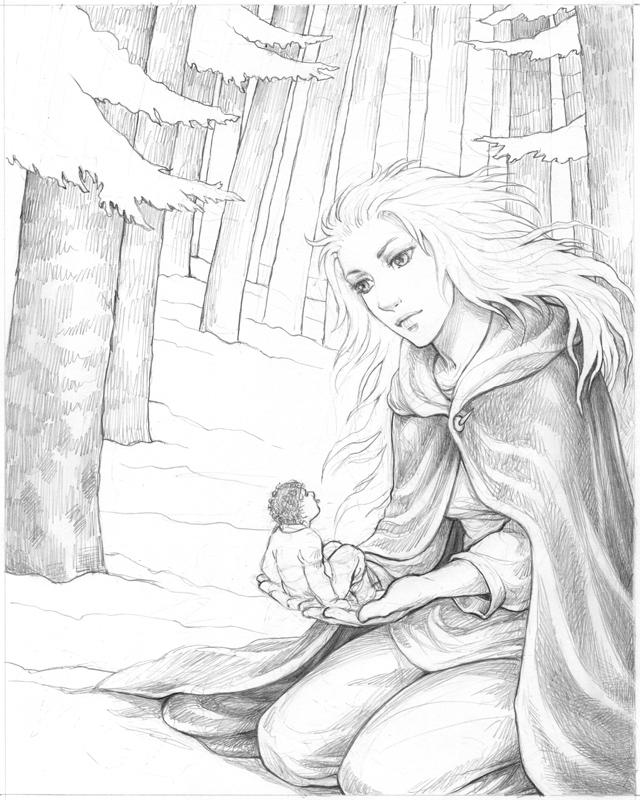
“Meliroc and Pierpon,” art by Kaysha Siemens
My “Atterwald” playlist
The three things that make my world spin — books, movies, and music — are strongly intertwined. When I write, I visualize the scene as a movie, with my favorite actors or animation styles, and when I listen to music, it merges with the stories in my head. Everything from Broadway standards to classic jazz to ’70s and ’80s pop is re-purposed (often very illogically) into a soundtrack for whichever story happens to hold my imagination captive at the moment.
I write my stories out long-hand before I word-process them onto my laptop. I’m not sure why, but I can’t compose my best material at the computer keyboard; I think and work much better with a pen in my hand. When I’m typing a chapter I’ve finished drafting long-hand, I play music, specifically movie scores. I draw these scores into my own creative world, imagining the themes accompanying the story that spreads out before my eyes on the computer screen. Here are some of my favorites:
1) Erich Wolfgang Korngold: The Warner Brothers Years, which includes excerpts from Korngold’s classic scores from 1938’s The Adventures of Robin Hood, 1940’s The Sea Hawk, 1942’s King’s Row, 1943’s The Constant Nymph, and many gorgeous others;
2) Ben Hur: The Essential Miklos Rosza, which features stirring themes from 1956’s Quo Vadis, 1945’s Spellbound, and 1961’s El Cid;
3) Bernard Herrmann’s appropriately haunting, evocative score for 1947’s The Ghost and Mrs. Muir;
4) Various scores by Thomas Newman, including Little Women, Fried Green Tomatoes, The Green Mile, and Cinderella Man;
5) Elmer Bernstein’s To Kill a Mockingbird, quite possibly the finest score in cinema history.
Music like this helps move me into my “creative zone,” no matter the story I’m working on. But each story has its own special songs, with lyrics that come close to what I hope to capture in the characters and their relationships. Each of the major characters in Atterwald, my YA fantasy romance now available from CreateSpace and Amazon.com, has a song I consider his/her own.
Nichtel’s song is “I Stand,” by Idina Menzel from her album of the same name. The sharp, intense optimism in the lyrics might fit many of my heroines, but since Nichtel is a shape-shifter, the first lines of the chorus may be taken literally as well as figuratively. Though the lyrics are hopeful, the melody has an edge to it, which works with Nichtel as well. Hers is the hope of someone convinced she will die young.
Simon and Garfunkel’s classic “I Am a Rock” makes a perfect anthem for Baltasar, the sorcerer who has sought to make himself impervious to pain. This ode to alienation ends on a soft, doubtful note, as if the singer has not quite managed to convince himself of the truth of his words. Likewise, Baltasar is loath to admit that his efforts to shield himself may in fact have failed. (Baltasar may be my favorite character in the book. If he resonates with readers, much of the credit is due to Bill Ritch of the Atlanta Radio Theatre Company, my “book doctor.” The first draft of Atterwald was written almost entirely from Nichtel’s point of view. After Bill read it, I asked him what the story needed, and he told me, “A lot more Baltasar.” He convinced me to develop my villain’s backstory and spend more time in his head. In the end I found myself sympathizing with him as much as with my hero and heroine.)
Meinrad’s song is a Broadway love ballad, “Unusual Way” from the musical Nine, specifically the rendition given by Brian d’Arcy James on The Maury Yeston Songbook. Not all the lyrics fit the situation precisely, of course, but where Meinrad leaps out from the song at me is the bridge, where the singer expresses terror at the love he feels. Meinrad is falling inexorably in love with the girl who is working to heal him, while at the same time believing quite firmly that her efforts will prove vain. He doesn’t know what to do with all these weird feelings and isn’t sure he quite likes them. Nonetheless, by the end of the song, the singer has come to the conclusion that he wouldn’t have it any other way. To see how this might happen to Meinrad, readers must venture into the book.
Now available in paperback!
My novel Atterwald is now available in paperback! This represents the culmination of decades of hard work and fervent hope… and it’s just the beginning.
 Nan Monroe