From my bookshelf: warrior heroines

One thing I have yet to do, that I would very much like to do before much longer in my career, is create a warrior heroine, a powerful, capable fighter who does not flinch in combat situations and is far more likely to rescue others from mortal peril than to be rescued herself. The reasons why I haven’t tried my hand at such a heroine already are twofold. First, I don’t know enough about fighting and combat techniques to give realistic detail about such a character. This problem I could (and intend to) solve with a little research. The second reason is a bit harder to work around: while I may have a vague idea of the warrior heroine I would like to create, I don’t yet have a plot in which to put her. To write about a warrior heroine, I would have to write about war, and right now I don’t have a war story strong in my head.

Warrior heroines have been getting a rough time lately, I’ve noticed. Critics and reviewers tend to be hard on them. They claim there are too many of them in the fantasy genre, so many that they supposedly drive other kinds of heroines underground and leave us with the general impression that the only way for female characters to be capable and impressive is to “act like men.” What does that even mean? Warrior heroines get accused of being “men with boobs.” I used to think this criticism held some validity, but now I’m ready to call BS on it. It smacks of what I’ve heard called “gender essentialism,” the idea that certain characteristics are essentially masculine or feminine and are shared, to varying degrees, by all men or all women. This concept goes against my grain of individualism, and it compromises writers’ efforts to create the kinds of individualist characters (male as well as female) that I love reading about. I may not have much of the warrior in me — when conflict rears its head, I’m more inclined to look for a table to hide under — yet I delight in stories of women who thrive in that role.

The operative word in my title is heroines. I like my warrior women to be good, or at least have something resembling a working moral compass, a line they won’t cross. Lately I’ve run across certain fantasy novels and series that present female warriors as creatures to be dreaded and/or despised. They’re not always, or necessarily, bad books. Late last year I read a very engaging middle-grade fantasy adventure, Lou Anders’ Frostborn, which I liked in almost every way, except that its villains include a race/nation of statuesque Amazons who fly into battle mounted on wyverns and who are determined to make life as miserable as possible for the story’s heroine, Thianna. (I may have to give this one a pass, though, since Thianna herself, who is half frost-giant, stands poised to become a formidable warrior heroine herself as she grows up.) The first two volumes of Brandon Sanderson’s The Stormlight Archive also gave me much pleasure, except for the fact that while the society our heroes fight for has very strict gender roles, while their enemies in war — who may not be evil, but who nonetheless are out to destroy our heroes — have both male and female soldiers in their ranks.* In John Gwynne’s old-fashioned epic fantasy adventure Malice, one of the sympathetic soldier heroes suspects that an army of allies is not to be trusted due to the “unnatural” presence of women in their ranks. One young woman on the side of Good does try, bless her heart, to be a warrior, and does have a rudimentary skill or two, but alas, she’s an incompetent screw-up, and as a reader I’m left with the impression that her failures are the very things that make her acceptable as a heroine. If she could actually hold her own in a fight, she’d be too scary.

Would an otherwise talented fantasy creator really feel moved to make a heroine less competent in order to make her more likable? Well, it’s happened before. When the late TV producer Glen A. Larson took creative control of the sci-fi adventure Buck Rodgers in the 25th Century, he decided that the tough fighter Col. Wilma Deering wasn’t appealing enough. He “solved” the problem by transforming her into a glorified flight attendant. That’s why I want to write my own warrior heroine — to do my own small part to avenge Wilma Deering, and other fighting heroines who may find themselves “chickified” as their writers reduce their abilities in order to make them more “relatable.”

When I read books that cast warrior women in a negative or unsympathetic light, it helps me to remember the courage and confidence of my favorite fighting heroines. Here are a few I’ve loved getting to know: Starhawk in The Ladies of Mandrigyn et. seq.; Sulien in Jo Walton’s The King’s Peace; Dhulyn Wolfshead in Violette Malan’s sadly underrated Dhulyn and Parno series, starting with The Sleeping God; the towering Bryndine Errynson and her fearless troupe of female soldiers in Ben S. Dobson’s also criminally underrated Scriber; romantic sword-wielder Meguet in Patricia McKillip’s The Sorceress and the Cygnet and The Cygnet and the Firebird; Harry in Robin McKinley’s The Blue Sword and Aerin in her The Hero and the Crown; and Kerowyn in Mercdes Lackey’s By the Sword. Far from thinking there are too many warrior heroines in fantasy fiction, I believe we could always do with a few more women like these. They aren’t “men with boobs.” They are themselves.

*I may have issues with the depiction of female fighters in The Stormlight Archive as enemies/villains, but I have to give Mr. Sanderson his due, since he is one of today’s male fantasy writers whom I like a great deal. First, his Mistborn series does center on a warrior heroine. Also, Words of Radiance, the second volume in The Stormlight Archive, does include one of the most gratifyingly feminist statements I have ever read in fantasy fiction: “I say there is no role for women — there is, instead, a role for each woman, and she must make it for herself. . . A woman’s strength should not be in her role, whatever she chooses it to be, but in the power to choose that role” (772) Granted, this does come from the point of view of one of his characters, but if Sanderson himself really feels this way, he definitely belongs in my pantheon of heroes. Sanderson, Brandon. Words of Radiance: Book Two of The Stormlight Archive. NY: Tor, 2014.

In YA: boys, girls, and adventure vs. romance

Publishing follows trends, and the trend in current YA fantasy seems to be toward a blue and pink division, adventures “for boys” (about 40%) and romances “for girls” (about 60%).

Boys get books like John Flanagan’s Ranger’s Apprentice series, Joseph Delaney’s The Last Apprentice series, and James Dashner’s Maze Runner series, in which the emphasis is on a young male protagonist coming into his power, finding his courage, or both. Romance is minimal, if it is present at all. Female characters may show up, but they’re often irrelevant (with very little page time) or untrustworthy (with readers, along with other characters, questioning their allegiance from one chapter to the next). Girl readers may enjoy these books, but because they appreciate the adventure and the strength of the male protagonist, not so much because they admire or identify with the questionable female characters. The writers of these books certainly don’t mind girls reading them, but they mainly have a male audience in mind.

Thanks to the unstoppable juggernaut of popularity that is Twilight, girls get its innumerable knock-offs, stories of ordinary high school girls falling for mysterious, brooding bad boys (e.g. Hush, Hush, Tiger’s Curse, Fallen, Halo, Evermore…). The heroines of these books don’t have an adventurous bone in their bodies, except when it comes to attaching themselves to dangerous, powerful guys. Not all female protagonists in current YA are quite so wimpy; take the girl out of the contemporary high school setting, and she may rise to an adventurous occasion, as in Suzanne Collins’ The Hunger Games series, Kristin Cashore’s Graceling, Marissa Meyer’s Cinder, Alison Croggon’s wonderful Books of Pellinor, and Laini Taylor’s excellent Daughter of Smoke and Bone. But all these books include romance as a crucial factor. It’s not uncommon for writers to force even the toughest and most independent female protagonists into a love triangle, so that their journey towards self-discovery is tied to their realization of which of two “hot guys” they belong with. Boys are central to these girls’ stories, while girls are more peripheral in the boys’ stories. Yet it is far more common to see a girl reading Ranger’s Apprentice than to see a boy reading Twilight.

What I long to see are more YA fantasy tales with cross-gender appeal, in which adventure and romance may coexist happily and both male and female characters are interesting, believable individuals with vital and sympathetic roles to play. I love the Harry Potter series and its title protagonist, but it’s Hermione Granger, that wonderful magical nerd, that first drew me to the series and has held my heart ever since. Hermione’s allegiance is never for one moment in doubt; she is a trustworthy and resourceful ally. Even when she ventures into damsel-in-distress territory in Harry Potter and the Chamber of Secrets, spending the last third of the book petrified by the basilisk, she provides Harry and Ron with the answers they need to defeat the monster. In the next book, Harry Potter and the Prisoner of Azkaban, Ron is the one taken out of commission, while Hermione fights at Harry’s side. The Harry/Hermione friendship shows that boys and girls don’t have to fall in love in order to be important to each other. Romance is introduced in the later books, but it never overwhelms the fight or diminishes the agency of the characters involved.  Other series in this mold, with male and female characters sharing the adventure, include Rick Riordan’s Percy Jackson series, Jonathan Stroud’s Bartimaeus Trilogy, and Eoin Colfer’s Artemis Fowl books. All the books have well-developed heroes of both genders — yet in all these stories, the central character is male. Publishers and writers still hold to the notion that boys aren’t likely to read a book with a female lead, however rollicking an adventure it might be.

I love a good romance. After all, I write YA romance fantasy and am very proud of it. But as a reader I catch myself wondering, do all female protagonists in YA fantasy have to fall in love? The genre does include a good many female-led adventure stories, including the aforementioned Graceling and Books of Pellinor, Robin McKinley’s The Hero and the Crown, Gail Carson Levine’s The Two Princesses of Bamarre and her fairy-tale adaptations Ella Enchanted and Fairest, and, of course, Tamora Pierce’s series involving Alanna the Lioness, her daughter Aly, Daine the practitioner of wild magic, Beka the Terrier, and Keladry the Protector of the Small. These are wonderful characters in wonderful stories, the sorts of girls I would have loved to read about as a teen and love to read about now. They are the saviors rather than the saved. Yet I do believe that Keladry is the only heroine of this set who doesn’t end up in love and/or married by the story’s end. If a YA hero can manage to get through a series of adventures without falling in love, why can’t a YA heroine?

I don’t have an answer. But perhaps, before my own writing days are done, I will manage to cool my romantic heart long enough to send a heroine on an adventure in which she finds her strength and courage as well as loyal friends but doesn’t find romance. It’s on my bucket list.

From my bookshelf: Gifts from Down Under

The website Fantasy Cafe gives me something to look forward to when April rolls around: the “Women in SF & F” series, in which female authors and bloggers discuss the work they’re doing in the science fiction and fantasy genres, along with the problems that women still face as both creators and fans of the genres This month, as part of a year-in-review assessment, the website re-posted a blog from 2014’s “Women in SF & F” by Trudi Canavan, author of The Black Magician Trilogy, the Age of the Five series, and Thief’s Magic.

I’ve read and liked some of Canavan’s work, so naturally her blog would catch my eye. But it held my attention first because she echoes frustration that I have felt when I’ve browsed lists on Goodreads with headings like “Best ‘Strong Female’ Fantasy Novels,” “Kick-Butt Heroines,” and “Best Fantasy Books With Strong Women Characters,” only to find these lists overwhelmingly dominated by works of urban and contemporary fantasy. Nothing is wrong with urban fantasy in or of itself. What rouses my objection is the perception on the part of some writers, fans, and publishers that urban fantasy is (or should be) a playground for women authors, characters, and readers, while epic or alternate-world fantasy is (or should be) men’s territory, full of male authors telling men’s stories. When I read for pleasure. I seek out books that feature women doing awesome things. But while I may read and end up loving the occasional UF book (e.g. Daniel O’Malley’s The Rook, a book so much fun it deserves a blog of its own), the urban fantasy genre as a whole just doesn’t interest me. Like Canavan, I much prefer to read (and write) alternate-world fantasy, and finding well-written and engaging alternate-world fantasy in which female characters take leading roles can be a bit challenging.

Challenging, but not impossible. Canavan’s blog is not an exercise in banging the head against a stone wall of dissatisfaction. She offers guidance for readers who share our tastes. Some of the best female fantasy novelists come, like her, from Australia, where they haven’t absorbed the notion that alternate-world fantasy should be for and about men while women should content themselves with urban fantasy. I was pleased to spot on her list some authors whose works I’ve greatly enjoyed and can recommend.

1) Alison Croggon — Her Books of Pellinor series, beginning with The Naming, places a gifted girl, Maerad, in a role normally reserved for boys: the questing hero of great potential, around whom the winds of prophecy swirl. Adding to my delight in her story was her musical talent, since, as those who read Atterwald will discover, I have a soft spot for stories about female musicians. A girl/woman in the role of Bard! More, please.

2) Jennifer Fallon — I’ve read The Gods of Amyrantha, The Immortal Prince, and The Palace of Impossible Dreams. (I still need to read the concluding volume, The Chaos Crystal.) Normally I don’t care for “magical guy/ mundane girl” romantic plots and subplots, but in this case the “mundane” heroine is a scholar, a nerd. When I’m reading for pleasure, if I like the heroine, I’ll like the book, and I like Arkady Desean. I look forward to exploring Fallon’s work further, in Wolfblade and The Harshini Trilogy.

3) Kate Forsyth — I discovered her about a year and a half ago, with the Rhiannon’s Ride series, an adventure with several intriguing heroines in its cast of characters. But while those books offered abundant fun, I discovered this year that they offered a mere hint of Forsyth’s capabilities. She is responsible for two of the most moving and thought-provoking reads I enjoyed this past year: Bitter Greens, a retelling of Rapunzel that also tells the story of the remarkable French fairytale author Charlotte-Rose de la Force; and The Wild Girl, the story of Dortchen Wild, neighbor and eventual wife of Wilhelm Grimm, who contributed some of the best tales to his and his brother’s famous collection. Anyone with an interest in fairy tales should read these splendid books.

4) Glenda Larke — So far I have only read one of her works, but that one, The Aware, is a rollicking piece of world-building with a funny, unpredictable, charismatic heroine. Blaze Halfbreed is big, brave, and capable, a formidable force. What would I love to see more of in alternate-world fantasy? More ladies like Blaze Halfbreed.

5) Juliet Marillier — I fell wholeheartedly in love with my first Marillier book, Wolfskin, and that love remained strong through the original Sevenwaters Trilogy (Daughter of the Forest, Son of the Shadows, Child of the Prophecy). I wasn’t quite as taken with The Bridei Chronicles or with the more recent Sevenwaters books (Heir to Sevenwaters, Seer of Sevenwaters), but still, the detailed world-building, the mystical lyricism of style, and the creative, tenacious heroines that populate her books ensure Marillier a continued place among my favorite authors. A new Marillier book is always cause for rejoicing. I can’t wait to read Dreamer’s Pool.

Thank you, ladies of Australia, for not drinking that poisonous Kool-Aid that would convince you that alternate-world fantasy is for men and urban fantasy is for women. You have provided me with a great deal of pleasure.


A Reader’s Perspective: Things YA Writers Should Know — Part 1

Some social critics would say a woman my age should be ashamed to read YA Fantasy. Nuts to them. I read my share of YA Fantasy for three reasons. The first is practical: I read it because I write it, and it helps me to know what other authors in the field are up to. The second is that coming-of-age stories interest me; if told well, self-discovery tales are incredibly potent and easy to relate to, for readers of any age. After all, do we ever stop discovering bits and pieces of ourselves? Are we ever really “finished”? And finally, a well-written YA fantasy adventure is just plain fun to read. One of the authors on a panel at DragonCon pointed out that the difference between adult and YA fantasy can be summed up in a single word: “Hope.”

Yet as I both read and read about YA fantasy, I’ve developed certain preferences, things I would like to see more of, and conversely, less of. I have my own list of things I’d like YA writers (including myself) to know and bear in mind.

1) It’s okay for your heroine to have talents, interests, and ambitions.

When I’m browsing on Goodreads and I click on a book title, only to see the heroine described as “typical” or “ordinary,” my first thought is to pass it by. Maybe it’s not a bad book, and certainly plenty of readers appreciate the blank-slate heroine through whom any and every teenage girl can live vicariously — but it’s just not for me. I gravitate toward heroines like the titular Cinder and Seraphina, a top-notch mechanic and a gifted musician respectively, and the female lead in Daughter of Smoke and Bone, a brilliant and ambitious artist. These are heroines I can enjoy looking up to, even as old as I am.

2) It’s okay to let the reader know what the heroine looks like.

I just finished a popular YA fantasy romance, Robin LaFevers’ Grave Mercy. This book has much to recommend it; for one thing, LaFevers knows Element 1) and shows her heroine to be quite capable in her field — assassination. (I appreciate that this book delves into the ethics of being a skilled assassin.) However, while the novel’s hero is described in handsome detail, I came away with only the sketchiest idea of what the heroine looks like. I think she has dark hair, but I’m not quite sure. LaFevers isn’t the only writer of YA fantasy to be rather sparing in physical descriptions of the heroine. Again, perhaps this is done so that the widest variety of readers possible can dream themselves into her shoes. Maybe this paucity of description doesn’t appeal to me because I’m outside the target demographic, but I’m pretty sure that even as a teenager I liked knowing that Jo March was a coltish brunette and that Anne Shirley was a gray-eyed redhead. I actually find it easier to connect with a character if I can see her in my mind’s eye. I don’t need, or want, every heroine to look like me.

Coming Soon: Part 2

The Blooming of “Christmas Rose”

The Blooming of “Christmas Rose”

“Christmas is for children,” Mel Torme tells us in song. Certainly the vast majority of holiday-themed pop culture is heavily kid-centric. Stories of Santa Claus and the magic he brings to children abound, the 1947 classic Miracle on 34th Street being the best- known (and the best); and who could forget all those do-or-die Christmas wishes, like little Ralphie’s longing for a Red Ryder BB gun? Adults’ role in these stories is to support their children and/or to rediscover their own faith with their children as a mirror of their former, innocent selves. Childless adults usually don’t enter these stories at all, except as villains.

No one would ever (I hope) begrudge children the fun and excitement of Christmas, but since childhood is such a small fraction of a normal, healthy lifespan, I can’t help wondering sometimes: how and when might adults, particularly those without children, claim a share of the holiday bliss?

It’s easy to forget, in the midst of all the kid-directed Christmas entertainment, that the most famous Christmas story since the Nativity itself, Charles Dickens’ “A Christmas Carol,” centers on an elderly, childless bachelor. Even readers who don’t generally care for Dickens often like this story, as well they should, for Ebenezer Scrooge is a superbly drawn protagonist. He’s thoroughly unlikable and anti-social when we first meet him, but Dickens paints him in such a way that he catches and holds our interest, and we root for his redemption rather than for his destruction. The main lesson he learns is that he may still find a place at the celebration. The man with no traditional family may embrace his role in the family of humankind. He need not be alone.

Back in 2004, when I was rehearsing for my first Christmas show with the Atlanta Radio Theatre Company, I was pleased to see that the scripts for the show focused on a variety of protagonists, including not only families with children but a pair of singles at a Christmas office party, a World War I soldier, a pair of World War II soldiers, an impoverished married couple in the Great Depression, and a department store Santa. Yet I noticed one under-represented demographic. Except for a funny piece detailing an elementary school teacher’s efforts to manage an out-of-control Christmas pageant, none of the plays featured a past-her-prime single woman as a major character. I started to consider how I might write a Christmas play about a spinster who neither has nor works with children. How might such a woman — the woman I expected to become, before my husband came along — keep Christmas in her heart?

Though Rose is the title character of both the play and the short story I adapted from it, she is not the protagonist. She is a figure of mystery, a recluse whose elaborate holiday light and decoration displays rouse the neighbors’ curiosity. The real protagonist is Laura, a teenage girl selling holiday bells as a fund raiser for her high school band. Laura is the Scrooge figure, the character who has lost faith. She believes that “Christmas is for children” and she has outgrown it. She’s ill inclined to try to penetrate the mystery of the woman she calls “the second coming of Boo Radley,” but her friend and sales partner insists on it. The recluse surprises them both: the cheerful, bird-like old lady is happy to welcome them, and the indoor decor, which few have ever seen, proves even richer and more festive than the outdoor display. The effect Rose has on the cynical, heartsick Laura I leave for the reader to discover. but Rose gave me the opportunity to explore how an aging woman with an Emily Dickinson-like lifestyle may take joy in the holidays. Christmas is for everyone.

Rose’s story can be found in Gilded Dragonfly Books’ anthology A Stone Mountain Christmas, along with a variety of entertaining stories which feature protagonists from all walks of life, of many ages and circumstances, from a young woman reeling from a painful break-up to a middle-aged daughter concerned about her aging father, from a lost dog in search of a family to the dynamic super-heroine Ultra-Chick. The collection is now available on Amazon.com, in both paperback and Kindle formats.

“Everything Is Awesome!”

“Everything is cool when you’re part of a team,” proclaims that zingy song from The LEGO Movie. In the context of the movie, the song turns out to be ironic, but for me the words ring true, as I’m part of the team of writers at Gilded Dragonfly Books, and we are celebrating the publication of our newest holiday anthology, A Stone Mountain Christmas.

I had a chance to chat with my fellow Gilded Dragonfly writers when I attended my first (as Nan Monroe) meeting of the Georgia Romance Writers on November 15. Here’s a picture of us; my husband Matt, whom my writing comrades have dubbed “Nan’s prince,” took the photo:

Gilded Dragonfly family

Front row L – R: Carol Ansardi, Mary Marvella, Jackie Rod. Back row L – R: Melba Moon, a.k.a. M.J. Flournoy, Nan Monroe, Yasmin Bakhtiari.

You can read our work in Haunting Tales of Spirit Lake as well as A Stone Mountain Christmas. Readers of these anthologies will enjoy a pleasing variety of styles and perspectives. The anthologies are available on Amazon.com. We are all awesome!

***

Anna diStefano, one of the speakers at the 11/15 GRW meeting, imparted this bit of crucial wisdom: It’s important to know why you write.

This should be obvious, but it isn’t. When we’re caught up in the hard work of writing, particularly in the choresome business of preparing a draft for publication, we may forget what we love about writing. We may lose sight of why it’s so important to us. If we’re to make any impact as writers, we need to keep our purpose clear before our eyes.

So on this day I declare why I write:

1) I write so the female monsters in my imagination will find both agency and love.

2) I write to play around with the usual notions of what a romantic hero and heroine should be, in appearance and situation.

3) I write for the same reason I read: to transform myself, for a little while, into something other than the real, physical, twenty-first century me. I write, as I read, to stretch myself beyond the here and now.

Fairy Tales and Me

“When I was ten, I read fairy tales in secret and would have been ashamed if I had been found doing so. Now that I am fifty, I read them openly. When I became a man, I put away childish things, including the fear of childishness and the desire to be very grown up.” — C.S. Lewis, On Stories: And Other Essays on Literature

Frankly, I find it hard to imagine any fantasy author not having a deep familiarity with fairy tales. But I wonder how many of them own three translations of The Complete Brothers Grimm and two translations of The Complete Hans Christian Andersen. I do — along with five different “folktales of the world” collections, and compilations of Scandinavian, African, Chinese, English, Celtic, Italian, and French fairy tales. (No, my collection is not complete.) They are the well to which I return again and again when I find my inspiration waning, and I’ve never failed to come across something useful in them. Most of the stories I’m proudest of have their roots in fairy tales, employing folktale motifs even if they’re not linked to a specific tale.

Many of my plays for the Atlanta Radio Theatre Company are folktale adaptations. “The House Across the Way” is a Cinderella variant; “Candle Magic” is a steampunk retelling of “The Little Match Girl”; “The Worst Good Woman in the World” has its origin in an old Russian story called “The Bad Wife.” But I want to throw a spotlight on two plays of which I am especially proud.

One of my favorite “around-the-world” collections, Fearless Girls, Wise Women, and Beloved Sisters, came about because its editor, Kathleen Ragan, saw that too many of the best-known and most popular fairy tales featured female characters as passive victims (e.g. “Snow White,” “Sleeping Beauty”), and she decided that a search for more proactive fairy-tale heroines was in order. Her compilation features an impressive array of virgins, mothers, and crones whose courage and ingenuity saves the day. One story that caught my attention immediately was “The Tsaritsa Harpist,” the story of a Queen who disguises herself as a traveling minstrel-man in order to rescue her husband the King from the clutches of a foreign enemy. Since I have a bent toward writing about women who play musical instruments, I knew at once that I wanted to use the basic story as the foundation for something of my own.

But how could I make it mine? First, I wanted to do away with the cross-dressing element. I didn’t fancy setting my story in a society in which traveling minstrels must be men or appear to be men. Yet the disguise aspect was crucial to the story. The heroine must rescue the hero without his realizing who she is. So my mind began to turn around this idea: what if, in this alternative steampunk world, the powers that be have decreed that all music should be played by clockwork automatons? What if the heroine must pretend to be, not a man, but a machine? Thus did “The Tsaritsa Harpist” become “Sarabande for a Condemned Man,” performed by ARTC at LibertyCon in Chattanooga, TN and at DragonCon in Atlanta in 2011. I’ve written three major plays for ARTC since then, and I love all of them. But “Sarabande” may well be my favorite.

An earlier play, 2008’s “Nothing at All,” has a more complicated history. Its source was an obscure English tale called “Nix Nought Nothing.” While a King is journeying through a foreign land, his wife gives birth to a son and decides that until the babe’s father comes home, he will be called “Nix Nought Nothing.” The King doesn’t have a clue about this, but unfortunately, a wicked giant does. When the King needs his help to cross a river, he says he’ll gladly carry him across if only the King will give him Nix Nought Nothing. The clueless King agrees. Drama ensues.

The titular Nix Nought Nothing is a bit of a drip, utterly helpless and reliant on his resourceful love interest (the giant’s daughter) when faced with danger. I didn’t want to make a hero or heroine out of such a weak personality, but the idea of the name that isn’t a name burrowed into my brain and wouldn’t leave me alone. You must do something with this, it insisted — but how to make something out of Nothing? I started with the story’s big unanswered questions: why does the giant want Nix Nought Nothing in the first place? And why, after he rears the lad to adulthood, does he suddenly start threatening to kill and eat him? The villain’s motivations became the seed of my elaboration, so my villain served as the fulcrum around which the story turned.

I decided my villain should be, not a giant (I like my giants to be good — another blog for another day), but a short, stocky sorcerer patterned after Claude Rains, one of my favorite actors from the classic-movie era. He has, not a daughter, but a son who is a life-long invalid. Through his magic he learns about a skilled healer called “Nothing-at-All,” and, like the villain in the original tale, he tricks her long-absent father into giving her to him. Yes, my Nothing is a girl. I switched the genders of my heroine and hero. This Nothing is creative and resourceful. The villain has good reason for believing she can cure his son, so he has a tangible, understandable motive for laying claim to her. Why, then, does he later become a threat? Because he sees her feelings for her patient growing beyond what a healer should feel. He becomes jealous. So Nothing-at-All must find a way to save herself from the old man and, at the same time, finally cure the young one.

The story I managed to weave from this little English folktale so delighted me that I wasn’t ready to leave it behind once the ARTC script was done. Another idea was kicking around in my head, of a society populated entirely by shape-shifters, in which pacifist were-mice were locked in a struggle with rootless marauding were-rats. I had the concept, but no story to put into it — until I decided my Nothing-at-All could be something I couldn’t recall having seen before: a female were-rat protagonist. She is “Nothing” because her chaotic people haven’t bothered to give her a name, and the were-mouse who adopts her as a child dubs her “Nicht Naught Nothing” partly in an effort to keep herself from getting attached to her. But she soon learns that being “Nothing” gives her a freedom no other were-rat has, to author herself and her own story. “I may be Nothing,” she tells the hero, “but I might be anything.” So, as the ARTC play “Nothing-at-All” was transformed into the novel Atterwald, my heroine taught me why the whole idea of “Nix Nought Nothing” caught my attention in the first place.

I have a legion of tales from all corners of the world left to explore. I have no idea what I’ll find in them next, which ideas will catch hold in my mind. Being surprised is half the fun.

Who Are These People?

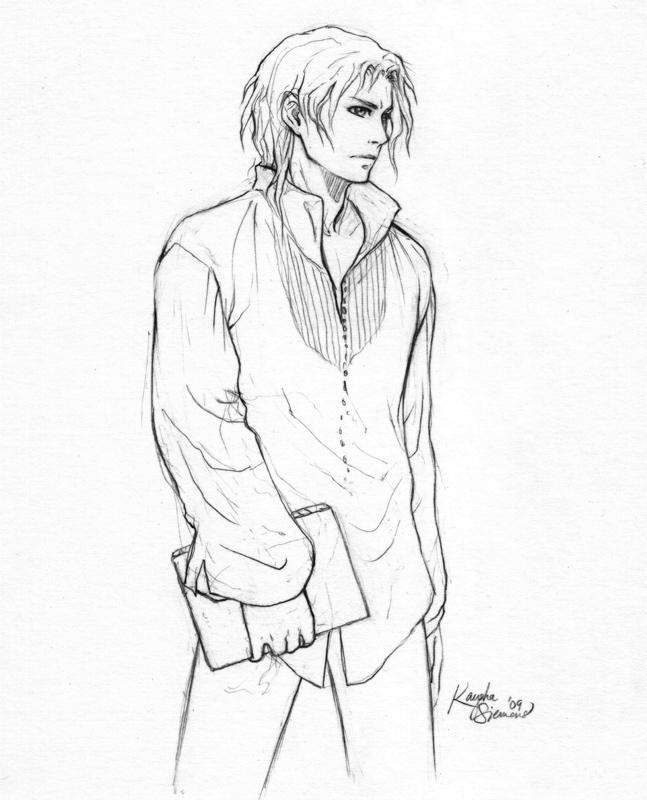
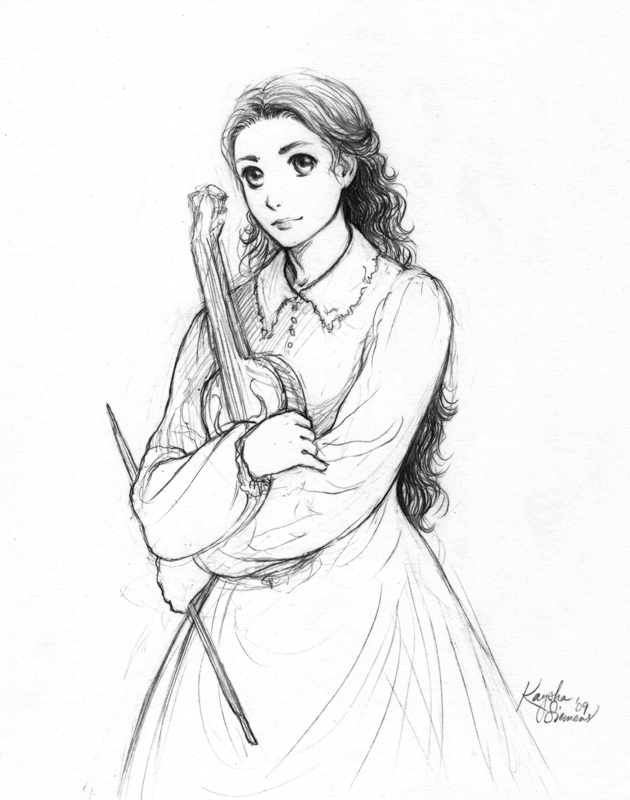
Baltasar for Kelley AWA 09_small Meinrad for Kelley AWA 09_small Nicthel for Kelley AWA 09_small

The city of Atlanta, very near where I live, is a fan convention paradise. Not only is it the site for DragonCon, a mega-convention for fans of science fiction and fantasy, a wild, wonderful, sprawling event where the Atlanta Radio Theatre Company performs every year; it’s also the home of Anime Weekend Atlanta, a convention that celebrates Japanese animation in its multitudinous forms. My husband, Matt Ceccato, got me interested in anime before we were married, and persuaded me to come to AWA with him; we’ve been back every year since. The convention has much to offer: lots and lots of screenings of anime old and new, discussion panels on everything from anime history to cosplay, and a manga reading library. But my very favorite thing — the thing to which I look forward year after year — is Artist’s Alley, where gifted artists congregate to share their visions of characters both in anime and in pop culture in general. Some of these artists will take commissions; tell them what you want them to draw, and they’ll produce a brilliant work to your specifications.

A few years back, I started sniffing around Artist’s Alley with an idea: I wanted to see what characters from my stories might look like if I ordered drawings of them, if I gave the artist a brief description of the image in my head. First I had to find an artist whose drawings matched my vision, and I found Kaysha Siemens. From the descriptions I gave her, she drew the above pencil portraits of Baltasar, Meinrad, and Nichtel, the three major characters from my upcoming novel Atterwald. They fit my vision so perfectly that every year since, I’ve gone back to her with new commissions. I’ll be sharing more drawings in future posts.

Perhaps my favorite thing about it is that at the time I asked for these three portraits, I hadn’t even finished Atterwald‘s first draft. With the drawings I had a new reason to push myself to the conclusion, and to make their story as engaging as possible. Those penciled faces looked up at me and demanded that I bring them fully to life, not just for myself but for others who might enjoy their company. They wanted to be known. So I learned the value of commissioning portraits of characters whose stories are still in progress or may still be in the conception stage. Once drawn, they have a more tangible reality than just an idea in my head, and I simply can’t let them down. I have to help them become what they were meant to be.

So here is Baltasar, my ambitious and cold-hearted wizard, looking like a jovial Claude Rains (but don’t trust him). Here is Meinrad, his sickly, rebellious son, looking appropriately edgy. Here is Nichtel, the violinist whose music has strange powers; her eyes radiate hope.

Soon you’ll have a chance to get to know them.

From my bookshelf: Women who help other women

Be warned, all who read this blog: feminism and women’s roles in fantasy, science fiction, graphic novels, movies, TV, etc. is a very big concern of mine, and is likely to drive many, if not most, of my posts. Just so you’ll know. At issue today: does the presence of a competent, powerful heroine at the center of a story make the story “feminist”? If she takes on all comers and saves the day, is she automatically a feminist heroine?

My answer to both questions is “no.”

In my reading, as well as in my endless search for new things to read, I’ve found myself growing tired of novels that feature the “exceptional woman” — the lone female character who smashes through her society’s glass ceiling, throws off all gender-based restrictions, and wins the respect of the men around her. The operative word in that description, the crux of my impatience, is lone. The key to this character is that she is Not Like Other Women. She is the only woman who breaks the rules, the only woman who impresses and astounds, and her rebellion against society begins and ends with herself. She doesn’t want to live by the usual gender restrictions, yet she doesn’t consider that those restrictions could be wrong for other women as well as herself. More often than not, she holds other women — the “normal” ones — in contempt, and forges meaningful friendships only with men.

This “exceptional woman” can be fun to read about, and I’ve enjoyed my share of stories in which she features. A few examples include Deryn Sharp of Leviathan, Alexia Tarabotti of Soulless, Raine Benares of Magic Lost, Trouble Found, Jehane bet Ishak of The Lions of Al-Rassan, Aralorn of Masques, Menolly of Dragonsong, Sarene of Elantris, and Rosalind of The Fire Rose. I particularly admire the gifted budding composer Menolly, the skillful and determined physician Jehane, and the politically savvy princess/diplomat Sarene. But I can’t quite call their stories feminist when any substantial friendship between women is conspicuous by its absence. (In Soulless, Alexia does have a “particular friend,” but this friend is such a thoroughgoing dimwit that I found it hard to imagine the intelligent, sophisticated Alexia actually enjoying her company. I’ve been told the sequels fix the problem.)

This is why the Bechdel Test matters. It was never meant to be an indicator of a book’s quality; many superlative works of yesterday and today fail the Test. Rather, the Test is designed to make us — both readers and writers — aware of the limits placed on female characters, particularly when they’re forced to interact almost exclusively with men and when their competence and power are presented as “out of the norm” for women in general.

The works I find most meaningfully feminist are those in which women help each other — usually, but not always, to overcome gender-based oppression. (I have a soft spot for fantasy fiction in which the world constructed for the story does not reflect the sexism of our historic past, but that’s another blog for another time.) A few I’ve read recently are worthy of mention:

The Steel Seraglio by Mike, Linda, and Louise Carey tells the story of a community of women exiled from their city when the Sultan and his family are slaughtered and a bitter ascetic misogynist seizes control. At first the women band together only to survive, but gradually they learn trades and skills and become an active working community, and in time they grow strong enough to return to the city and reclaim it. In striking down the woman-hating ruler, the women not only take back their lives but free other women from his harsh regime. In a good bit of speculative fiction, societies and governments led by women are shown to be as oppressive to men as the worst of patriarchies are to women, but the Careys don’t follow that plan. The order the women establish is an enlightened democracy in which both men and women enjoy full rights. Along with a strong, vivid style that evokes The Arabian Nights, the book features one of the most satisfying examples I’ve seen of female leadership as well as cooperation.

In Barbara Hambly’s The Ladies of Mandrigyn, we read of a town where all the menfolk are away at war, and of a nasty wizard keen to take advantage of that situation. Rather than languish in slavery, the titular ladies of Mandrigyn band together to become a fighting force; the suffering of one is the suffering of all. We see their struggle through the eyes of a male mercenary leader whom they kidnap and force to train them. Of course he responds with rage, but as he works with them, his respect for them, and their goal, grows, until at last he works with them out of a genuine desire to see them succeed. Meanwhile, in a parallel plot, his female second-in-command (Starhawk, perhaps my favorite of all the warrior women I’ve met in fantasy fiction) protects his mistress of the moment. Both women love him, but where we might expect claws-out rivalry, we get strong friendship.

Snake, the heroine of Vonda McIntyre’s Dreamsnake, is a healer, and as such is an advocate for all who suffer. Yet in the towns she moves through, women do most of the suffering, even though Snake herself, as a healer, commands respect. She lends her aid to several female characters throughout the story, most notably a young victim of sexual abuse. As a disfigured girl in a town that values beauty above all else, little Melissa has no one to take her part against her big, brutal victimizer. Snake liberates her, not only physically but psychologically. Through Snake’s kind treatment and example, Melissa learns to value and see the possibilities in herself.

There it is: the difference between the “exceptional woman” and the heroines I perceive as feminist. The latter may be exceptional, but they give other women around them the chance to be exceptional as well.