Toward a More Female-Friendly Fantasy Canon

Part 1: My Own Experience

As a child I read quite a bit of fantasy, most of it the animal or fairytale variety but fantasy nonetheless. I also saw my fair share of both fantasy and science fiction movies. I would almost invariably latch on to a character whom I perceived as the “coolest,” and I would imagine myself as that character, engaged in adventures galore.

When I read Kipling’s The Jungle Book, I was Bagheera — much cooler in Kipling than in Disney, and besides, I loved that name. When I first encountered The Wind in the Willows, I was Toad; when I’d grown up just a little, I became Water Rat. When I fell in love with Watership Down, I couldn’t decide if I most wanted Hazel’s good sense, Fiver’s mystical insight, or Bigwig’s bluff badassery, so I took turns being all three. When I got my first taste of the King Arthur stories, I was, from time to time, most of the knights except Lancelot. When I saw the 1940 Korda fantasy classic The Thief of Bagdad, of course I was the rakish and fearless Abu, and when Star Wars Episode IV: A New Hope entered my life, I couldn’t be anyone but Luke. (It wasn’t until The Empire Strikes Back that I grew to appreciate Han.) This habit lingered even into my teenage years, for when I saw The Princess Bride, I was instantly Inigo Montoya.

In those days it didn’t occur to me to question why the coolest characters, the ones I so badly wanted to be, always seemed to be male. Yet oddly enough, when I slipped into their shoes (or paws, as the case may be), I didn’t become male. Instead, they became female. Since none of my favorites were heavily involved in romance plots, I saw no reason why they couldn’t be girls if I imagined hard enough. Even when certain plotlines made their maleness necessary, my imagination always found some work-around. I wanted them to be female, like me, and so they were.

Not until I entered adolescence did I find female characters I really wanted to be — Scout Finch, Jo March, Anne Shirley, Jane Eyre. But by that time, I was drifting away from fantasy, at least as far as reading was concerned. Where were the female characters in fantasy that might have won my allegiance to the genre? Tamora Pierce’s Alanna the Lioness, Robin McKinley’s Harry and Aerin, Anne McCaffrey’s Menolly of Harper Hall? They were there when I was a teen, yet somehow, to my everlasting regret, I missed hearing about them, and I didn’t encounter them until much later, when I’d aged beyond the presumed target audience.

In my last year of college, fantasy found me again. I reread Watership Down, and read Tolkien’s The Hobbit and Lord of the Rings for the first time. An ambition woke in me, to write fantasy novels of my own, and I was anxious to read more in the genre because first, it would improve my understanding of fantasy as a whole and give me some idea of the techniques I might employ, and second, it would be fun. So I started to sniff around libraries and bookstores, knowing what I wanted: something as wondrous as Tolkien, but with more women, since by then I was growing impatient with turning male characters into heroines and wanted to find stories where the “coolest” characters might actually be girls. But without Goodreads or Library Thing to help me, I wasn’t sure where to turn.

I turned first to Ursula K. LeGuin’s A Wizard of Earthsea, assuming naively that a female author would be bound to include more female characters and give them interesting things to do. How quickly I realized my mistake. Very early in the books, a key ethos is laid down: “Weak is women’s magic” and “wicked is women’s magic.” After I read that, I thumbed through the rest of the book, noted the scarcity of female names and pronouns, and returned it to the library unfinished. (I know now that if I’d started with the second book in the Earthsea Series, The Tombs of Atuan, my reaction might have been very different.) My second experience with a female fantasy author wasn’t much better: Mary Stewart’s Merlin Trilogy, starting with The Crystal Cave. These books I actually enjoyed, but I had to wait until Volume 3, The Last Enchantment, to meet with any character resembling a heroine, and she didn’t appear until halfway through the book. Clearly, trusting in female authors just because they were female wasn’t the answer.

I had very little guidance, since at that time none of the people to whom I was very close were avid fantasy readers who could point me toward exactly what I was looking for. Thankfully, when I entered grad school, I found some friends who were fantasy fans, and from them I learned about Mercedes Lackey’s Valdemar, Tad Williams’ Osten Ard (Memory, Sorrow, and Thorn), the various alternate-history worlds of Guy Gavriel Kay, and best of all, Terry Pratchett’s Discworld.This helped me find my feet, and from there I’ve moved on to Barbara Hambly, Juliet Marillier, Patricia McKillip, and quite a few others whose new releases I await with pounding heart. Thanks to these I learned that female characters could and did have a place in fantasy literature — in fact, a variety of places. They didn’t have to be the hero’s reward, or the passive avatar of Goodness/ the active agent of Evil, or the damsel in need of rescue. They could be heroes.

My story of falling in love with fantasy has a happy ending (though the term “ending” hardly fits, since I have books to go before I sleep). But I wonder what might have changed if I’d discovered the right books sooner, if I’d sought out Tamora Pierce and Robin McKinley as a teen. I wonder if their work might have made me a little more confident, a little more optimistic, on my rough ride through adolescence. I wonder if my ambition to become a fantasy novelist, which hasn’t abated since college, might have taken earlier root.

I also reflect with amusement on my habit of making heroines out of male characters. Just yesterday I browsed through an old Reddit Books thread that began with the question to the men of the group: how often did they read books by female authors and/or books with female protagonists? While plenty of the responding men wrote that they have and would happily read a book by a female author, I lost track of the number of posters who claimed they just couldn’t get into stories with female protagonists because they “couldn’t relate” to those characters. My first impulse was to judge them harshly for their unimaginative short-sightedness, but then, while I’ve identified with countless male characters, I’ve never really identified with them as male, even if they were played by Mandy “Mr. Awesome” Patinkin. I still have the habit of transforming my favorite male characters into female, even though I’ve now found plenty of female characters in the genre to love and admire. If I can’t identify with the characters as I find them, as their authors give them to me, but instead feel moved to make them something else, how am I any better than those posters on Reddit?

I will say only this in my defense: that gender-flipping habit of mine has had an inescapable influence on the way I gender my own stories and the kinds of characters I imagine as female. Whether that’s a good or a bad thing, I leave to my readers to decide.

(Coming Soon: Part 2 — The “Best” Fantasy Novels?)

Movie Adaptations I’d Love to See

The difference between books I’d love to see become TV series and those I’d love to see become movies is simple and obvious. If the book is part of a series, it needs to be adapted for television Game of Thrones style, with one or two seasons to cover each book. But if the book is a stand-alone, it could work very well as a movie. What the Big Screen needs even more than its small counterpart is diversity, so that’s the theme for my choices of dream book-to-movie transformations.

Kindred. OscarsSoWhiteMale? A well-done adaptation of Octavia Butler’s compelling and troubling timeslip fantasy could be a big step away from that, with Selma‘s Ava DuVernay directing and Condola Rashad, of Showtime’s Billions, starring as Dana, the modern African-American woman mysteriously transported to an antebellum plantation. Dana is just the sort of active, smart, complex heroine the movies could use more of, and her story, if told with the care and attention it merits, should be impossible for the Academy to ignore. Oscars all around, for DuVernay, Rashad, and the heartbreaking score by Thomas Newman.

Wild Seed. If Kindred‘s Dana is a victim of circumstance who must find a way to claim some measure of power despite a system designed to keep her powerless, Anyanwu, the heroine of another Butler classic Wild Seed, is a mighty force, a shape-shifting entity whose transformations are delightfully detailed; her transformation into a dolphin, for instance, could become a moment of pure joy on screen. Anyanwu is a figure of creativity and love, and Gugu Mbatha-Raw, who impressed me in the underrated costume drama Belle, could bring her to vivid life. For her opposite, the destructive Doro, Idris Elba would be perfect; he even fits Butler’s description of the character. He could endow Doro with the charisma he needs in order for an audience to understand how so many people could willingly fall under the evil man’s spell.

Who Fears Death. I don’t have a dream cast for this one. Onyesonwu, the heroine of Nnedi Okorafor’s fantasy of injustice, anger, and supernatural power struggles in post-Apocalyptic Africa, could be a career maker for some gifted unknown. (Twenty years ago, the superb Sophie Okonedo might have played her to perfection.) The story is harrowing and hopelessly involving, impossible to look away from even though all instincts warn that heartbreak waits at the end, as Onyesonwu tries to understand the nature of her strange power and the responsibilities that come with it. Done right, this movie could leave an audience devastated — in a good way — for hours afterward.

The Secrets of Jin-Shei. A faithful, well-directed, and well-cast rendering of Alma Alexander’s fantasy novel set in mythic China, with its roster of heroines ranging from an introspective poet to an ambitious alchemist to a sensual dancer, could transport audiences and leave them breathless. As with Who Fears Death, I don’t have a dream cast for this one (although Michelle Yeoh might be wonderful as the narrator, the poet looking back on her youth and friendships), but Ang Lee, so brilliant at the helm of Crouching Tiger, Hidden Dragon and Sense and Sensibility, is the very director to do the project justice. I don’t really see Hollywood having much to do with it at all. Rather, I see an Asian cast, screenwriter, and cinematographer (Peter Pau, who worked with Lee on Crouching Tiger). This could be a strong Best Foreign Language Film contender.

The Rook. Daniel O’Malley’s novel of a secret organization of metahumans operating in London is one of the few urban fantasies I like unconditionally. Like my other choices, it’s led by women, with a hapless heroine, Myfanwy Thomas, coming into her strength guided by a series of letters from her pre-amnesiac self. Jenna Coleman, recently departed from Doctor Who, matches with uncanny precision the physical description of Myfanwy in the book, so much that I have a hard time picturing anyone else in the role. She has the smarts and the energy to pull it off. Cate Blanchett is probably too big a star to be considered for the role of secretary Ingrid, who’s much more badass than she first appears, but she’s the actress I have in my head. And Firefly alum Gina Torres would rock as Shantay, the American metahuman agent who becomes Myfanwy’s bestie.


What’s Making Me Happy: March 2016

March is my birth month, which means it’s time for new books and/or the means with which to acquire them (gift cards from Barnes and Noble and Amazon.com, for example) to come into the house. I have more books on my shelves than I could read in my lifetime, and that isn’t even counting the ones I’ve already read but have enjoyed enough to keep on my shelves with the idea of revisiting them at some point. Yet I relish few things as much as acquiring new books. Judge me as you please, but I’d have it no other way. The ache of frustration I sometimes feel when I’m trying to choose a new book to read from among the hundreds is a blissful ache indeed. So first on my list of things making me happy this March (and every March, really) is my own vast but ever-expanding library.

More specific items:

The Girl With All the Gifts

I write quite a bit, here and elsewhere, about authors who do a fine job of creating active, interesting, and competent heroines. I say more when male authors do it because it takes me by pleasant surprise — although it really shouldn’t, since a hallmark of good writing is the ability to create compelling characters, and gifted writers, like good characters, come in all genders. Does creating female characters require some extra dash of skill and insight? How messed up are we if the answer is “yes”? Plenty of authors, both male and female, seem to have a hard time writing women. Sometimes they omit them from their stories or give them very minimal background roles. Other times they construct their roles and personalities from a box of stereotypical tropes. On occasion the resulting characters come across less as believable individuals than as wish-fulfillment fantasies, as in “I want to be her” or “I want to be with her.” Men have been the “default gender” for so many literary centuries that our thinking still suffers from it. We may be getting better, but our perception of the kinds of stories that can be told with and about female protagonists is still regrettably limited. There is still a small set number of things a female lead can do, whereas a male lead might do anything.

That’s why an author like M.R. Carey is a treasure. I knew he was one of the good guys since I’d read and enjoyed The City of Silk and Steel, a.k.a. The Steel Seraglio, which he co-wrote with his wife and daughter and which features one of the widest-ranging casts of female characters it has ever been my pleasure to read about. But then, that novel, alternate-history with a few fantastic elements, I might have picked up as a matter of course. The Girl With All the Gifts is a horror/thriller  set in a post-desolation England overrun with parasite-ridden cannibalistic “hungries,” not the kind of thing I’d normally choose if I hadn’t heard it praised by certain trusted sources.

Yet here Carey confirms my impression of him as outstanding with character, and three out of the five major characters in this novel happen to be female. Caroline Caldwell, the cold-hearted scientist out to discover the cure for the “hungry” affliction at any cost, could easily have been written as a man, but in this case the character whose gender isn’t dictated by the plot defaults to female. With Helen Justineau, the teacher, a gender-flip is less imaginable, yet she is a most intriguing woman, a part of a system she abhors, compromised by her own compassionate heart. The fulcrum around which the plot revolves is little Melanie. Sadly I can’t say too much about Melanie without veering into Spoiler territory, but she is adorably and painfully real, a genius but still very much a little girl. Despite her dire situation and the novel’s overall dark tone, she’s funny in surprising ways. The story she composes (ignoring the prescribed vocabulary list), in which a little girl saves a “beautiful, amazing woman” (an expy of her teacher Miss Justineau, whom she hero-worships) from being eaten by a monster, is an early highlight, and many readers might lose their hearts to Melanie at that very point.

I’m a little more than halfway through the book, and I can’t say how the story will finally play out. But my rooting interest in Melanie and her bond with Miss Justineau keeps me reading. This horror/thriller manages to be both frightening and heartwarming.

Supergirl.

No TV show should ever be judged by its pilot. If the pilot has noticeable, even glaring flaws, that just means the show has plenty of room to grow.

I can’t defend the pilot of Supergirl. It’s incredibly cheesy, and its characters, including the clumsy and desperate-to-please Kara Danvers and her cutting, tyrannical boss Cat Grant, seem to belong more to a mediocre big-screen romantic comedy than to an action-adventure TV show. Yet I was so hungry for a show with a super heroine as its lead character that my husband and I decided to keep watching in the hope that it would improve. And lo, it has! So much that it’s barely recognizable as the same show. Each episode has added new layers to its characters.

Kara may seem rather aggressively average in her civilian guise, but we the audience have been allowed to see and understand how she came to be that way, and Melissa Benoist brings such earnest charisma to the role that she reminds me at times of a female Carrot from Pratchett’s Discworld “Night’s Watch” novels. Cat Grant, too, has evolved far beyond the initial stereotype. She’s still the master of cutting quips, many of which are very funny indeed, but she does have an underlying core of integrity; so far in one season she’s shown more character than Calista Flockhart’s most famous role, Ally McBeal, ever displayed. Another big mark in the show’s favor is the bond between Kara and her foster sister Alex; I can’t help wishing more of the “normal” women in superheroes’ orbits were more like Alex, who shows on a regular basis that she doesn’t need supernatural powers to kick major butt. J’onn J’onz, the Martian Manhunter, my favorite character from the animated Justice League, plays a crucial and intriguing role here as well.

This show needs a Season 2, CBS. If this one dies while all the male superhero-led shows  go merrily on, I will be very peeved indeed.


TV Adaptations I’d Love to See

Recently we’ve seen a rise in television adaptations of speculative fiction, sparked by HBO’s popular Game of Thrones and continuing with such shows as Penny Dreadful, The Expanse, Jonathan Strange and Mr. Norrell, The Magicians, and The Shannara Chronicles, not to mention shows based on graphic novels and superhero lore like The Walking Dead, iZombie, Gotham, Arrow, The Flash, Legends of Tomorrow, and my own unquestioned favorite, Supergirl. All this has me convinced that many of the novels I’d love to see adapted to a visual medium would fare far better on television, where the limited-series format would give them room to breathe, than on the Big Screen. Here, just for fun, are a few titles I daydream of seeing Coming Soon to HBO, Showtime, Amazon, or Netflix:

The Witches of Eileanan. Kate Forsyth’s epic fantasy series has magic in abundance, evil plotting sea-creatures, mystical elvish beings, tree shifters, powerful animals, and landscapes ranging from jagged mountains to dangerously misty swamps to lush forests. With the right budget, it would be a visual feast. Then of course we have a plentiful cast of characters, all with their own intriguing struggles; anyone who has succeeded in keeping the dramatis personae of Game of Thrones straight should have no trouble here. My dream cast: Eleanor Tomlinson, on whom I girl-crushed as I watched the new BBC adaptation of Poldark last year, has the beauty and intelligence and spirit to carry off the dual role of twins Isabeau and Iseult, the saga’s prime heroic movers; Morena Baccarin could play the villainous Maya the Unknown with soft-spoken, seductive venom; and Dame Judi Dench, who has yet to win the awards she so richly deserves, would be sublime as Meghan of the Beasts.

The Stormlight Archive. Sooner or later Brandon Sanderson’s work has to reach the Small Screen, and this work could more than match Game of Thrones in terms of epic grandeur. Those enjoying the current spate of superhero shows would find in this story plenty of heroics to relish, and filmed properly, a raging highstorm or an attack of a monstrous, bloodthirsty chasmfiend could leave a TV audience breathless. My dream cast: Another Poldark star, Aidan Turner, could bring the haunted Kaladin Stormblessed to smoldering, charismatic life. (Twenty years ago, Colin Firth would have been ideal for this role.) Rose Leslie, lately of Downton Abbey and Game of Thrones, is the very image of Shallan. And I would kill to see Timothy Dalton, in all his grizzled handsomeness, embody the aging but still powerful Brightlord Dalinar Kholin.

The Shadow Campaigns. Battle scenes offer abundant opportunities for dazzling visual storytelling, and this series has military action aplenty, not to mention the combat that takes place on the mean streets of Vordan’s capitol city. With good location scouting, the world of Vordan in the late eighteenth century, with its palaces and political halls, ballrooms and barrooms, could be brought to vivid life. My dream cast: frankly, I’d rather see Henry Cavill as the imperfect but solidly decent Marcus D’Ivoire than as gloomy-gus Superman, and while Saoirse Ronan may not match the physical description author Django Wexler gives Winter Ihernglass, her performances in Hanna and Brooklyn convince me she has more than the necessary intensity and intelligence to pull off the journey this complex heroine makes.

The Sevenwaters Trilogy. Juliet Marillier’s lushly romantic historical fantasy series would give some wise director and visual designer a chance to put the world of ancient Celtic folklore on screen. My dream cast: if Saoirse Ronan isn’t too busy playing Winter Ihernglass, she would absolutely kill it as Sorcha in Season 1, “Daughter of the Forest”; since the character spends a substantial portion of the book not speaking, but it’s imperative that we get some sort of feel for what she’s thinking, her expressive eyes would serve an eloquent purpose here. Jessica Brown Findlay, the big-hearted, rebellious Lady Sybil of Downton Abbey, would more than adequately fill the role of Sorcha’s outspoken daughter, Liadan, in Season 2, “Son of the Shadows.”

Forthcoming: Movie Adaptations I’d Love to See.


The Nightmare Lullaby 5: Meet Feuval

As much as I love being a writer of fantasy fiction, it does come with its own peculiar challenges. One of those is trying to come up with a non-silly sounding answer when a friendly acquaintance who doesn’t read fantasy asks, “What is your book about?” If a fellow fan asked this question, my reply could last all day, yet with non-fantasy lovers I find myself tongue-tied, helpless to explain the convolutions of my daydreams. To solve this problem, I’ve been told to come up with nutshell descriptions of the “X meets Y” variety. Whereas Atterwald is “‘Beauty and the Beast’ meets The Secret Garden, with shapeshifters,” The Nightmare Lullaby is “The Iron Giant meets The Phantom of the Opera.” Whatever conclusions you’re drawing about that mash-up are probably, well, partially right.

Feuval is the Phantom in my story, the masked man hidden away from the world, who lives in and through his music. He’s the only major character of whom I have no drawing, and the only one whose point of view we never see. Yet he was the story’s starting point. Several years ago, on a visit to the Georgia Renaissance Festival, my husband and I were intrigued by a big black wagon that housed a carillon and a man in a gold mask who played the bells inside. “There’s a story in him,” I thought at once, and all the other ideas for what would become The Nightmare Lullaby branched out from this root.

This is the first scene in which he appears, an early turning point for the heroine, Meliroc.

***

Of all musical instruments, only the carillon conceals its player, making it easy to imagine that it plays itself. Now I sensed a magical mind within it. Hadn’t I learned to shun magic, to loathe its practitioners? Why did I relish this spell when I should have been fighting it?

The trees, bushes, and rocks I passed on my uphill march flickered in the corners of my eyes like smoke-trails from a fire. Only the music was tangible. The figure of the carillon blazed silver in the distance. Fingers of light stretched out to draw me toward it. Once I reached it I caught my wheezing breath and dropped to my knees before it. Its gleam subsided into a quiet shimmer.

“What’s-this-what’s-this-what’s-this?”

The sharp whistling voice jolted me. A creature half the size of Master Pierpon hovered in the air beside my ear, jerking its head at me. Long gray hair spilled down its back and sides, nearly covering the dusty gray rags that draped it. The oval thing atop the rags could not really be called a face, for it boasted only a wide, lipless mouth and a pushed-in nose. Where were its eyes?

“What’s-this-what’s-this?” it squeaked, pinching my chin.

Distaste squirmed in my stomach. Pierpon might have gotten around my prejudice, but he hadn’t overthrown it.

“Tell us who you-are-you-are-you-are!”

I thought my name, hopeful that it might hear me.

The tiny creature gave an irritated trill. “Are you simple-simple-simple?” it jabbered, shaking its fist at my nose. “Say who you are! What you are!”

“Whishk?”

The black curtain in the window fell aside, revealing a hawk-shaped golden mask. Its glint shot ahead of the opening to strike me full in the face. Through the blare I traced the outlines of a man’s figure shrouded head to foot in white.

“What causeth this agitation, my whishk?” A resonant baritone voice folded about me like a downy quilt.

“That!” Again the gray will-o’-the-wisp shook its fist at me. “Make it go away! It’s too big-big-big!”

“Be not uncivil, good whishk.” A touch of admonishing hardness crept into the voice, yet still it rang rich and wonderful. “Draw thou nearer, stranger.” The man’s white-gloved arm slipped through the window to beckon to me.

“Send it away!” The imp bobbed up and down in mid-air, puffing in indignation. “It’s no good. It can’t even speak!”

The mask tilted rightwards. “Is this true, maiden pale?”

I placed a hand to my lips, then sadly nodded.

“And doth that justify thy rudeness, whishk? Be still, if thou canst not call on thy good manners.” The mask’s glint softened upon me. I felt a smile in it. “Wilt thou stand? I would see thy full measure.”

I climbed to my feet. My shadow stretched out to the carillon-wagon, swallowing the masked man.

“Ah!” The voice sounded more pleased than disturbed. “A tree thou art, made all of alabaster moonbeams. Didst my song reach thy ears, moon-tree?”

I nodded yes, kneeling once again. I didn’t want to loom over this man. “Moon-tree” – a beautiful name! How he spoke it! I grinned, a delighted tremble in my toes.

“Too big-big!” fumed the dusty imp. “Send it away-away!”

“Heed not the words of my whishk, fair moon-tree,” the man said. “I am Feuval. Dwell I in this box, with my musical bells.” He stretched out his hand, then rested his fingertips against my cheek. “My music have I given to many villages, yet no listener hath ever spoken back to me.” A note of sorrow rang in the marvelous voice.

I glared down at my quivering hands. Shrink from this man. Distrust him. I tried to picture myself bolting back down the hillside to the safety of my tent, but the image slid through my fingers.

“At each place I do visit, I send forth a summoning, a song that can only be heard by a friend. For so long none hath heeded it. Yet tonight it hath brought thee.” He drew his hand away and rested it on the window-ledge. “I wish that I might learn thy name!”

A cool gust bore down on my heart-fire. This man obviously had magic. A sorcerer would hear my mind-voice. “Meliroc,” I thought at him.

“Why knit’st thy brows so?” he asked. “Fear thou me?”

I summoned every shred of energy to force my mind-voice past that gleaming mask. “Meliroc! Meliroc!

“Thou’rt distressing thyself.” The wonderful voice rang gentle. “Be at peace. I ken thy heart. I called it hither.” He tilted his head toward me. “Dost thou play a musical instrument?”

I shook my head.

“But thou hast wished thou might?”

I nodded yes.

“Then my apprentice shalt thou be,” Feuval pronounced. “I shall teach thee to give life to the stirring inside thee which led thee here.”

How? my mind screamed.

“‘Tis a pity thou art mute,” he said, fumbling for something under the window, “but I shall give – thee – aha!” He drew himself upright again, a strange object in his hands, eight wooden planks fixed to a thick black board. “This shall be thy voice.”

He raised a mallet and struck the left-most plank, and out came a chime, a star’s gleam. The mallet danced lightly down the other planks, raising a succession of notes that shone in a constellation. This was an instrument! The planks were rooted on bells, a miniature carillon.

Gripping it by its sides, he reached through the window and held it out to me. “Take it.”
I wanted to wrest the instrument from his hands and see what constellations I could shape, but memories held me still. So many broken instruments and the Bitter Chord’s mocking laughter. You were not formed to make music.

“Take it,” the masked man repeated more firmly.

My stomach swirling, I claimed the instrument, then the mallet. My fingers folded around the polished wood.

“Now, play the scale.”

Don’t break, don’t break, don’t break… I lifted the feather-weight mallet and dropped it cautiously on the top plank. A bright twinkle answered, my own star.

The instrument held solid. In its ring I heard it accept me. A tremor surging through me, I sent my mallet skipping down the planks as I’d seen him do. Each note rang sweeter than the last. The light-strings from the great carillon wound more tightly about me, and I imagined them as the threads of a chrysalis, promising to transform me into – what? Surely something better than I was.

“Take it with thee,” he instructed, “and draw from it a song of thine own making. A melody of a merry heart. On the morrow’s eve I will summon thee and hear what mettle is in thee.” He snapped his fingers, then jerked his thumb to his left. “Go thy way, moon-tree. Begin thy work.”


The Nightmare Lullaby 4: Meet Meliroc

Meliroc for Kelley AWA 09_small

It’s all about her.

At one point, very early in my conception, the plucky innocent Valeraine was to be the heroine of The Nightmare Lullaby. The story would have been about the young girl befriending the misunderstood monster and working to free said monster from the curse under which she suffers. But I abandoned this tack pretty quickly. Valeraine certainly has heroine potential, and one day I may write a story that is well and truly hers. But this one belongs to the monster. I’ve noted a fair number of fantasy novels that have monstrous protagonists, but not many of those protagonists have been female. Meliroc grew strong in my mind as someone I hadn’t seen before, and wanted to see.

Because I found Meliroc so fascinating to visualize, I’ve commissioned more than one portrait of her. In the one above, she looks wild and fierce, “frightening” as some of my Facebook friends have said. This may be my very favorite of all the drawings Kaysha Siemens has done for me, because of how perfectly she captures that feral intelligence in the character’s eyes. In the one below, Meliroc is dressed in the style in which we see her for most of the novel. Here she wears a melancholy expression, reflecting a different side of her personality.

Meliroc progress 1-23-12

She really came to life when I decided her perspective should be told first-person. In this quiet sequence from the second chapter, she and her best friend, the tiny Pierpon, talk about the things they love most. (Note: being afraid of the sound of her own voice, for reasons that become clear in the narrative, Meliroc speaks telepathically. That’s why her lines are italicized.)

“What does it mean to be good?

I’d read of goodness in books, and often I imagined it in the faces and manners of people in the towns I passed through. Apparently no one could be truly good in isolation. Good people smiled at each other, aided each other, depended on each other. Good people loved and were loved.

I’d found the pixy-man almost frozen in the snow-drift. I didn’t like pixies. Why hadn’t I left him and walked on? The music — that was it. The music had found some secret thing in my heart and drawn it out of hiding. When I remembered Jickety Pierpon coming to his senses in my hand a thought blossomed in my mind for the first time.

I might be good.


………

With my tent secure and my bundles unpacked, I stretched my gray wool blanket over the snow and sank down to read. I reached for the thickest of the three books I carried with me, the strange-beings compendium, and tried to consider how Pierpon’s kind had been left out of it. Instead, I caught myself wondering exactly what end I would meet if Cedelair turned me away. My gaze kept gliding up to that lighted window.

‘You’d love to hear what they’re saying now, wouldn’t you?’ chuckled Pierpon with a jerk of his head toward the tantalizing casement. ‘I can listen for you, I can.’

‘Please don’t. Just talk to me and keep my mind from it.’

Hopping onto my blanket, he tilted his head up at me with an interested spark in his eye. ‘All right, then. What shall we talk about?’

‘What’s the thing you love most in all the world?’

‘Tears. Human tears. Now, now, don’t look like that,’ he chortled when I gaped in horror. ‘Tears have value, they do. When a man wakes from a nightmare and weeps into his pillow he’s learned something, and he’ll put his wrongs to right. Humankind would be lost without us, mam’selle Meliroc.’

I tried to weigh this explanation, but it ran up against the wall in my mind that sealed off things I could never remember — people’s names, places’ names, my ‘childhood.’ I winced at a knocking in my head. ‘I never remember my dreams,’ I told Pierpon.

He knitted his wiry eyebrows. “Oh?”

‘But they must be horrible, because when I wake I find my face soaked with tears and my muscles sore as if I’d been shaking all night. I must have done something abominable once, and when I dream it comes back to me, but when I wake it’s always gone again. How can I learn from that?’

A tiny hand touched mine. ‘That’s not how we jicketies work. And I can’t imagine, I can’t, you being guilty of a terrible crime.’

‘You scarcely know me.’

‘I know you saved me. I know you have kind, warm hands.’

I stared at those work-weathered hands, with their tremble that had become second nature to me. ‘They shiver.’

‘That’s because you feel so much, even more than you realize.’ He let out a whispery whistle. ‘So what’s the thing you love most in all the world?’

The memory of the carillon’s songs ran through me, quickening my blood-flow as only my favorite thing could. ‘Music!’

Pierpon clutched his sides with a laughing grin. ‘You’re serious, you are?’

My small friend’s indifference to music was a grave flaw. I resolved to take him in hand and teach him better. ‘How much do you know about music, Master Pierpon?’

‘Valeraine the Vixen has a little wooden pipe. When she blows into it, it makes a noise she calls music.’

A penny-flute, one of the many instruments I’d tried to teach myself to play. All had shattered to splinters under my fingers. ‘Had you never heard music before you came here?’

His black curls quivered as he shook his head. ‘We don’t bother with it back home, we don’t,’ he declared, almost a boast.

Was there a time when I hadn’t known what music was? As my mind fled that dark and dead-silent past, my heart-fire trembled under a press of sympathy for Pierpon. ‘When you hear Mistress Valeraine play, how does it make you feel?’

‘Tired.’

How much work I had ahead of me!”


The Nightmare Lullaby 3: Meet Cedelair

When the idea for what would eventually evolve into The Nightmare Lullaby first sparked in my mind, Cedelair was just what he appeared to be: an aging sorcerer, mentor to a young apprentice, a type we’ve seen in innumerable fantasy tales. Yet somewhere along the way — I’m not entirely sure how or why — he started in a different direction. He developed from the crusty mentor into the male lead, a young man cursed to appear old, a man with his own burdens to bear and journey to make. I even, just for fun, composed a “back-of-the-book” blurb from his point of view:

“Cedelair was only twenty-two when a blow in a magical duel cursed him with the appearance of old age. In the five years since, he has lived a hermit’s life, interacting only with his teenage apprentice, Valeraine, and her nightmare-imp companion, Pierpon. All Cedelair really wants is to be left alone to mix and brew his potions in peace. But when an eight-foot-tall woman with bone-white skin and hair and furious green eyes appears in his front yard and announces, ‘I have come to labor for you,’ what’s a sorcerer to do?”

Cedelair should look like an older, more disgruntled version of Hugo Weaving’s Elrond from Peter Jackson’s Lord of the Rings film trilogy. I love the way Kaysha Siemens absolutely nails the “disgruntled” part.

Cedelair progress 1-23-12

In this sequence, the first from Cedelair’s own point of view, we learn that he has a habit of not sleeping, and that he can be as surly as any of us when a song gets in his head.

“Cedelair shook his head with a sigh as he picked up the book lying open, face-down on Valeraine’s chair. He had lost count of the number of times he had told his apprentice not to leave books this way, but she never could remember.
He glanced at the title on the spine and frowned. The Magical Art of the Geas. He’d noticed her poring over this volume, her frown deepening steadily until at last she had pleaded a sick-headache and slumped off to her room. He’d warned her. Magicians’ books offered minute instructions on how to lay a geas in place but never bothered to mention how to get rid of one.
After he slid the book back into its place on the shelf, he took down one for himself, Sacrifice Magic among Belfaire’s Hill Folk, bound appropriately in blood-colored leather. He settled down on his stool, letting his back and shoulders slack. With half-closed eyes he wondered how it might feel to drift off into sleep.
In five years he had not slept. A satisfying wall of wakefulness stood between him and visions which would carry him back to that moment of horror and pain, of wrinkles chiseling into his skin and the brittle smirk on his enemy’s face. Sometimes he girded that wall with the most gruesome tales he could find. The spine-chilling blood sacrifice customs of Belfair’s hill folk were especially useful. But this night something new kept mixing in with the grim words – chimes that gleamed like sun on a clear stream, playing a cheerful tune.
Valeraine had told him of the efforts she’d made to befriend Meliroc, most notably the songs she’d played on their walk home which had moved the giant to share a melody of her own invention. They’d felt like friends in that moment, a current of song flowing one to the other. ‘We ought to be friends,’ she’d concluded, ‘and I’m sure we would be if her former masters didn’t stand in the way.’
Cedelair had met this plaint with a disinterested grunt. He had to keep a careful eye on the outsized ogre, but he would think no more of her than he could help.

Yet there it was again, weaving its way through a blood-dripping paragraph – that funny little tune, drawing a smile to his lips. Something of himself seemed to move in that song. Yet it had come from her. He slammed the book shut and set it down at the foot of his stool. He sprang to his feet and started for the door.
Drawing his long gray coat about his shoulders, he strode over the front step and into the light-pool. He caught sight of Meliroc treading across the lawn, her bell-machine and mallet tucked under one arm and the writing-book Valeraine had given her clutched in her opposite hand. She strode with a purpose, headed somewhere.

Answering a call.
‘Best go after her, he whispered. Following the tracks she had made, he marched beyond the reach of the moonlight spell. As he stepped into darkness he mouthed two words of the Second Tongue, the Tongue of Light. A pale blue flame sprang up from his palm to light his way.
Something in this sojourn might shed some light on how he and Valeraine might rid themselves of the intruder.”


What’s Making Me Happy: February 2016

February isn’t quite as bleak as January. At least in February we get the soft, sweet reds and pinks of Valentine’s Day (and chocolate, lots and lots of chocolate, on sale at discount prices). This shortest month of the calendar year has brought its share of pleasures.

The Pool of Two Moons, the second in Kate Forsyth’s “Witches of Eileanan” series. After Forsyth won my allegiance with Bitter Greens and The Wild Girl, I decided last year to begin her multi-volume epic fantasy series, and so far, as I progress through Book 2, I’m finding in it much of what I love seeing in the genre: a world apart from our own, with a distinctly Celtic tinge in the landscape and culture; nonhumans both trustworthy and treacherous; a strong sense of danger and conflict; and capable, important female characters, both young and old, positioned all along the moral spectrum. I’m very glad I have plenty of books left to enjoy this world and its people.  (And thanks for the Twitter follow, Kate!!)

Tower of Thorns, the second in Juliet Marillier’s “Blackthorn and Grim” fantasy-mystery series. If this series doesn’t quite reach the stylistically lyrical heights of Wolfskin and the original Sevenwaters Trilogy, it doesn’t really have to. I love the two central characters. Big, bulky, wise, and generous Grim is one of the most purely sympathetic male characters I’ve seen in a while; he’s the series’ beating heart. As for Blackthorn, I love her because she isn’t always lovable. In some ways she strikes me as a younger edition of Terry Pratchett’s Granny Weatherwax, a weary, cynical, observant, and sharp-tongued woman who would be worse than she is if only Fate and her own inner core of decency would let her. It’s a pleasure to see a heroine who’s such a mess, bitter and distrustful yet still capable of kindness and empathy. Besides, on a much shallower note, I just think Blackthorn is a cool name for a heroine.

The return of The Muppets. When the show changed showrunners and was said to be undergoing “retooling,” I admit I was a little worried, but what I’ve seen so far of the season’s second phase has given me little cause for alarm. Some commenters have complained that the show has gone “sappy,” but I see in it the same mix of sharpness and sweetness that I loved about the first phase, and that I’ve always loved about the Muppets in general. A recent episode delighted me with its showcase of the friendship between Miss Piggy and her swaggering, hammy dresser Uncle Deadly (my new favorite Muppet). Any tip of the hat to male/female friendship is bound to win points with me. Plus we got to see Uncle Deadly in a blonde wig aping Alicia Silverstone’s Clueless performance. There’s no way I wouldn’t love that.

Spotlight. From the quirky and often ridiculous I now move to the deeply earnest. My husband and I saw this one at Cine in Athens, GA, our favorite art-house movie theater, to get ready for the Oscars. Whatever the Academy voters end up doing, I’m very pleased to have seen this one. Like recent Best Picture winner Argo, this movie features a group of dedicated professionals banding together to right a great wrong, and I have a soft spot for such stories, old-fashioned as they might seem. All the performances are solid, but I have to mention Rachel McAdams as the woman on the team, another heroine I can root for. I can never have too many of those.

The return of Blindspot. This one comes back tomorrow night, the very last night of February, so I can’t say too much about it. I just know it will make me happy.

One more thing: my husband insisted that I get an iPhone so that I can use Twitter appropriately.  Why not give me a follow at @nanmonroeauthor?  Thanks!

The Nightmare Lullaby 2: Meet Valeraine

“My name is Meliroc, and I am your servant.” When the terrifying white-skinned eight-foot apparition shows up at the door of sorcerer Cedelair and his apprentice Valeraine, Cedelair would naturally rather be left alone. But Valeraine, whose imagination has been fed by a steady diet of action-adventure fiction, sees the giant’s appearance as the call that might start her on a hero’s journey.

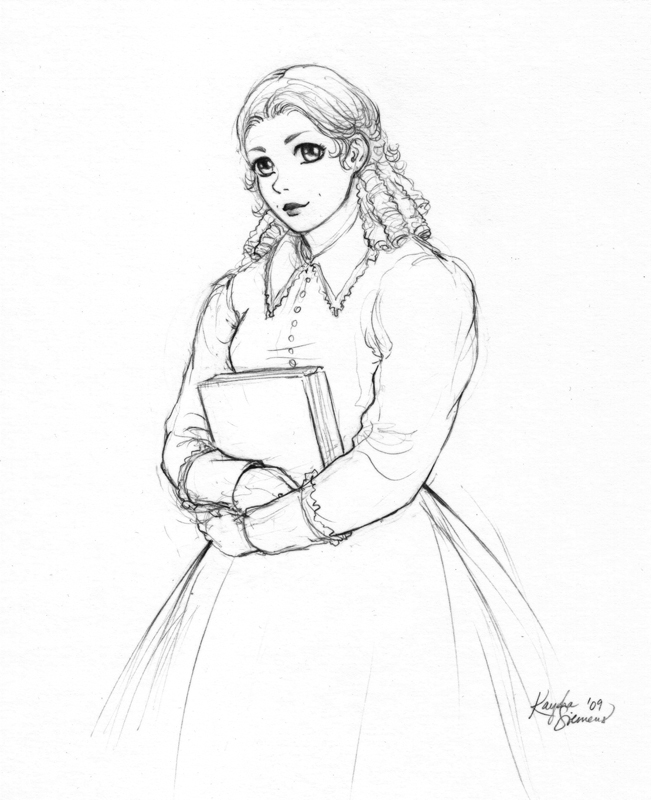
Valeraine is a round-faced, doll-like blonde, the sort prone to being underestimated. Artist Kaysha Siemens captures her perfectly, with the wide-eyed, eager expression and the precious book tucked in her arms. (Anyone attempting to get between Valeraine and her book would soon learn the error of underestimating her.)

In this excerpt, Valeraine and her master debate what should be done about the mysterious Meliroc:


Brave Bennelise and the Cursed Mountains beckoned from her bed. Beside it, her wooden penny-flute whistled to her. Both would surely speed her journey into slumber. Yet how could she content herself with reading of Brave Bennelise’s victory over the bloody-toothed Giant of Cormboise, when a giant now lurked outside her very window? The towering ivory woman with the heart of coal-fire meant adventure at hand. How could Set-in-his-ways Cedelair want to be rid of her?

“We cannot keep her,” he had pronounced, his jaw set in stone. “I will not have some ghastly hulking golem from who-knows-where haunting my home.”

All politeness, she’d pointed out, “Sir, we may not have much of a choice. She’s obviously under a geas. Let’s just give her a few tasks to do. Where’s the harm?”

“There may be quite a bit of harm. We can’t be sure of her real purpose here.”

“We could find out quickly enough.”

Master Cedelair had locked withering eyes upon her. “How?”

“The Seventh Tongue.” Her words had shrunk to near-silence under his gaze.

She’d felt the snap of his ire. If she wanted to see his face redden, she had only to mention the Seventh Tongue. “A last resort,” he’d insisted, his voice sharp and deep.

“Sir, we wouldn’t have been given the Seventh Tongue if we weren’t meant to use it on occasion.”

“Not now.”

“But the point remains, she’s under a geas. What better way to be rid of her than to remove it?”

“That can take time.”

“Time well spent, I think, the chance to do a good turn.” Valeraine’s chest had swelled with the spirit of Brave Bennelise, her mentor in print. “Sir, would you let me try? She can be my servant. You wouldn’t have to bother with her at all.”

He’d chortled under his breath. “Do you imagine looking after a giant will be as simple as looking after a lost puppy?”

“Far from it, sir. But I’ll learn all the more.”

Cedelair had flexed his jaw as if gnawing on some idea. “You’ll have your answer tomorrow. Now, off to bed with you.” He’d turned his back to her, unwilling to hear another word on the matter.

He was not truly an old man. A night’s hard thought on the question of the giant could rouse a dormant spark of adventure in him. So Valeraine hoped, as with a cool breath she pored over the pages of her book and saw and felt with her mentor, Brave Bennelise.

Valeraine for Kelley AWA 09_small

The Nightmare Lullaby 1: Meet Pierpon

If everything goes as planned, Spring 2016 will see the release of The Nightmare Lullaby, the second of my “Magic Music” novels. As one can tell from the title, nightmares play a significant role, so it shouldn’t be too surprising that the first of the four main point-of-view characters the reader meets is Pierpon, an imp whose responsibility (until recently, that is) has been the crafting of nightmares. He’s proud of his job, believing that a good nightmare can rouse the conscience of an erring human. Unfortunately, after his dark visions failed to frighten the fearless young sorcerer-apprentice Valeraine, he was kicked out of the dream realm, given corporeal form, and bound to Valeraine until he can find a way to scare her. It’s in this state that we meet him.

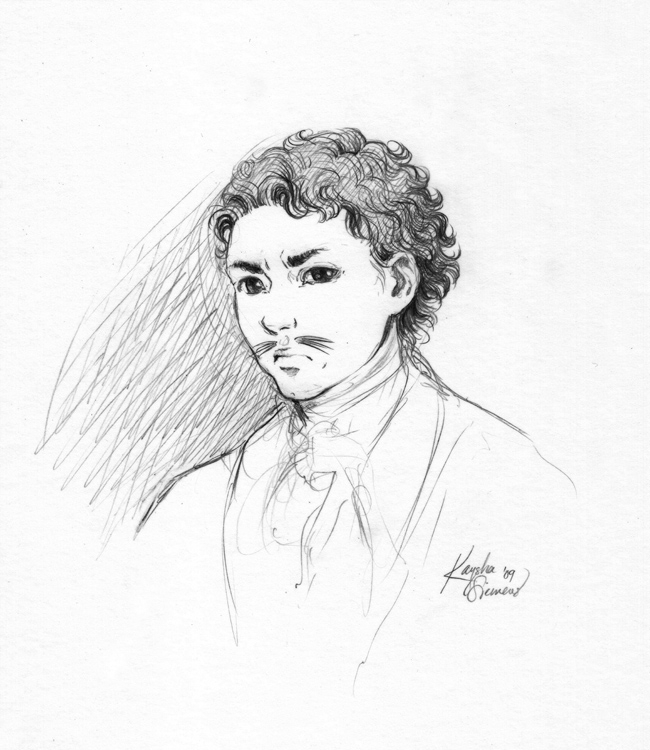
The drawing of Pierpon is done from a description I based on an earlier draft, in which he was more surly and out-of-temper than he ended up being in the final version. Still, the black curls, the big dark eyes, and the porcupine mustache are on-the-nose accurate. Many thanks to Kaysha Siemens.

The following excerpt from Chapter 1 shows the result of Pierpon’s ill-advised attempt to run away:

“Pain seared through Pierpon, turning his breath into daggers of ice in his chest. His eyelids froze shut. In his mind’s eye he saw the winter-devil of so many nightmares, its gaping mouth sending forth a cloud of bitter breath to sting him. Then a balm swept over him. A hand, he realized after a moment, warm as a hearth-fire, lifted him free of the smothering cold.

Nearby a drunkard swung from a bell-pull, creating a head-pounding clamor.

Water dripped from Pierpon’s eyes. Through the blur he could discern the outlines of a massive woman in a long black cloak. As his vision cleared he found green eyes staring down with cat-like curiosity. A tremble started in his toes. In his exile he’d grown used to the idea that only magicians, with their supernatural sight, could see him. This creature was either a sorcerer or something other than human. Perhaps both.

Clad in the simple style of a traveler, she wore black boots and trousers and a high-collared indigo tunic under the cloak. But it took him two good blinks and a rub at his eyes to make out anything like a face, near-invisible as it seemed against the snow. Her skin and her long, tangled hair were white – not pale, but the absolute white of an ivory statue given life by a demigod.

She had a clear brow, a sharp, slender nose, upswept cheek-bones, a delicate mouth, pointed chin, and slightly pointed ears, a little like his own. Her elfin face seemed out of tune with her gigantic stature. From his vantage point of four inches, ordinary humans looked enormous, but he took the measure of the folded legs, along with the length from her waist to her head. She was an authentic giant, at least eight feet tall. Such towering brutes lumbered through slumberers’ nightmares, swinging their clubs and threatening to roast any flesh-bearing thing within reach. He rolled in her palm, glancing about for an escape path.

She did not look hungry. A muted glow in her eyes suggested distraction. Her head tilted toward that ringing row nearby.

She set him down upon her leg and scooped up a handful of snow. As she breathed upon it it dissolved into water. With her free hand she helped him to sit and brought the water to him. He sniffed at it. ‘It’ll warm my insides, it will,’ he remarked with a pat of his ribs. Pierpon for Kelley AWA 09_small‘Much gratitude, ma’am.’ He lapped up the water from her palm, and by the time he’d drunk it dry, the last remnants of the killing cold had left him.

With a self-conscious twinge he attempted to smooth the wrinkles from his damp gray smock and breeches. He bowed from his waist. ‘Master Pierpon of Jicket-Castle, at your service, madam.’

The giant put a finger to her smiling lips and shook her head. He read her gesture easily enough. Pray keep quiet for now. He followed her gaze to a ledge a little above them, where sat a wagon with a shining silver roof. The wagon’s sides quivered whenever the racket swelled. Something inside it was making this noise.

The faces of a listening crowd in the valley beneath echoed the giant’s rapturous look, though perhaps less intense. Among them he spied a familiar lace-trimmed straw bonnet and under it honey-gold ringlets, a dimpled face, and a bell-skirted gown of bright coral taffeta standing out amidst the dark woolen coats and scarves and caps like a pink rosebud sprouting from a patch of brown leaves. Like the others, Valeraine stood stock still, attention riveted to the racket-making wagon. What did she and the rest hear in it that he could not? At least, distracted by the clamor, she did not miss him, and would never dream he’d managed to slip out of her basket hours ago.

The row faded to silence. Pierpon’s rescuer gazed at him with friendly eyes. A soft voice sounded in his ear. ‘Pier-pon.’