My Interview on ARTC’s Podcast

Not long ago, my friends at the Atlanta Radio Theatre Company paid me the tremendous compliment of asking me to be interviewed for the podcast. It’s available here! William Brown, one of the founders of ARTC, is a gracious host and questioner. I even like the photograph on the site, which shows me in my standard performing-for-ARTC mode.

ARTC will be performing at CONjuration in Atlanta, GA this weekend. If you’re in the area, and you love fantasy conventions but would welcome something a little smaller and less hectic than DragonCon, check us out! We’re performing on Sunday at 1 p.m. In “Alba Salix, Royal Physician,” I get to play a hyperactive fairy. This will be followed by “Nothing-at-All,” the play I authored which eventually grew into Atterwald. Each show is a delight in its own way, well worth seeing.

Things I’d Like to See More of in Fantasy Fiction: YA heroines with hobbies

A number of popular fantasy writers, particularly in YA, like to create “blank slate” protagonists, people who have few or no special qualities (at least evident on the surface) until the plots of their stories kick into gear. As their adventures proceed, they discover strengths in themselves they never thought they had. At any rate, this is ideally what happens, and watching it happen can be quite rewarding. Bilbo Baggins, the hero of The Hobbit, is quite happy in his life, with no desire for change. Yet as he’s forced into an adventure, he has to draw on unexpected qualities in order to survive — notably, quick wits, humor, and courage. “There is more about him than you guess,” Gandalf says more than once of Bilbo, and by the end of the story, J.R.R. Tolkien has shown us what he means.

We know thereby that a “blank slate” protagonist can be entertaining, yet I’ve noticed I appreciate such protagonists far more if they are male, largely because of the difference in the stories they tend to be placed in. Male blank slates like Bilbo and Harry Potter and Richard Mayhew of Neil Gaiman’s Neverwhere discover their heroic potential as they are placed in one crisis situation after another. Reserves of insight, generosity, and resourcefulness get them out of tight spots, and in the end, they save themselves and others. Yet entirely too often, the storylines given to female blank slates revolve around, not adventure, but romance. The girl with no particular interest in life learns to live for her special someone, and the ultimate goal of her story is not to learn to depend on herself and become a rescuer, but to depend on a love interest and be rescued. Crisis situations don’t bring out reserves of courage and ingenuity, because someone else gets her out of trouble.

Books with such “heroines” may be wildly popular with their target demographic of teen girl readers, but I can’t imagine that even as a teenager I would have enjoyed reading about such weak-willed, passive drips. I don’t want a female-shaped empty space that I can fill with my own personality and appearance. I want a heroine I can look up to, one who’s good at something. The heroines who win my heart most quickly are the ones with hobbies and interests.

My last foray into YA fantasy fiction was Betsy Cornwell’s Mechanica. It may be the umpteenth retelling of the Cinderella story, yet for me it stands alongside Marissa Meyer’s Cinder as one of the most enjoyable of those retellings, because its “Cinderella” is an inventor and engineer, who stumbles onto her late mother’s plans and makes them her own. Her goal is not to go to the ball and find romance, but to enter one of her creations in an engineering contest. She actually devises her own glass carriage and glass slippers; while she has some help from a sentient mechanical horse named Jules, she does most of the work herself. At no point is she a blank slate. Her head is full of mechanical dreams throughout, and this makes her perspective fun to read. Some reviewers have complained the book is too much like Cinder, which features the titular cyborg mechanic, also quite good at what she does. But since Mechanica is clearly steampunk and Cinder is clearly science fiction, I see plenty of room for both stories and both heroines.

The female leads of Mechanica and Cinder are both deeply involved in STEM. YA heroines of this kind are regrettably rare, but one more worth mentioning is the brainy young mathematician Caitlin Decter, who discovers and befriends a sentient, far-ranging A.I. in Robert J. Sawyer’s W.W.W. trilogy.

YA heroines with interests and skills in the arts are more common, but rewarding nonetheless. Some of my favorites are musicians: Menolly in Anne McCaffrey’s Harper Hall of Pern trilogy; Maerad in Allison Croggon’s Books of Pellinor; Zoe in Patricia McKillip’s The Bards of Bone Plain (which also features an archaeologist princess — a double win); Rune in Mercedes Lackey’s The Lark and the Wren; Seraphina in Rachel Hartman’s Seraphina and Shadow Scale. Some artist/ painter heroines include Iris in Gregory Maguire’s Confessions of an Ugly Stepsister, Karou in Laini Taylor’s Daughter of Smoke and Bone, and Madeleine in Andrea K. Host’s …And All the Stars. Then there are those with more generalized interests, for whom reading is not merely a pastime but a passion: Hermione in the Harry Potter series, Honor in Robin McKinley’s Beauty, Morwenna in Jo Walton’s Among Others, and Nepenthe in McKillip’s Alphabet of Thorn.

These sorts of heroines give the young female reader something concrete to which to aspire — to create, to build, to dream. Let’s see more like this, and fewer blank slates.

Five Things I Love about… The Nightmare Before Christmas

Tim Burton’s The Nightmare Before Christmas is one of my very favorite Disney films. It is without question my favorite Burton film, only Corpse Bride and Ed Wood (and maybe Beetlejuice, though I haven’t seen that one in years) offering it any serious competition. And it’s a Halloween tradition for my husband and me. This year we watched our Blu-Ray with the commentary turned on, and we heard auteur-producer Burton note that of all the movies he’s made, this is the most widely beloved, the one whose merchandise he is most often asked to sign. I might dislike some of what he’s done, but even if he’d made no other worthwhile film, he should still be remembered for this one.

My five favorite things about The Nightmare Before Christmas:

The songs. At least 50% of the movie’s running time consists of songs. Haters of musicals will want to stay away, but I’ve loved musicals nearly all my life, and while the melodies are hardly on a par with the best of Richard Rodgers or Jerome Kern, the songs do just what a good musical’s songs should do: illuminate character and advance plot. Each song is just what the story needs it to be. Which is my favorite? The tone-setting “This Is Halloween,” with its ominous driving beat of low strings? The exuberantly tongue-twisting “What’s This?”, inspired, as composer and lyricist Danny Elfman says in the commentary, by Gilbert and Sullivan? The yearning “Sally’s Song,” the emotional core of  the movie? “Kidnap the Sandy Claws,” with its sadistic black humor? “Oogie Boogie’s Song,” with its villainous jazzy swagger? You want me to choose? Nope. Can’t do it.

The look of the film. No “prerequisite” viewing is necessary to enjoy The Nightmare Before Christmas, but those who know a bit about the German Expressionist films of the 1920s should get a special kick out of the weird and wacky designs of Halloween Town, with its crooked twists and angles. By contrast, Christmas Town, into which our disillusioned Halloween hero Jack Skellington stumbles, is a riot of bright colors reminiscent of the happy Who-Ville of Dr. Seuss’s How the Grinch Stole Christmas — appropriate, since this movie offers an alternative take on Seuss’s story.

Jack Skellington. This movie asks its viewers to identify and sympathize with the Pumpkin King of Halloween Town, whose job it is to terrify people and orchestrate all the nightmares and horrors associated with his holiday. Against all expectations, Jack turns out to be a charismatic and engaging hero. We can appreciate his weary boredom with his life, his longing for something new, as he sings in “Jack’s Lament.” Likewise, we share his child-like joy as he explores Christmas Town and believes he’s found just what he’s been missing (“I want it, oh, I want it,” he sing-spiels in “What’s This?”). We can see why the denizens of Halloween Town adore him, because we come to love him too. Yet Jack is unique among movie heroes in that, while we understand his zeal to claim Christmas for himself, we know he’s traveling a wrong path. We don’t want him to succeed. He can only triumph in the long run by failing to achieve his short-term goal.

Sally. Burton’s films are known for their unorthodox, innovative, often iconoclastic male leads, a class to which Jack belongs. Yet the heroines in his films, with the notable exceptions of Emily in Corpse Bride and Lydia in Beetlejuice, tend to be cast as the representatives of convention, regrettably dull and passive. Sally, however, is a Tim Burton heroine I can actually love. True, she does represent “convention” to a degree, but it’s a Halloween Town kind of convention that’s automatically quirky. She’s a ragdoll created by a mad scientist, and she can break herself apart and stitch herself back together when the need arises. She loves Jack, worshiping him from afar, but while a lesser heroine might say, “My man, right or wrong,” when he forges ahead with his plans to take over Christmas, she challenges him and tries to thwart him. What I love most about Sally isn’t so much that she’s the voice of reason as that you won’t find an inch of Quit in all her stitching. Like Jack, she craves freedom and new experiences, and she escapes on a regular basis from the scientist who would like to keep her prisoner. When one plan fails, she comes up with another. She does need rescuing at the climax, but by then she has solidly established herself as an active heroine. She only finds herself in trouble because she alone has the sense and courage to try to rescue Santa Claus from Oogie Boogie’s lair.

The ending. In case anyone reading this blog hasn’t seen The Nightmare Before Christmas (what are you waiting for?), I’ll keep the details vague. I’ll just say this movie has what may be the most sweetly romantic final shot in any movie of its decade. Sigh.

I’ve heard the movie’s detractors complain that it sends a conventional, even reactionary message not to depart from the routine, not to try new things. I suppose if that’s the message you’re looking for, you’ll find it. But I see the movie as a redemption story. Only by departing from convention, by stepping out of the comfort zone that has become more burden than comfort, can Jack re-discover himself and come back home. Taking a risk, even if the risk brings about chaos and results in failure, can yield great rewards. Despite the scares, the movie’s conclusion is a happy one.

My Carolina Renaissance Festival Photo Album

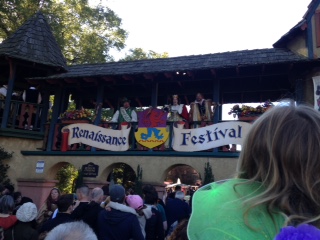
In the wake of my recent blog in which I share my love for Renaissance festivals, I post some pictures my awesome husband took at the Carolina Renaissance Festival on Saturday, October 17.

CARF Entrance The entranceway. We got there just five minutes before the gate opened.

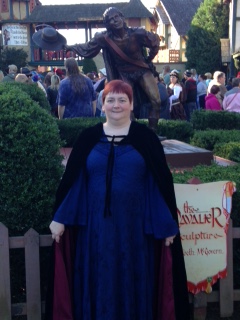
CARF Statue Self Here I am in my blue gown (courtesy of Holy Clothing.org) and cape (sadly can’t recall where I bought that).

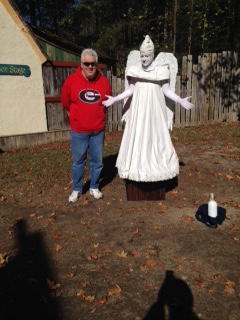
CARF Matt and Angel Statue My husband, Matt, poses with a Renaissance stone angel. Don’t blink!

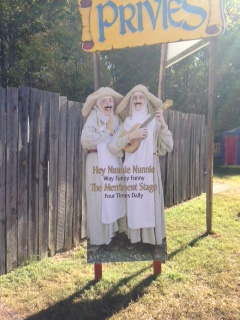
CARF Hey Nunnie Nunnie pic A poster for Hey Nunnie Nunnie, a favorite act of ours.

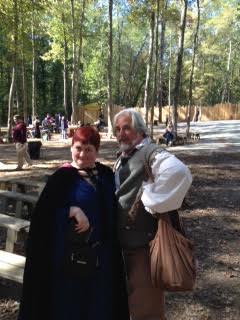
CARF Me and Zilch Here I am with Zilch the Torysteller, master of Spoonerisms.

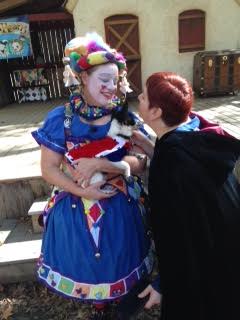
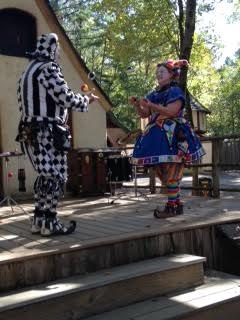
CARF Ima and Peanut Ima Nutt, the female half of Fool Hearty, introduces me to the youngest member of her and her husband’s dog family, Prince Peanut the long-haired Chihuahua.

CARF Ima and Marquis Ima and her husband Marquis juggle in their first show. We would return later for the Untrained Dog Show.

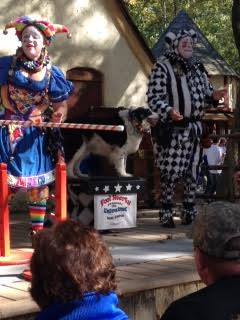
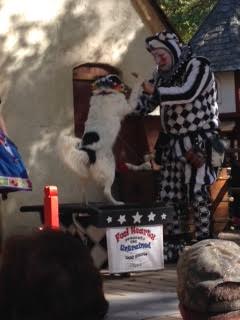
CARF Fool Hearty and WingnutAnd this is the Untrained Dog show. The gorgeous creature in the middle is Wingnut, who is so smart that she can get her own treats from the bubblegum-machine style treat dispenser.

CARF Marquis and PolkaDotHere is PolkaDot, the third member of the doggie troupe, dancing with her daddy Marquis.

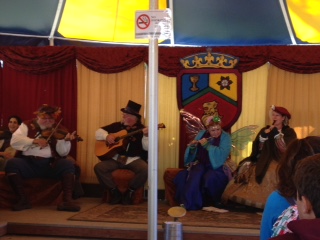
CARF Lissekeole dancersCARF Musicians Dancers and musicians welcome visitors in a tent just inside the Fair.

Five Things I Love about… Renaissance Festivals

In the eyes of pop culture, Renaissance festivals are distinctly uncool. Pop-culture sound bytes from TV shows like Gilmore Girls and The Daily Show to advertisements for Free Credit Report present Renaissance festivals as places where only “losers” work or hang out. But one of the chief geek virtues is that we have never allowed mainstream disdain, born of myopic misunderstanding, to come between us and the things we love. My husband and I are proud Renaissance festival-goers. We make our pilgrimage to Georgia’s festival at least twice each spring, once with dog in tow for Pet Friendly Weekend (which my husband wrote about earlier this year) and once without. Last year we went to the Carolina Renaissance Festival in Huntersville, NC for the first time, and this year we went back; it promises to become another tradition.

So what draws us? Five things I love about Renaissance festivals:
Costumes. As a child I loved to play dress-up and I’ve never outgrown it. For the Renaissance Festival, as for DragonCon, I clothe myself in my most comfortable period garb (half purchased from the festival itself at various times, and half from Holy Clothing) to enter the other world. And here, as at DragonCon, I get a kick out of seeing legions of fellow time-travelers getting their geek on in flowing gowns, pirate coats and boots, kilts, chain mail, and fairy wings. I have a soft spot for the fairy wings, as they serve as one of many reminders that the Renaissance Festival depicts not the gritty, grimy realistic past full of rampant disease and infrequent bathing, but the past of fairy tale and legend where fairies and dragons take wing. When I don my gowns, I become part of the fantasy.

Shows. We go to the Renaissance Festival not only to step into the fantastic but also to revel in enthusiastic silliness. The performers we love to revisit present themselves with unflagging energy and good-natured humor that ranges freely from groaners to zingers. We delight in the randy antics of the Tortuga Twins (all three of them), the playful songs of Hey Nunnie Nunnie (e.g. “Five Constipated Men in the Bible”), and the agile feats and winking camaraderie of the Barely Balanced acrobatic troupe. Last year at Carolina we discovered London Broil, Don Juan and Miguel, and Zilch the Torysteller, whose Spoonerisms and sharp sense of humor quickly won him a place among our favorites. This year we got to know the husband-and-wife jester duo Fool Hearty; in their “Untrained Dog Show,” a treat-snatching Border Collie named Wingnut ran away with my heart. What engages us most is the very obvious love these people have for their work and for their audience.

Music. Music is everywhere at the Renaissance Festival. Talented instrumentalists and singers abound, offering a variety of tunes from sea shanties to Celtic folk songs to rock music with a Renaissance flair (the Lost Boys!). Some of my favorite musical acts are the most unorthodox; last year we heard a mini-concert on the glass harmonica, and several years ago we were treated to a performance by a masked master of the carillon, which planted the seed in my imagination that would eventually grow into my Novel no. 2, The Nightmare Lullaby. Like the acrobats and comedians, these musicians love their work, and one of their most delightful aspects is their authenticity. No AutoTune in sight!

Food. All right, nobody expects to eat healthy, or cheaply, at the Renaissance Festival. Yet all of us regular festival-goers have our favorite fair cuisine. My husband loves a good turkey leg and a chocolate-covered banana. I enjoy a concoction called a “strawberry pillow,” a fresh croissant topped with a layer of whipped cream topped with a layer of fresh strawberries. So far I’ve only found this drool-worthy treat at Georgia’s festival, but Carolina makes up for the lack with a bakery that serves super-moist cakes worthy of a high-end restaurant’s dessert menu. My sweet tooth is throbbing even now.

Shopping. I have to be careful with this one. Each time I pass a clothing shop I have to tell myself, “I don’t need another one.” My mantra is, “Look, don’t buy.” But looking has pleasures of its own, with all the gleaming, gorgeously-designed swords, adorable feathered dragon-puppets, bewitching incense, detailed and colorful fantasy art, and classic tapestries on display. And of course we have the sky-chairs. Matt and I try to get in at least five minutes in the sky-chairs each festival visit.

I would be remiss if I didn’t mention one of my favorite parts of our first 2015 visit to the Georgia Renaissance Festival: the Pet Costume Contest, where Pomeranian princesses in conical hats and Golden Retriever knights in black armor strut their stuff. This year one of the winners was “Thor,” a tiny brown dachshund clad in the cape, armor, and helm of the Son of Odin. His black-and-tan brother “Loki” didn’t make it onto the podium, but Matt and I both got a kick out of his Harley-Davidson leathers.

Coming soon: a Renaissance Festival photo album!

Five Classic Horror Films I Love

(This blog was originally titled “Five Things I Love about… Classic Horror Films,” but I decided on another approach.)

With the emphasis on ghosts, witches, monsters, and other things supernatural, October is a fantasy lover’s dream. When October comes, I know it’s time to turn to my DVD collection of classic horror movies for some quality entertainment.  That makes October my favorite month of the year.

I have a love/hate relationship with the horror genre. On the one hand, I loathe to my very core the “slasher films” in which casts of nubile teenagers are set up for indiscriminate slaughter in the most gruesome fashion. Such movies are distressingly unimaginative, not to mention misogynistic, as most of the victims are young women and their painfully protracted death scenes qualify as torture porn. Yet classic black-and-white horror films intrigue me with their play of light and shadow, their aura of the unexpected. They aren’t slaughter-fests; in most of these movies the body count, at least of recognizable characters, is fairly low. They have ideas at their root. Plus, they feature some wonderful performances.

Five classic horror films I love:

The Mummy (1932).

Boris Karloff isn’t just one of my favorite horror movie actors; he’s one of my favorite actors, period. 1931’s Frankenstein made him a star, and with 1932’s The Old Dark House his star rose a little higher, but in both these films he played mute characters. By contrast, in The Mummy he makes full use of his slightly lisping and wonderfully resonant baritone voice. Unlike the mindless priest-controlled bandaged corpse who shambles through the “Mummy” movies of the 1940s, Karloff’s millennia-year-old undead Egyptian thinks and acts for himself, and he’s a fascinating character. The movie does have flaws, most notably the pacing. My husband doesn’t care much for it because he finds it moves too slowly, and I can’t say he’s wrong. Yet I get caught up in the idea of a 3,700-year-old man suddenly reborn into a modern world he couldn’t possibly recognize in any way. What would such a man live for? Why, the same thing he died for — forbidden love.

(One side-note on The Mummy: I was watching this movie back in 1995, at the beginning of my Auburn University days, the night Hurricane Opal blew through town. I went to the bathroom during a commercial break, and while I was in that windowless room with the door shut, the power went out. The “flashback-to-ancient-Egypt” scene, with its dirge-like score, had just aired. I was trapped in total darkness with that music in my head. I won’t forget that experience anytime soon.)

The Body Snatcher (1945).

A case can be made for Targets (1968), as well as for his voice work in 1966’s How the Grinch Stole Christmas, but many would assert that the great Karloff gives his best performance in this grim historical drama about a grave robber who resorts to murder so he can continue supplying a renowned doctor with cadavers and thus maintain his diabolical hold over the man. (Ubiquitous classic-film character actor Henry Daniell, who plays the doctor, also gives an excellent performance.) One of the masterworks of producer Val Lewton, directed by Robert Wise, the movie has atmosphere to burn. It also includes one of the most chilling murder scenes in the genre’s history, one that takes place entirely in the shadows (we hear the crime rather than see it) and is over very quickly, all the more unnerving for its brevity. This one scene offers an exemplum of why the classic black-and-white horror film is ten times more compelling than the modern slasher film.

The Bride of Frankenstein (1935).

Oddly enough, this sequel to Frankenstein is more faithful than the original film to the letter and the spirit of Mary Shelley’s novel. The moving sequence involving the Monster and a blind hermit (brilliantly parodied in Mel Brooks’ 1974 masterpiece Young Frankenstein) has its roots in Shelley, though the relationship works out differently in the novel. The movie also includes a bit straight out of Shelley, in which the Monster rescues a shepherdess from drowning and is rewarded by her terrified screams. Yet what really distinguishes this movie is director James Whale’s black sense of humor, best displayed in the character of Dr. Pretorius, played with maximum camp by Ernest Thesiger. He has a bitterly dark soul, yet he’s the only (sighted) person not to react in terror to the Monster’s approach. The movie is funny in the right places, but the brief encounter between the Monster and his newborn bride is downright heartbreaking. Again, unlike the modern slasher film, the classic black-and-white horror film can make an audience care.

The Invisible Man (1933).

Any true classic movie buff should admire this one at least a little bit, since it introduced the public to Claude Rains, who appeared to faultless advantage in Casablanca, The Adventures of Robin Hood, Mr. Smith Goes to Washington, Now, Voyager, Notorious, and countless other classics. Rains was James Whale’s only choice to play mad scientist Jack Griffin, who is turned invisible by experimental drugs but then discovers he can commit crimes almost with impunity. Universal Studios was pushing Whale to cast Karloff. I don’t doubt that Boris would have been awesome, yet thank God Whale won the battle. Equipped only with his unique voice, Rains turns in a marvelously manic performance. He’s the central character, with no stalwart hero going up against him. We see society grapple with him, but a part of us can’t help being on his side, since he’s by far the most dynamic individual around. He is brought down for the greater good, yet we feel something tragic in his loss.

The Uninvited (1944)

Can a horror movie be romantic? Actually, yes, as this film demonstrates. It has all the right horror-movie trappings: a haunted house, an abundance of dark secrets, an insane asylum that’s terrifying in its squeaky-cleanliness, beautiful light-and-shadow interaction, and the threats of madness and death. Yet it also has a lush, lyrical music score by Victor Young to set a romantic tone, and it has Ray Milland, perhaps the most charismatic of all horror-movie heroes, paying court to the beautiful, mysterious Gail Russell. Milland’s equally charming sister, Ruth Hussey, is also a welcome presence. So often the “good guys” in horror films are bland ciphers, but these are horror movie heroes we can actually root for.

A few runners-up:

The Wolf Man (1941). This film establishes the big-screen werewolf mythology and features memorable performances by Lon Chaney Jr., Bela Lugosi, Maria Ouspenskaya, and the priceless Claude Rains.

The Walking Dead (1936). Karloff is at his most sympathetic here, playing a wrongly convicted and executed man brought back to life. This one has a higher body count than most horror films of the day, but here the victims have it coming.

The Devil-Doll (1936). Lionel Barrymore does the revenge thing disguised as an elderly lady whose “dolls” he can psychically animate to do his bidding.

Dead of Night (1946) and The Curse of the Demon (1958), two hauntingly atmospheric horror films from England.
Things I Would Like to See More Of In Fantasy Fiction, Part 4

Heroines who are rescuers.

I’m well aware that every person, however strong, occasionally needs to be rescued. Getting in trouble and needing a bit of help to get out of it does not necessarily make a character weak, and may go with the territory because said character is willing to take risks. Nonetheless, when I’m browsing Goodreads in search of titles I might find worth reading (despite my To-Read pile already being higher than Mt. Everest), I tend to shy away from books with female leads in which some variation of “…is kidnapped by…” and “…is rescued by…” appears in the plot blurb, and I’m particularly leery when the blurb indicates the kidnapped heroine will at some point fall in love with the hunky vampire/werewolf/bandit/pirate who has captured her. I find it distressing to see so many books with plot blurbs like this, especially in YA fantasy.

This may seem a tad hypocritical of me considering my first novel, Atterwald. I’ve been fond of calling it, “‘Beauty and the Beast’ meets The Secret Garden, with shape-shifters,” and people seem to like that description. But “Beauty and the Beast” has been decried, not groundlessly, as a “Stockholm Syndrome” story, and the main thrust of my plot does involve my heroine, Nichtel, falling into the hands of a villain who demands she complete a task in order to free herself. Yet I can say, without giving too much away, that while Nichtel might seem a distressed damsel at first glance, she proves in the fullness of time to be something I feel the genre could use: a rescuer heroine. On occasion she may need saving, but she is also a savior. This is the kind of character I want to read about, as well as showcase in my own fiction.

I have to be sparing with the detail in order to avoid too-serious Spoilers, but I can recommend some good books in which the heroine is savior rather than saved (or at least, as well as saved):

Django Wexler’s The Thousand Names and Ben S. Dobson’s Scriber both showcase female soldiers who preserve and protect those under their command. When danger rears its head, they are quick to face it down.

Barbara Hambly’s Stranger at the Wedding features an outcast older daughter who has scandalized her family by becoming a wizard, but who risks her life and health to save her imperiled younger sister.

Juliet Marillier’s Daughter of the Forest is a retelling of the fairy tale “The Six Swans.” In the novel, as in the tale, the heroine endures great pain in order to save her brothers from an evil enchantment. Physically weak but incredibly brave, she proves a heroine need not be a warrior or even a powerful wizard in order to be a savior. (A YA retelling of the same tale, Zoe Marriott’s The Swan Kingdom, is also good.)

Vonda McIntyre’s Dreamsnake features one of the most impressive rescuer heroines I’ve read about in the past five years, a healer who may not be able to save everyone she tries to help, but nonetheless never stops trying. Also impressive is the heroine of Naomi Novik’s Uprooted, who starts out by saving a friend and eventually saves her whole world.

To learn just how all these rescues are accomplished, read these books and get to know the heroines in them. It will be time well spent.

Five Things I Love about… Brooklyn Nine-Nine

It’s the new fall television season, so it’s time for me to pay tribute to some of my favorite shows. I’ll start with the one that took me the most by surprise last year, Sunday night’s “cop comedy” Brooklyn Nine-Nine. Five things I love about this funny, good-natured show:

The characters are engaging.

This show took me by surprise because I don’t normally care for sitcoms. Too many of them, I’ve always thought, rely on one-note characterization and snarky put-downs, allowing little room for character or relationship development. I can recall an Entertainment Weekly article pointing out that sitcoms exemplify the charm of stasis; since the characters don’t change in any meaningful sense, the audience can rely on them to be funny in the same ways, week after week. Good for you, EW; you put into words why I prefer to avoid sitcoms.

Brooklyn Nine-Nine‘s first couple of episodes might not show much departure from that norm. The show needs to establish its characters’ principal traits. Jake is the wisecracking clown who rarely takes anything seriously. Boyle is the foodie nerd with the huge man-crush on Jake. Rosa is the humorless tough gal. Amy is the ambitious overachiever whom nobody in the office likes very much. Holt is the dour, deadpan authority figure who happens to be gay. The one most fleshed out from the get-go is Terry, the iron-strong sergeant and devoted family man. But in the course of the first season, the show carefully broadens these characters beyond these primary identifying traits. Jake is very good at his job and cares about his colleagues. Boyle is smart and observant. Rosa does have a sense of humor; it just manifests itself in unusual ways. Amy earnestly wants to do the right thing and can be a loyal, giving friend. And Holt… more on him in a minute.

Andre Braugher shows he has major comic chops.

Before Airplane!, Leslie Nielsen had never made a comedy. That one film showed he could be brilliant in the genre, and it changed the direction of his career. Likewise, Andre Braugher, who plays Captain Holt, has always been known for serious roles, and acclaimed in those roles even when the movie or show around him isn’t up to his level. To my knowledge he has never given a bad performance, but apparently up until Brooklyn Nine-Nine, it hadn’t occurred to anyone just how he might excel in a comedy. It turns out that Braugher succeeds in being very, very funny by playing Captain Holt absolutely straight. He rarely cracks a smile. He speaks in a deep, serious monotone. He never intends to be funny, or even amusing — an effective contrast to Andy Samberg’s Jake, who is quite self-consciously funny. Holt is hilarious because he has no idea he’s hilarious. One of my favorite moments from last season: Holt in tears as he sits in a theater watching his favorite movie, Moneyball. “Statistical analysis… it’s so beautiful!”

The cast is wonderfully diverse.

Jake and Boyle are white guys. Holt and Terry are African-American. Rosa and Amy are Latina. Holt is in a happily stable marriage with his husband, Kevin (played by Marc Evan Jackson, whom I also know as “Sparks Nevada, Marshal on Mars,” from the Thrilling Adventure Hour podcast). I’m hard pressed to think of a more diverse cast on a current TV show. Yet the show never sets aside its comic storytelling to hand down any heavy-handed sermons about diversity. It simply sets its characters in motion and lets them be who they are — which, in the end, may be the best message about diversity we could hope for.

Two of the main male characters are happily married.

One of the most disheartening features of current and recent comedy, on the big and small screen, is the prominence of the “boy-man,” the male character(s) locked in a state of permanent adolescence, unwilling to commit to a job or a romantic relationship or anything that smacks of responsibility. The Brooklyn Nine-Nine character who most nearly fits the “boy-man” type is Jake, the young dude who likes to flirt and can’t stop with the one-liners — though even he departs from the type, through his dedication to his job, and he may be settling down on the romantic front as well. Two of the show’s most significant male characters, Holt and Terry, go further than that. Mature, sensible men who are committed to both career and spouses (and, in Terry’s case, children as well), they offer sorely needed proof that male characters can be honest-to-goodness adults and still be very funny.  And, for bonus points, Terry’s children are named Cagney and Lacey.

It’s funny and good-natured.

The show isn’t perfect. Some of the elements I see as flaws have been praised by others, most notably Kyra Sedgwick’s Madeline Wuntch, whom many of the show’s fans see as a worthy nemesis for Holt but who comes across to me as an unpleasantly stereotyped caricature of the Evil Boss Lady. (Honestly, how many of those do we need?) Yet when we leave Wuntch out of the equation, we see a cast of characters who actually like one another, help one another, and support one another. Even Gina, Holt’s narcissistic assistant who seems to be around to fill that apparently necessary “snarky put-down” quotient, can on occasion be generous and helpful, usually when interacting with Jake or Holt. It’s clear the show’s creators like these characters, and so, even when they’re at their most mistake-prone, we like them too. It’s good to see a show that does not rely on mean-spirited hostility for its humor.

Things I Would Like to See More of in Fantasy Fiction, Part 3

Heroic female dragons.

Not everyone likes dragons. They’ve fallen slightly out of favor of late, with a number of writers and readers pointing to them as the chief example of overused classic-fantasy stock characters that the genre as a whole should move beyond. That a fair number of fantasy writers are laying dragons aside and seeking out less well known yet no less fascinating mythical beasts to include can only help the genre stay fresh and inventive. Yet dragons aren’t going away anytime soon. They’ll be a fantasy staple as long as readers like me exist. I can sympathize with the reasoning of those who dislike dragons, but darn it, I love them. And while, with their great, strong wings and fiery breath, they make splendid villains, I have a soft spot for those who use their awesomeness for Good.

Yet I have a quibble. While heroic dragons are fairly plentiful in the current fantasy landscape, it seems at least 80% of those dragons are male.

Who are the most recognizable dragons in the Disney cinema canon? The big, clumsy, loyal, lovable male Elliott of Pete’s Dragon, who protects a young boy from danger, and the monstrously evil shapeshifted female Maleficent of Sleeping Beauty, who threatens to decimate a valiant hero. In her famous Temeraire series, Naomi Novik pits her magnificent though child-like dragon hero Temeraire against the vengeful dragon villainess Lien. In Mercedes Lackey and Andre Norton’s The Elvenbane and Elvenblood, good-hearted male dragon Keman must do battle with his wicked sister, Myre, and has to goad his ice-cold mother into doing the right thing. Lackey’s series The Enduring Flame, co-written with James Mallory, also juxtaposes a heroic male dragon (or at least, an ally of the heroes) with a villainous female. Melanie Nilles does the same in her novel Legends. Diana Wynne Jones’ entertaining Dark Lord of Derkholm also features a male and female dragon, and again, the male plays a major heroic role, while the female, though not out-and-out evil, is depicted as vain and unlikable and gets very little page time.

Then, of course, we have quite a few paranormal romances that feature dragon shifters, as this Goodreads list makes clear. In at least nine out of every ten — probably even more than that — the shifter is male, and his love interest is a human woman. Then we have stories that leave female dragons out of the picture altogether. With only one exception I can think of, and that exception lamentably bad (the screen adaptation of Christopher Paolini’s Eragon), the “last dragon” in movies and television shows is invariably male. In George R.R. Martin’s famous saga A Song of Ice and Fire, all dragons are male, as if the very idea of the dragon were inherently masculine.

Where are the dragon heroines?

There are a few, but you have to sift through an ocean of heroic males in order to find them. Anne McCaffrey’s Ramoth (Dragonflight) and Zaranth (The Skies of Pern) certainly deserve mention. The most enjoyable is probably Kazul, the female who fights to claim the title of King (not Queen) of the Dragons, and proves a loyal friend to a wayward princess, in Patricia C. Wrede’s Enchanted Forest Chronicles (beginning with Dealing with Dragons). E.E. Knight also presents readers with a dragon heroine, the complex Wistala, in his Age of Fire series. Jane Yolen’s Pit Dragon Chronicles and Mercedes Lackey’s Dragon Jousters series also feature sympathetic female dragons, but unlike Ramoth, Zaranth, Kazul, and Wistala, they are strictly animal in intelligence. Saphira in Paolini’s Inheritance Cycle may be impressive, but Paolini’s work lacks the polished prose and the creative world-building that would draw me to it. Rachel Hartman does a better job in her YA novels Seraphina and Shadow Scale, particularly the latter, in which two dragon heroines play significant supporting roles. Kitten, the female dragonet who features in Tamora Pierce’s Immortals series, is also engaging. Yet despite good examples, dragon heroines are so vastly outnumbered by dragon heroes that they have a lot of catching up to do.

As a long-time dragon lover, I’m doing my part in my own writing, telling my own stories of dragon heroines. At DragonCon 2013, the Atlanta Radio Theatre Company gave the premiere performance of my play In Need of a Bard, which features a female dragon in a heroic role; formerly a princess, she was bewitched into her current form by a jealous stepmother, but she loves the change, calling it the best thing ever to happen to her, since she can battle the evil forces that beset her world far more effectively than before. In “Firegale at the Festival,” my offering for Gilded Dragonfly BooksLegends of the Dragon, Vol. 1, the dragon heroine is tasked with learning everything humankind has to say about dragons, so every year she assumes human shape and goes to DragonCon. She may not battle evil on a large scale, but her generous spirit shines through as she takes a couple of Con-going newbies under her (ahem!) wing.

At a couple of points in her story, Firegale contemplates writing a novel. I think of my brand-spanking-new project All Color as the novel she might have written, the story of a dragon who loves humans (female) and a human who loves dragons (male), friends who must venture beyond their mutual comfort zone when the theft of a talisman traps the dragon in human form. I can’t say more, since I am just beginning the first draft and untold twists and turns may lie ahead. But I look forward to the time I’ll spend in my heroine’s head.

Interview with Brad Strickland

Today’s guest is acclaimed and prolific author Brad Strickland.

Brad has had quite an impact on me. It was he who first put into my head the idea of going to my first DragonCon in 2003, after which my life was never quite the same. He introduced me to the Atlanta Radio Theatre Company and generously served as beta reader for a number of my plays for the group. He’s been kind, supportive, an all-around mensch, and I’m glad to have the chance to share some of his words with you.

Me: Biography/ work history?

Brad Strickland: I’m a native of New Holland, Georgia. It’s a mill village and I grew up there, though my maternal grandparents were farmers, and I spent lots of time on the farm with them, too. I have a Ph.D. in American Literature from the University of Georgia and did postdoctoral study in the literature of the American South at the University of North Carolina at Chapel Hill. For over 35 years I taught English, primarily at the University of North Georgia (formerly Gainesville State College). In 2014 I retired and my wife Barbara and I moved to Snellville, Georgia, to be closer to our first grandchild, Elora Sweeney. I began writing while still in high school and sold my first short story to Ellery Queen’s Mystery Magazine when I was about sixteen. For a time I taught in Georgia’s annual Governor’s Honors Program, and a fellow teacher there–in science, not English–got me interested in writing science fiction. I sold a number of stories to the four big SF magazines of the day and as a result, an agent, Richard Curtis, got in touch with me and urged me to write a novel. I did, he sold it, and since then I’ve written eighty-odd in all, not all under my own name!

Me: As a writer and a reader, what is your favorite thing about speculative fiction?

Brad Strickland: The fantasist and mystery writer John Bellairs said it best: With this kind of writing, you can let your imagination run wild! I like the exciting “what ifs” about this kind of storytelling, but I also like the discipline that it takes to control a magical story. Magic has to have rules–if anything can happen in a story, then nothing much is interesting about it. There must be limits. As Robert Frost said about free verse, there’s no fun in playing tennis with the net down. So world-building, setting up a convincing society, creating defined technologies or systems of magic–this is all part of the creative process for speculative fiction. I stand in awe of J.R.R. Tolkien, who created a world, various races, and five or six languages–legitimate though imaginary languages, each with its own vocabulary and grammatical rules–before writing The Hobbit and Lord of the Rings.

Me: Which of your works are you proudest of, and why?

Brad Strickland: My favorite book of my own doesn’t fall in the speculative fiction category. It’s When Mack Came Back, a historical YA novel about life on a North Georgia farm in the last year of World War II. I put a lot of my childhood memories in it–though I’m not quite that old–and the farmhouse is my grandpa’s farmhouse, the dog in it is one of his dogs, incidents in the book are based on ones that happened to me, and so on. I don’t think it’s nostalgic, but it does a good job, I think, of capturing the feel of a certain place and the people who inhabit it.

Another of my favorites is Wicked Will, a YA mystery in which a twelve-year-old William Shakespeare turns amateur detective to solve a murder that occurs in Stratford-upon-Avon. I had a lot of fun working echoes–or maybe foreshadowings–of a great many Shakespeare plays into that one.

Me: Who are some of your favorite science fiction and fantasy authors, and why?

Brad Strickland: Ray Bradbury, first of all, because he stirred my imagination when I was a kid. Loved The Martian Chronicles–science fantasy rather than strict science fiction–and even more Something Wicked this Way Comes. Bradbury had a poet’s ear and a reporter’s eye and the people in his stories take on a life of their own, with a style, a bounce, and depths that are hard to match.

For spooky stuff, Arthur Machen, whose tales evoke a sense of wonder–there’s a whole unsuspected universe whose laws are not our laws, just on the other side of a thin veil…and when the veil is parted, terrible things come through! To just a slightly lesser degree, H.P. Lovecraft, though his deliberately archaic prose style I find now less enthralling than it seemed when I was a teen.

Tolkien, of course, for the epic sweep of his stories, the sense of grandeur–anchored by the humble hobbits. Good lesson there–For all the magic and wonder you create, touch your foot to the earth now and again to remind us of the enduring human values.

Me: What would you like to see more of in speculative fiction?

Brad Strickland: Bigger paychecks for those of us who write it!
Oh–well, I’d like to see more optimism. I find too much fantasy cynical and dark these days. A little light would help, I think!
(I agree completely.)

Me: What would you like to see less of in speculative fiction?

Brad Strickland: Corollary of the above: I am sick and tired of vampires, whom I find boring. Vampire fiction feeds on itself–and the movies. Little if any of it takes any cognizance of the actual folklore about vampires; and if it did, we’d find they’re about as romantic as a rabid wolf. Lovecraft had an idea that writers should pursue–invent new creatures, new magics, alien and unknowable beings and realms.

Me: What advice would you give aspiring writers of science fiction and fantasy?

Brad Strickland: Don’t quit your day job–it’s very hard to break in.
Be true to your own vision and your own story. Don’t just imitate someone else–nobody but you can tell the story that you most want to read.
Avoid jumping on bandwagons. By the time you find a seat, the ride’s over; don’t write for trends. If baseball werewolves are big right now, by the time your book’s finished, the trend is over.
Don’t think editors are your natural enemies. You and an editor are on the same side: both of you are trying to get the best possible version of your story before the public.
As Sir Winston said, “Never give up. Never, never, never, never, never give up.”