Announcement: “Haunting Tales” now available in paperback

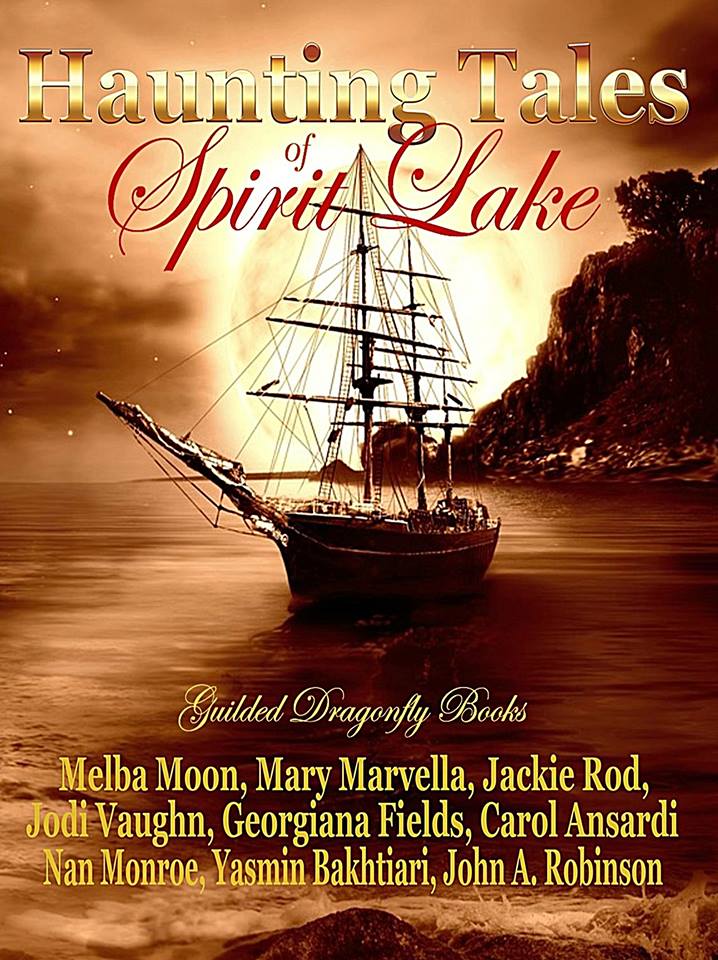
Gilded Dragonfly’s anthology of spooky Halloween stories, Haunting Tales of Spirit Lake, is now available in both Kindle and paperback! My short story “Sybilla diSante and the Sepia World” is one of many enjoyable stories in this collection.

Not much happens in the quiet Georgia town of Spirit Lake, yet when a masted sailing ship suddenly appears in the middle of the lake on Halloween night, mysteries swirl around it. What can it mean? Gilded Dragonfly’s authors offer a variety of possibilities. Check it out!

Romance and the Other, or, Why My Heroines Are Monsters

The current trend in romantic relationships in fantasy and science fiction seems to be the pairing of a human girl with a supernatural guy (vampire, werewolf or other shifter, alien, dragon, etc.). Stephenie Meyer’s Twilight series offers perhaps the most famous (infamous?) example, but examples in YA fantasy alone are legion (e.g. Hush, Hush, Fallen, Warm Bodies, I Am Number Four, Tiger’s Curse…). Non-YA examples include Soulless, A Turn of Light, Song in the Silence, War for the Oaks, The Silvered, One Good Knight, the Kate Daniels series, the Anita Blake series, the Kitty Katt series, Aiken’s Dragon’s Kin series, and most of Linnea Sinclair’s work. These are just the ones I can name off the top of my head. Truthfully, I can’t browse Goodreads for even one hour without stumbling upon at least one book that purportedly tells of undying love between a human woman and a male Other.

I do not say these books aren’t good. They vary in quality. Three that I’ve read (Soulless, War for the Oaks, The Silvered) are quite good, and I’ve heard very good things about A Turn of Light and Song in the Silence as well. There is nothing inherently wrong with “human girl/supernatural guy.” But the sci-fi and fantasy landscape is so heavily saturated with these kinds of stories that I can’t help wondering: why do we almost never see it the other way around? Why can’t the guy be the human, and the girl be the Other, at least once in a while?

Female Other protagonists aren’t entirely unknown; some popular examples are Mercy Thompson of the Moon Called series, Elena of the Bitten (Women of the Otherworld) series, and Magiere of the Noble Dead series. Yet when characters like these are paired romantically, it’s usually with a supernatural mate, rarely with a human hero.* Do writers find it difficult to imagine a human hero falling for an Other heroine (as opposed to an Other femme fatale, like Keats’s La Belle Dame Sans Merci)? Or are they simply giving audiences what they want?

The vast majority of these stories of human women finding love with supernatural men are written by, and marketed toward, female readers. The presumption is that women will identify more quickly and completely with the heroine if she’s human as they are. Sometimes, mostly in urban fantasy and science fiction, the human heroine comes equipped with mage-craft and/or top-flight butt-kicking skills. Other times, mostly in YA fantasy, great care is taken to make the human heroine as unexceptional as possible, a contrast to the exceptional boy who loves, protects, and rescues her. Her very ordinariness (words like “typical” and “average” crop up a lot in synopses) is part of her draw; any teenage girl, regardless of features, can imagine herself as the heroine who is loved, protected, and rescued by her fantastic Other mate. I once asked a girl shopping at a book counter with me, whether she ever wished the girl could be supernatural and the boy normal. Her answer was an emphatic “no.” If the girl were supernatural, the shopper explained, then she would be more powerful, and the boy should always be more powerful.**

So I learned the market for human gal/supernatural guy stories won’t run dry anytime soon. The fantasy is a potent one, likely to draw in many a reader: no matter how ordinary you think you are, you can win the love of someone extraordinary. Yet this has never been my fantasy, even in my teenage years. Being loved by someone extraordinary is all well and good, but I wanted to be extraordinary. I wanted to daydream myself into the shoes of heroines more remarkable than myself. I still do. My real issue with human gal/supernatural guy stories, even though I may enjoy certain specific ones, is this: no matter how badass she is, the woman is still only human, while the man can be anything. The wonderfully weird, monstrous qualities for which I’ve always had a soft spot are given to him, not to her.

So I’ve resolved that my heroines — even the human ones — should have a little monster in them somewhere. They should be the ones to test the usual rules of what is considered “loveable.” The first play I wrote for the Atlanta Radio Theatre Company, The House Across the Way, is a Cinderella retelling in which the heroine is a smallpox survivor with a horribly scarred face; the normal hero falls in love with her through the music she plays. (Music is a very big thing with me.) In my 2012 ARTC offering, The Wood-bound Werewolf, the titular werewolf is female, and the man she loves is human. My 2013 radio play In Need of a Bard features a rock musician trapped in a fantasy world. Naturally, like Dorothy of old, he wants to get home, but every step he takes toward finding his way back only draws him closer to the female dragon who serves as his protector.

My upcoming novel, Atterwald, is set in a society of human/animal shape-shifters. None of the characters are human. Position in society is determined by “Tribe,” that is, what animal serves as the shifter’s alternate form. The heroine, Nichtel, comes from the most despised of all the Tribes: she’s a were-rat. Her full name is Nicht Naught Nothing, and nothing is pretty much what is expected of her. But she refuses to let her Tribe dictate her identity. Hers is the struggle of free will against determinism. With her creative mind and generous spirit, the “rat” wins love.

I think a lot of writers must daydream from time to time about what sort of movies could be made from their books; I do it quite a bit. I can only envision my newest project, The Nightmare Lullaby, as an animated film (preferably in the style of Hayao Miyazaki) because no actress living or dead resembles Meliroc, my eight-foot albino giant heroine. This scary lass would be the villainess in many stories, but in mine — if I’ve done my work well — she’s the one we root for, as she fights to overcome two separate curses and chart her own path. She too finds love, with a man who calls her “large heart.”

These are the ones I know about, the ones to whom I’ve already given a measure of life. But my plans for future heroines include another dragon, an eagle shape-shifter, a goblin, and a gryphon. A few humans may get in there somewhere, but I doubt I will grow weary of creating monster heroines, and building struggles around them, anytime soon. My goal: to make it as easy for my readers to relate to them as to any human heroine.

*(Two exceptions are worth noting. In Terry Pratchett’s Discworld series, starting with Men at Arms, two members of the Night Watch — werewolf Angua and human Carrot — are a romantic couple; Carrot is over six feet tall and very broad in the shoulders, but since he was raised by dwarfs, he thinks of himself as one. In Rachel Hartman’s Seraphina, the titular half-dragon heroine catches the attention of a handsome prince. Both of these are well worth reading.)

**(Tanya Huff’s The Silvered gives us a human mage heroine who is actually much more powerful than the male werewolf with whom she is paired, so it doesn’t always follow that the supernatural guy has greater power. I recommend The Silvered highly.)
From my bookshelf: What I look for in a fictional heroine

As I’ve mentioned previously, I like to read epic/historical fantasy and science fiction that features women doing cool things. Since “cool things” is an awfully vague phrase, I need to elaborate a little more clearly about what that means. What do I enjoy seeing fictional heroines do, or be? What qualities do I admire most in them?

1) Competence. I always take pleasure in encountering a butt-kicking warrior woman in the pages of an epic fantasy or a sci-fi adventure, like Sulien in Jo Walton’s The King’s Peace or Starhawk in Barbara Hambly’s The Ladies of Mandrigyn or Cordelia Naismith in Lois McMaster Bujold’s Cordelia’s Honor. But heroines don’t necessarily have to kick butt physically in order to make me happy. All I ask is that, whatever they do — whether they be courtesan-spies like Phedre in Jacqueline Carey’s Kushiel’s Dart or rock musicians like Eddi in Emma Bull’s War for the Oaks — let them be good at it. This doesn’t mean they can’t make the occasional mistake or two, but if they’re constantly making mistakes and needing others to bail them out, they’re going to try my patience. I have little love for a heroine who triumphs through luck rather than skill or courage.

2) Kindness. The heroines I like best are not afraid to display generosity and compassion, and do not perceive these qualities as weak. The competent healer Dreamsnake in Vonda McIntyre’s novel of the same name is one of my recent favorites, because of the kindness she extends to almost all the people she meets, even those who may not deserve it. The tough warrior Starhawk in The Ladies of Mandrigyn is large-souled enough to extend friendship and help to a romantic rival. When the mystic Senneth stands up for a mistreated woman and child in Sharon Shinn’s Mystic and Rider, the hard-bitten soldiers with her are moved to reassess their views on mystics (people with magical powers) and on the value of compassion. Kindness can change worlds. My favorite heroines know this.

3) Courage. I define the word as the willingness to risk something one values highly in order to achieve something he/she values even more highly. The key word is risk. No character, male or female, who never puts himself/herself at risk in some way can be very interesting. We tend to think first of physical risk, but this is not the only kind of risk that matters. Anytime we love someone, we inevitably risk being hurt; we make ourselves vulnerable. All heroines (and heroes) who matter are in some sense vulnerable. Like kindness, this vulnerability does not undercut strength but instead adds to it. The greater the risk, the greater the courage.

4) Interests. Does the heroine have a “thing,” whether it’s literature, music, art, science, magic, or battle? Does she take an interest in, and form opinions about, the world around her? If so, she’s far more likely to win my heart than the blank-slate “heroines” who have neither aim nor ambition until a man comes into their lives. When most people think of Charlotte Bronte’s Jane Eyre, they think of her tumultuous romance with the older, married Edward Rochester; I think of her talent for art, as well as her friendships with Helen Burns and the Rivers siblings. Jo March of Little Women cares more about finding her feet as a writer than about finding love (though I like that she finds that as well); another favorite of mine, the titular Anne of Green Gables, also has literary ambitions. These were characters with whom I connected when I was growing up. Some of the heroines I’ve admired with talents and interests in more recent young adult fantasy and science fiction include Harry, Aerin, and Rosie in Robin McKinley’s The Blue Sword, The Hero and the Crown, and Spindle’s End; Maerad in Allison Croggon’s Books of Pellinor series; Caitlin Decter in Robert J. Sawyer’s W.W.W. series; Hermione Granger in J.K. Rowling’s justly popular Harry Potter series; Tiffany Aching in Terry Pratchett’s The Wee Free Men; and pretty much any heroine created by Tamora Pierce. I wish I’d had the pleasure of their company in my teenage years, but I’m glad to know them now.

5) Resourcefulness. I don’t mind if a heroine needs rescuing once in a while — from time to time, we all need rescuing — but a perpetual damsel in distress, unable to lift a finger without help from a man, is not likely to gain my allegiance. My favorite heroines are as likely to rescue themselves, or rescue others, as be rescued. They may survive by the sword, by their wits, or by some awesome combination thereof; but survive they do.

Nan Monroe has a Facebook page! Check it out at https://www.facebook.com/nanmonroeauthor!

“Geeky Friday”: What I Read

My reading life has been divided into three parts: my life as a student, my life as a teacher, and my life as a writer. One thing unites them all: my desire to experience life and the world beyond what my physical existence can show me. I seek out stories that are removed from me, by time or place or both. I look to books to give me a taste of worlds beyond my window, beyond the evening news.

My reading life as a student has been made up largely of nineteenth-century British fiction. When I was in the eighth grade, I read Jane Eyre and loved it. Then, toward the end of high school, I developed a taste for Charles Dickens. Not only did these books offer me a look at a place and century different from my own, but they were writing about the world outside their windows. What was time travel for me was contemporary for them, and this gave their works an authenticity of voice and detail that I couldn’t quite manage to find in twentieth-century historical fiction (though I my share of that too, Taylor Caldwell and Anya Seton being favorites of my high-school self). So I majored in English in college, and focused on nineteenth century British fiction for my doctoral work. I broadened my circle of friends to include Jane Austen (Pride and Prejudice, Persuasion), George Eliot (The Mill on the Floss, Middlemarch), Wilkie Collins (The Woman in White, The Moonstone), and Anthony Trollope (Barchester Towers, The Small House at Allington). School reading was pleasure reading, and I learned some very useful things about world-building during these days.

As a teacher, I have favorite texts to which I keep returning, and interestingly enough, none of them are nineteenth-century British novels. My Composition II students may get Shakespeare’s Othello or a selection of Edgar Allan Poe stories, as both offer compelling portraits of abnormal psychology that my students find fascinating. They definitely get Kurt Vonnegut’s “Harrison Bergeron,” as frightening a dystopian vision as anything that has emerged since, an intriguing look at the struggle between the individual and the collective. (I admire the story greatly in spite of its touch of anti-feminism, the villain being named for the archer goddess Diana.) Flannery O’Connor’s “A Good Man is Hard to Find,” which I hated reading as a freshman in college, becomes an opportunity to discuss issues of faith and self-abnegation as well as more abnormal psychology. I’m not sure I would read any of these works for pure pleasure, as brilliantly written as they are (although for pure pleasure I might take in a first-rate production of Othello), but I relish the ideas they bring out, and the chance to discuss them.

Then there is my reading life as a writer. Here is where my fantasy and science fiction live. I read the kinds of books I want to write, which means lots of fantasy; I haven’t yet tried my hand at writing sci-fi, but one day I might, so I’d better start reading it now — yet I confess that fantasy will always be my first love. I can’t remember a time when I didn’t relish it. My parents read fairy tales aloud to my sister and me when we were children; now I plunder fairy tale collections in search of lesser-known stories from which I can build a novel or an ARTC script or both (e.g. a Joseph Jacobs story called “Nix Nought Nothing” stretched itself in my imagination into “Nothing-at-All” and later Atterwald). I read plenty of animal fantasy as well, since like all little girls, I loved animals, and I liked the idea that they might be thinking beings with their own cultures. I read Kipling’s Jungle Books avidly, and got my father to read them aloud to me as well because I liked hearing him speak the characters’ names. Adams’ Watership Down was the first modern fantasy work I fell in love with. I was eleven, and inspired by Hazel, Fiver, Bigwig & co., I turned out a painfully amateurish but nonetheless valiant effort at an animal fantasy called “Budgie Town.” I’m quite glad it will never be made public, but I can still smile at the memory.

Toward the end of my undergrad days, I took up The Hobbit, and The Lord of the Rings naturally followed. After that I searched actively for more epic/historical fantasy to read, preferably featuring a few more important female characters than could be found in Tolkien. Tad Williams’ Memory, Sorrow, and Thorn may well have been the turning point for me. Since then I’ve gathered favorite authors, among them Guy Gavriel Kay (The Lions of Al-Rassan), Juliet Marillier (Wolfskin, the original Sevenwaters Trilogy), Mercedes Lackey (the Elemental Masters and the Five Hundred Kingdoms series), Barbara Hambly (The Ladies of Mandrigyn, The Witches of Wenshar), Sharon Shinn (the Twelve Houses series), Brandon Sanderson (Elantris, The Way of Kings, Words of Radiance), and Terry Pratchett (almost any of the Discworld books, especially those featuring the Night’s Watch). Not to neglect science fiction, I’ve recently loved McCaffrey’s The Harper Hall of Pern, Vinge’s The Snow Queen, Thomson’s The Color of Distance, and Czerneda’s Beholder’s Eye. Nearly all of these stories feature intelligent, competent heroines doing cool things — which is the thing I like best to write about.

Here’s to all those wonderful books yet unread, and those yet unwritten.

ARTC and I

I’ve been writing for a very long time, but my first big opportunities to make my work known came through the Atlanta Radio Theatre Company. I’ve been performing with and writing for them since 2004, under the name Kelley Swilley and later Kelley S. Ceccato. That summer, ARTC performed the first script I wrote for them, The House Across the Way, at the Tomato Festival in Stone Mountain Park. The script was later revived and performed at DragonCon in 2010.

Since 2004, ARTC has produced and performed seventeen of my scripts. Some of my personal favorites include Nothing-at-All (an embryonic version of my novel Atterwald), Candle Magic (a steampunk retelling of “The Little Match Girl,” soon to be performed at CONjuration in Atlanta this October), The Horseman of the Hollow (a re-imagining of “The Legend of Sleepy Hollow,” performed as part of the “Sleepy Hollow Ride Across America” in October 2011), Sarabande for a Condemned Man (a steampunk retelling of “The Tsaritsa Harpist,” performed at DragonCon in 2011), In Need of a Bard (a fantasy comedy performed at DragonCon in 2013), and Christmas Rose, a short piece that has become a part of ARTC’s holiday canon.

I value the company highly. They have been among my staunchest supporters and liveliest inspirations, and besides, working with them has been tremendous fun. You can hear some of their great work on the ARTC podcast website, including House Across the Way (July 2014), Sarabande for a Condemned Man (January 2012), The Worst Good Woman in the World (March 2010), Christmas Rose (December 2008), and Nothing-at-All parts 1 and 2 (October and November 2008):

My Website Begins!

Let me tell you about Me — Nan Monroe.

Nan Monroe was born Kelley Swilley in 1969, and is now Kelley Swilley Ceccato. “Nan” is my mother’s name; “Monroe” is my father’s name; together they comprise my writing identity. As Kelley S. Ceccato I have written a number of audio dramas for the Atlanta Radio Theatre Company. “The Challenges of Brave Ragnar (stand-alone version),” “The House Across the Way,” “Sarabande for a Condemned Man,” “The Wood-Bound Werewolf,” and “In Need of a Bard” have all been performed at  DragonCon.

I am a lover of books, movies, and music. I have a passion for Story, and anything that tells a good story, from a novel to a song to a painting, will interest me. I call these things “food for the imagination,” and for as long as I can remember, my goal has been to add my own recipe to the mix.

My short story, “Sybilla diSante and the Sepia World,” is available now on Amazon.com as part of the anthology, Haunting Tales of Spirit Lake. My first novel, Atterwald, is due at the end of September. In the tradition of the sales pitch “X meets Y,” I call this novel, “Beauty and the Beast meets The Secret Garden, with shape-shifters.”

Look for more exciting news in the days ahead. Thanks for reading!

Nan